
|
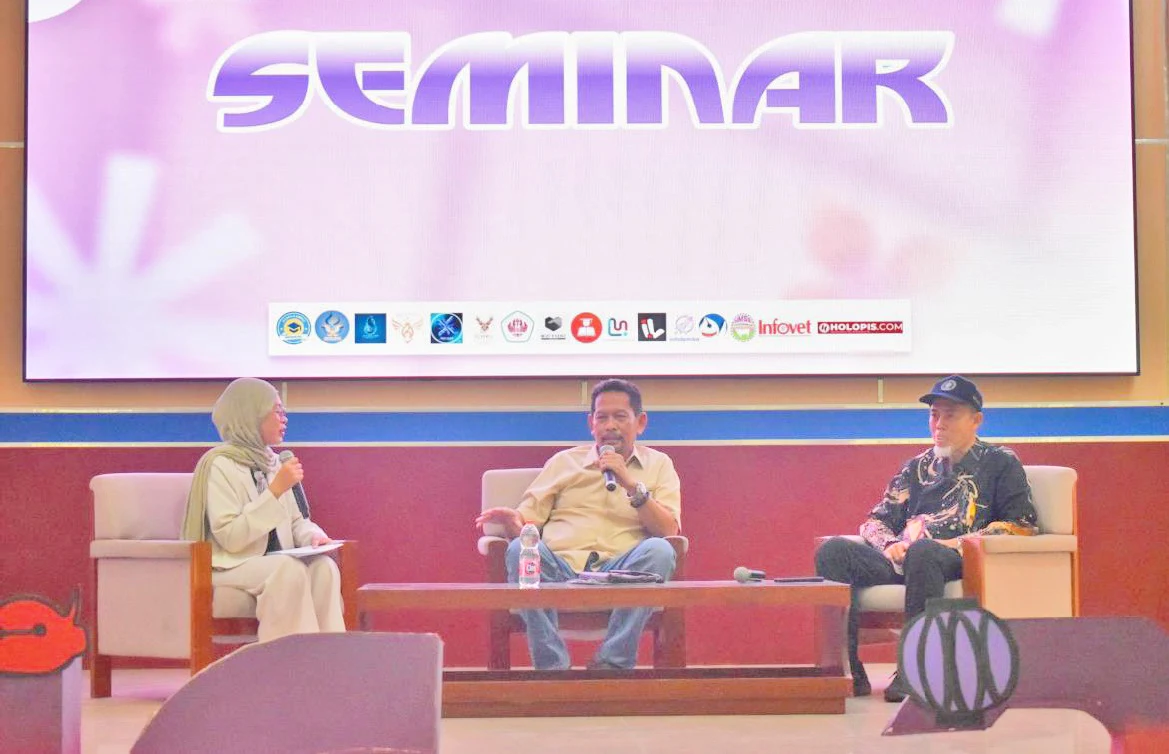
| The seminar discussed food security strategies for addressing global geopolitical dynamics as part of AFIS 2026. (Photo: Special) |
The Student Association of Animal Nutrition and Feed (Himasiter), Faculty of Animal Science, IPB University, successfully held the Animal Feed Innovation Summit (AFIS) 2026 on 25-27 September 2026 at the IPB University campus. Focusing on feed innovation, the event combined two main agendas: Feed Formulation Training (FFT) and Seminar and Competition of Animal Science (SCAS).
This national-scale event attracted strong enthusiasm from participants representing various leading universities in Indonesia, such as IPB University, Universitas Syiah Kuala, Institut Teknologi Bandung, Universitas Padjadjaran, BINUS Malang, Dian Nuswantoro, and Poltekkes Kemenkes Bandung.
The series of activities began on 25-26 September at the Faculty of Medicine and Nutrition with a workshop on FFT. On the first day, participants were invited to learn basic feed formulation techniques and strategies for adapting layer chicken feed (layer) to global geopolitical dynamics and fluctuations in raw material prices.
On the second day, the training continued with nutritional adjustments and an evaluation of the quality factors of key feed ingredients such as soybean meal (SBM), corn, and rice bran. This intensive session, from theory through to executing feed formulations, was directly guided by ration formulation expert Prof Dr Ir Budi Tangendjaja MS MAppSc.
The event series then moved to the Faculty of Animal Science on the third day for the SCAS seminar and scientific competition finale. This national seminar focused on the crucial topic of food security strategies amid global geopolitical dynamics, featuring Prof Dr Ir Nahrowi MSc (IPB University) and Sugeng Wahyudi (Secretary General of the National Association of Poultry Farmers Organizations/GOPAN).
In his presentation, Prof Nahrowi highlighted a fundamental problem in the national livestock sector: a shortage of protein-source feed ingredients. He called on academics and practitioners to change their basic approach to feed formulation.
“Do not calculate the biomass; instead, calculate the nutrients that livestock can actually use,” he said. He also added that Indonesia’s main problem is not, in fact, the availability of ingredients, but how to process local biomass into feed nutrients that are safe, digestible, standardized, and competitive.
As a concrete solution, Prof Nahrowi proposed a combination formulation of koro, palm kernel meal (BIS), and BSF maggot, rather than simply replacing soybean meal entirely.
From the industry and practitioner perspective, Sugeng also emphasized the importance of efficiency and solidarity among farmers. He encouraged farmers broiler to strengthen business resilience through a cooperative-based collective purchasing scheme for raw materials and feed. This step is considered strategic to help farmers better withstand market price fluctuations and currency exchange rate movements.
Through the integration of software-based feed formulation training and national-level scientific discussions, AFIS 2026 has not only served as a platform for developing character, scientific writing skills, and concern for sustainable livestock issues, but has also delivered an important message: national feed self-sufficiency begins with the ability to process local resources into nutrients that are ready to be used optimally. (INF)