
A marked decline in production at the beginning of 2027
European pork production could resume its downward trend in 2027.
Read also: Maintaining Brittany’s pork production by increasing production per farmer: utopia or realism?
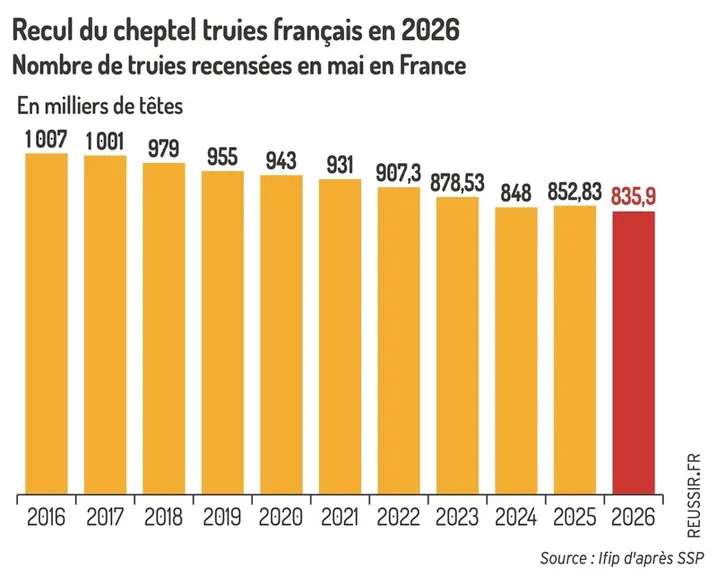
In the first half of the year, the decline is estimated at between 4 and 4,5% year on year. This contraction is said to be due in particular to the restructuring of Northern European supply chains, driven by public policies, poor financial results and the postponement of investment in a strained economic climate. In the Netherlands and Germany, for example, the number of recorded livestock farming sites fell by 8,3% and 4,7%, respectively, year on year in the second quarter of 2026. In addition, the census of mated sows, conducted before the episodes of extreme summer heat, already points to a contraction in production potential in Northern Europe, with declines of 0,7% in Germany, 0,6% in Denmark and 5,7% in the Netherlands. In Spain, the herd of mated sows remains broadly stable (+ 0,4%). However, ongoing export difficulties, declining imports ofpiglets, the extreme heat of summer 2026 and the pressure on slaughterhouse operators’ margins for more than a year could slow the growth of Spanish production in 2027. At this stage, however, the outlook remains difficult to pin down. In France, the sow herd was already down 2% in May 2026 compared with the same period in 2025, before the episodes of extreme summer heat. The delayed effects of the latter, including excess sow mortality and deteriorating reproductive performance, could reinforce this trend. In this context, French pork production could fall by around 2% in the first half of 2027 compared with 2026.
Consumption is expected to remain solid in 2027
Regarding demand, the trends observed in the European pig market in 2026 are generally expected to continue in the first half of 2027. In the domestic market, pork consumption is expected to remain solid, supported by its advantageous price positioning compared with other animal proteins. However, in the French market, competitive pressure from Spanish meats and cured meat products could persist, in an environment where households’ unavoidable expenses continue to weigh on food budgets. Internationally, the outlook remains less favorable. European exporters are expected to continue facing competition from Brazil and the United States, whose supply remains abundant, as well as difficulties accessing certain markets. The recovery in production in several Southeast Asian countries would also limit sales opportunities. Inthis context, European exports could decline by about 2 % in the first half of 2027. These various factors would therefore limit the impact of the decline in European supply on pig prices.
Stay up to date in real time!
Follow topics, legislative projects, companies and public figures to receive a notification as soon as we publish an article.
Elisa Husson, [email protected]
In the Netherlands and Germany, the number of livestock farms decreased by 8,3% and 4,7%, respectively, year on year.
Prices on a firmer footing, but uncertainties persist
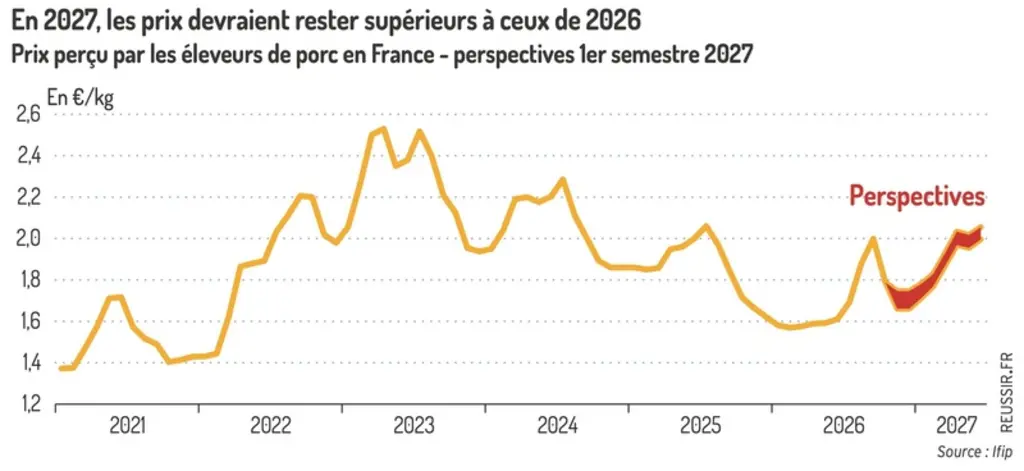
In France, pig prices could continue to decline gradually until the end of the first quarter of 2027, under pressure from the meat market and price differences between European countries. A seasonal recovery would then be expected at the beginning of the second quarter. Despite this early-year decline, prices are expected to remain higher than in 2026, a year marked by significant pork surpluses after the holidays and an influx of Spanish meat into Europe. In addition, production costs remaining at high levels could also support pig prices. Thus, depending on the assumptions used, the average pig price in the first half of 2027 could be about 20% higher than in the first half of 2026. However, despite these more favorable prospects, farm profitability would remain fragile, with feed costs and other operating expenses expected to remain high.However, this forecast remains subject to many uncertainties, particularly economic, health-related and commercial ones.