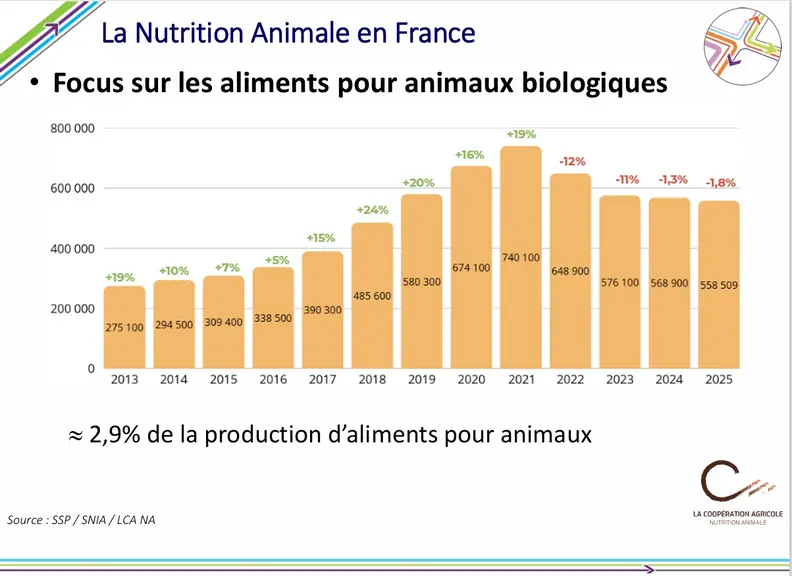
Since the beginning of the year 2026, the decline in organic compound feed production in France has tended to ease. While production in January 2026 was down 7% compared with the same month last year, the percentage was just -2,8% in July 2026, with a low in June 2026 (-1,6%). The shortage of forage this year could boost compound feed production for ruminants in the second half of the year.
| Distribution of organic compound feed production in 2025 | ||
| Volume | Variation 2025/2024 | |
| in tonnes | in percentage | |
| Laying hens | 338 609 | -4,5 |
| Chicken | 78 131 | +1,3 |
| Cattle | 65 332 | +5,5 |
| Swine | 53 167 | +6,1 |
| Grand total | 558 509 | -1,8 |
| Source: SSP, Snia and LCA NA | ||
Read also | Feed manufacturing: the decline in production volumes continues for the second consecutive month
Toward a potential increase in organic compound feed production in 2026
The drought exceptional summer 2026, coupled with episodes ofheatwaves prolonged, affects the availability of forage for ruminant livestock farms.
As of 20 September 2026, cumulative growth of permanent grasslands is 40% lower than that observed on this date during the reference period 1989-2018, according to Agreste. “Despite some rain at the end of August, soil drought has reached an exceptional level and is preventing any regrowth. The deficit is worsening in almost all regions,” the government agency notes.
Read also | Organic market: the shortage of forage straw cereals in France is driving up prices and pushing imports
Result: farmers give some hayto their livestock since July, dangerously depleting their winter stocks. Some are looking for straw to supplement the hay whose availability is limited. But if the showers are still delayed and the situation worsens, they will have no choice but to feed their animals straw supplemented with compound feed.
A downward trend since 2021 that is easing
The shortage of forage may bring an end to four years of more or less pronounced declines in the production of organic animal feed, which accounts for 2,9% of the volume of French production. While the volume oforganic compound feed advanced to 2020 following the expansion of the organic livestock sector, the covid-19 pandemic and the ensuing economic crisis brought the growth of organic consumption to a haltorganic consumption in France, particularly meat, and consequently undermined the organic animal feed sectororganic animal nutrition. To this must be added the various epizootics which have affected mainland France in recent years, resulting in a reduction in livestock numbers. In this context, compound feed production fell drastically in 2022 and 2023, before recording more moderate declines from 2024 as health pressures gradually eased.
Stay up to date in real time!
Follow topics, legislative projects, companies, and public figures to be notified as soon as we publish an article.
(Insert graph showing the evolution of organic compound feed production from 2013 to 2025)
“These contrasting developments reflect a situation that remains fragile for the organic sector, in a context marked by high production costs and organic consumption struggling to regain sustainable momentum,” analyzes Snia (Syndicat national des industriels de la nutrition animale).
Read also |Animal feed: “the increase in tonnage suggests a strong recovery phase for livestock farming worldwide,” according to Alltech
Organic compound feed dominated by the poultry sector
In 2025, the organic compound feed production in France stood at 558 509 t (-1,8% compared with 2024), versus 309 400 t ten years earlier and a peak of 740 100 t in 2021.
| Distribution of organic compound feed production in 2025 | ||
| Volume | ||
| in tonnes | ||
| Laying hens | 338 609 | |
| Chicken | 78 131 | |
| Cattle | 65 332 | |
| Swine | 53 167 | |
| Grand total | 558 509 | |
| Source: SSP, Snia and LCA NA | ||
Organic compound feeds for poultry remain largely predominant in the volumes produced. Compound feed intended for laying hens, down 4,5% between 2024 and 2025, remain the main production (61% of the total volume), “despite the still perceptible consequences of the episodes of’avian influenza highly pathogenic,” explains Snia. The production of feed for chickens (14 % of the total) increases (+ 1,3 %) at the same time.
The production of organic food intended for cattle (12 % of the total) records an increase of 5,5 % and that intended for the swine (9 % of the total) of 6,1%.