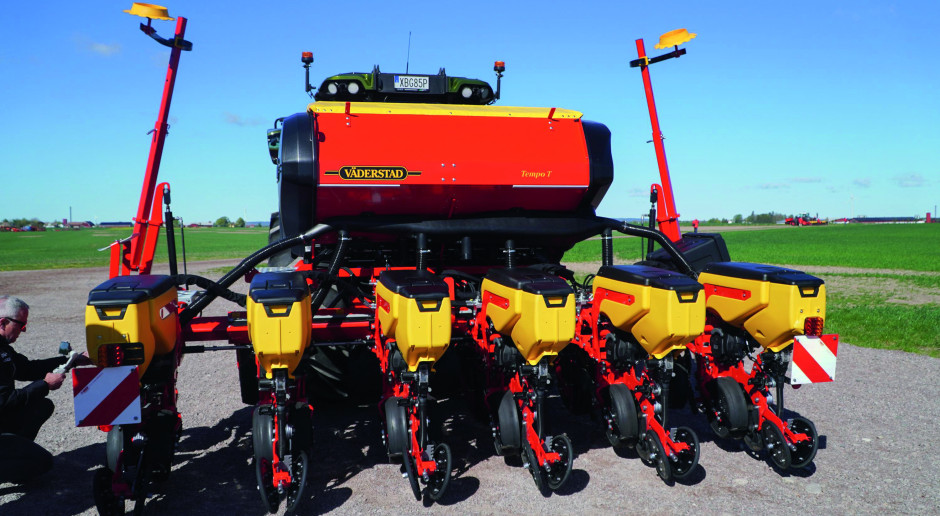
- Modern seed drills use GPS, ISOBUS and electric drives to control sections and rows and reduce overlaps on wedges and headlands.
- Precision keeps advancing: systems such as Kverneland GEOSEED synchronise seed placement between adjacent rows as well as within a single row.
- Electronics make it easier to vary the seeding rate and work with application maps, but profitability depends on data, agronomy and farm size.
A modern seed drill does more than sow. It knows where it is in the field, can switch off an individual section automatically, change the seeding rate while moving, maintain the depth, and even synchronise seed placement in adjacent rows. Farmers, in turn, are less and less likely to adjust the machine with a wrench and gearbox. Increasingly, they do it from a terminal in the cab. The only question is how much of this technological revolution is actually needed on the farm.
From the seed-metering wheel to the electric motor
If we look at seed drills from two decades ago, their basic operating principle does not seem particularly different from today’s. Seeds have to be metered, transported to the coulter, placed at the right depth, covered and pressed down. You cannot cheat physics. What has changed is how this process is controlled. In traditional mechanical designs, the seeding rate was linked to the drive from the seed drill wheel and the gearbox. Adjustment meant changing the gear ratio and the metering unit settings, carrying out a calibration test and calculating the result. The operator was not only the driver but also the machine’s primary control system. Today, electronics are increasingly taking over this role. Even a classic mechanical seed drill is a good example of the direction of change. In the new Lemken Saphir XMR, metering is supported by a dual-sided electric drive, which makes it possible to switch off half the working widthThe metering rollers can be removed individually without tools, and the machine settings are supported by the ISOBUS system.