
The improvement in sow productivity performance highlighted by the GT-porc network is also seen, to an even greater extent, in the long-standing farmer groups coordinated by the Brittany Chamber of Agriculture.
See also: “Our investment choices for our pig farm are based on efficiency”
Indeed, the groups’ farms’ average results show that between 2020 and 2025, sow prolificacy increased by 1,64 total born piglets per litter, i.e. + 0,33 per year.
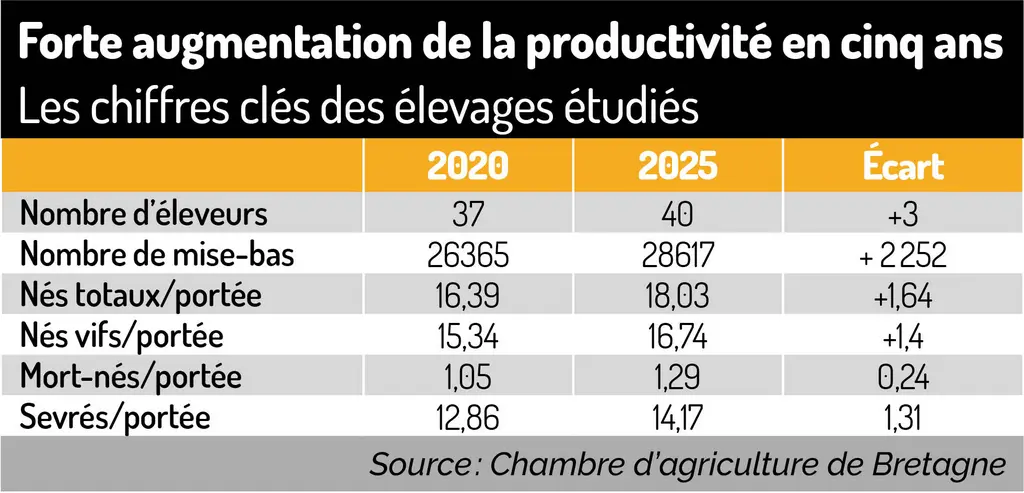
+ 1,64 total born piglets per litter in 5 years
The number of stillborn piglets (MN) also increased by 0,24 over 5 years, i.e. + 0,05 per litter per year. This represents a substantial increase of 1,31 weaned piglet per litter in five years. In 2020, only 40% of litters reached 18 total born piglets or more. In 2025, almost 60% of litters reach this level. This trend needs to be taken into account to adapt more effectively, both in terms of buildings—notably pen size and comfort at birth (temperature, drying, etc.)—and in terms of practices around farrowing, piglet management and, above all, fostering techniques.
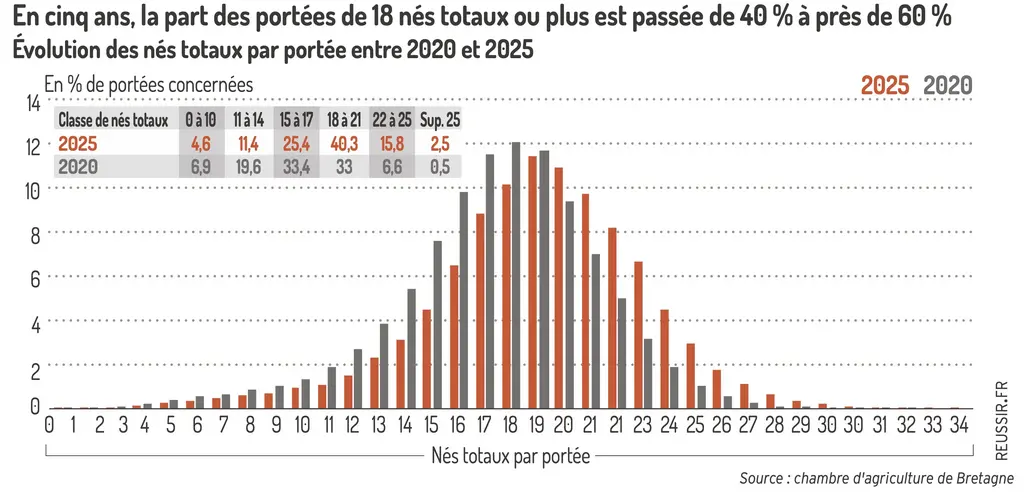
Breeding organizations continue to work on the number of functional teats, as well as piglet quality: vigor and birth weight. The results also show a difference in progress across the different litter parities. Parities 1 and 2 improve by 1,25 NT per litter, while parities 4 to 6 improve by 1,90 to 2,07 NT per litter. In 2025, some genetics show a decrease in prolificacy at parity 2 compared with parity 1.
Stay up to date in real time!
Follow topics, legislative projects, companies, and public figures to be notified as soon as we publish an article.
Stillbirths: prolificacy does not explain everything
Between 2020 and 2025, given the increase in the number of total born piglets, the number of stillborn piglets per litter has worsened. There are fewer litters with no stillborn piglets (44,5% in 2025 vs 50% in 2020), and nearly 10% have four or more. As a percentage of total born piglets, this rate rises from 6,42% in 2020 to 7,14% in 2025. However, this average result is not inevitable. For the same level of prolificacy, results can be very different. The results from 40 farmers in 2025 also show that, for a comparable level of prolificacy of around 18 total born piglets per litter, the proportion of stillborn piglets varies considerably between farms, ranging from less than 6% to nearly 12%.
14 to 16 weaned for 65% of litters
The evolution in the number of piglets weaned per litter over 5 years is remarkable. The peak percentage of farrowings shifts from 13 to 15 weaned per litter. In 2020, nearly 52% of litters had between 11 and 13 piglets weaned. In 2025, this proportion is halved, shifting toward the 14-16 piglets weaned range, which now accounts for 65% of litters.
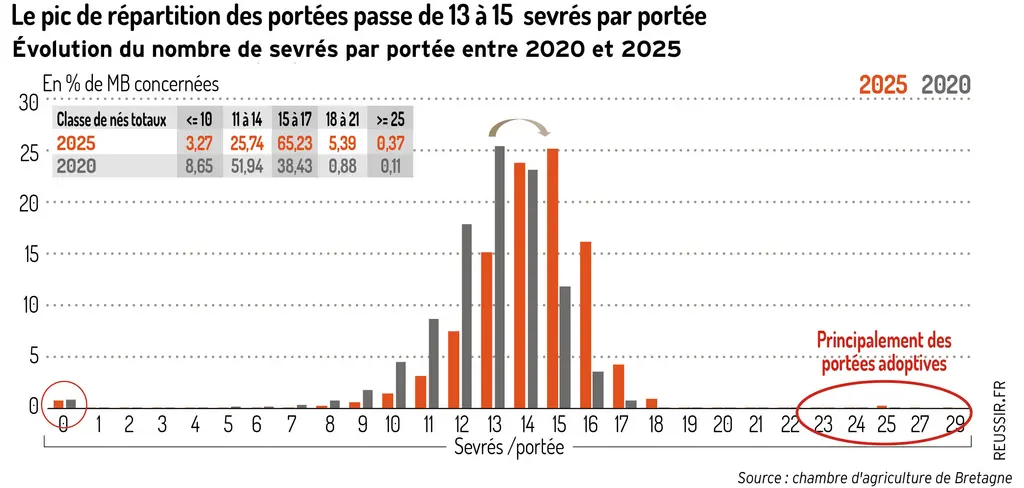
The proportion of sows weaning zero piglets remains worth monitoring, as it is a sign of a problem during farrowing. Although low, this rate did not change between the two years compared. Litters weaning more than 21 piglets are, in the vast majority of cases, linked to fostering. It is now not uncommon to see sows raising between 17 and 18 piglets, which raises the question for geneticists of the number of functional teats. Likewise, the sow’s nutrition, her feed intake capacity, the uniformity of birth weights and the vigor of the piglets, as well as the size of the farrowing pen, are becoming fundamental areas of focus on farms. This detailed analysis of results by litter helps groups encourage exchanges between farmers and make progress together on the techniques each one uses.
Estelle Renault, [email protected]
Share to move forward together
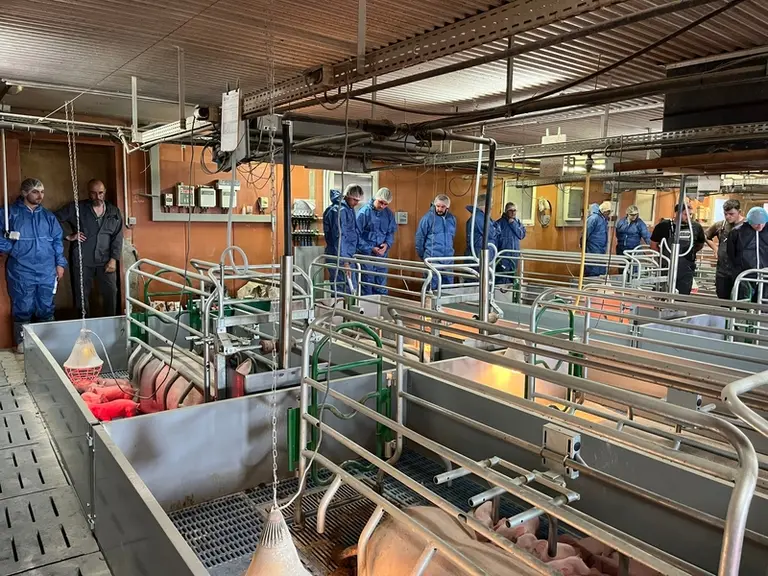
Every year, in three of the four groups of breeders facilitated by advisers from the Brittany Chamber of Agriculture, a day is devoted to analysing GTTT and GTE results: a key occasion for breeders to discuss their practices using figures and for each participant to identify areas of work for the coming year. In these groups, the individual data for each litter are analysed. This article presents the compiled results for 26 635 litters from 37 farms in 2020, and for 28 617 litters from 40 farms in 2025. The weaned piglets included are those reared by normal and foster sows. Piglets weaned in the nursery are not counted. Beyond analysing the figures, these groups are above all places for discussion and sharing experiences, to take a step back from one’s practices and make progress together. A dynamicwhich we invite you to join!