
Rethinking phytate and nutrient efficiency in dairy cattle
Optimising feed use while managing cost and environmental impact is a continuing challenge in dairy production. As input prices fluctuate and rations become more complex, nutritionists are looking to obtain greater value from nutrients already present in feed rather than relying on additional supplementation.
High feed intake changes nutrient use
Advances in genetics and herd management have increased dairy cow productivity and, with it, feed intake. Higher intake helps meet greater nutrient demand, but it can also increase the rate at which feed passes through the rumen. A shorter retention time leaves less opportunity for microbial fermentation, so some feed components may be only partly degraded.
Modern diets can add to this challenge. Greater use of concentrates increases the contribution of grains and protein meals to the ration, while rumen-protected ingredients are designed to limit degradation before the small intestine. Although these strategies support nutrient supply, they also make the effective digestion of concentrate ingredients even more important. One factor that deserves particular attention is phytate, a naturally occurring compound in many concentrate ingredients that can influence nutrient availability.
Phytate is a variable nutrient barrier
Phytate is the main storage form of phosphorus in many plant-based feeds, particularly cereals and oilseed meals. Around 60-80% of the total phosphorus in common grains and protein meals may be present as phytate, whereas forages generally contain much less. Consequently, concentrate-rich diets can introduce a substantial amount of phytate.
The amount and accessibility of phytate are not uniform. They vary with plant species, variety, growth conditions and processing. Grinding, fermentation, heat treatment and chemical treatment may also influence phytate availability and its interaction with other nutrients. As a result, this variation makes the phytate impact of a ration difficult to predict from ingredient inclusion alone.
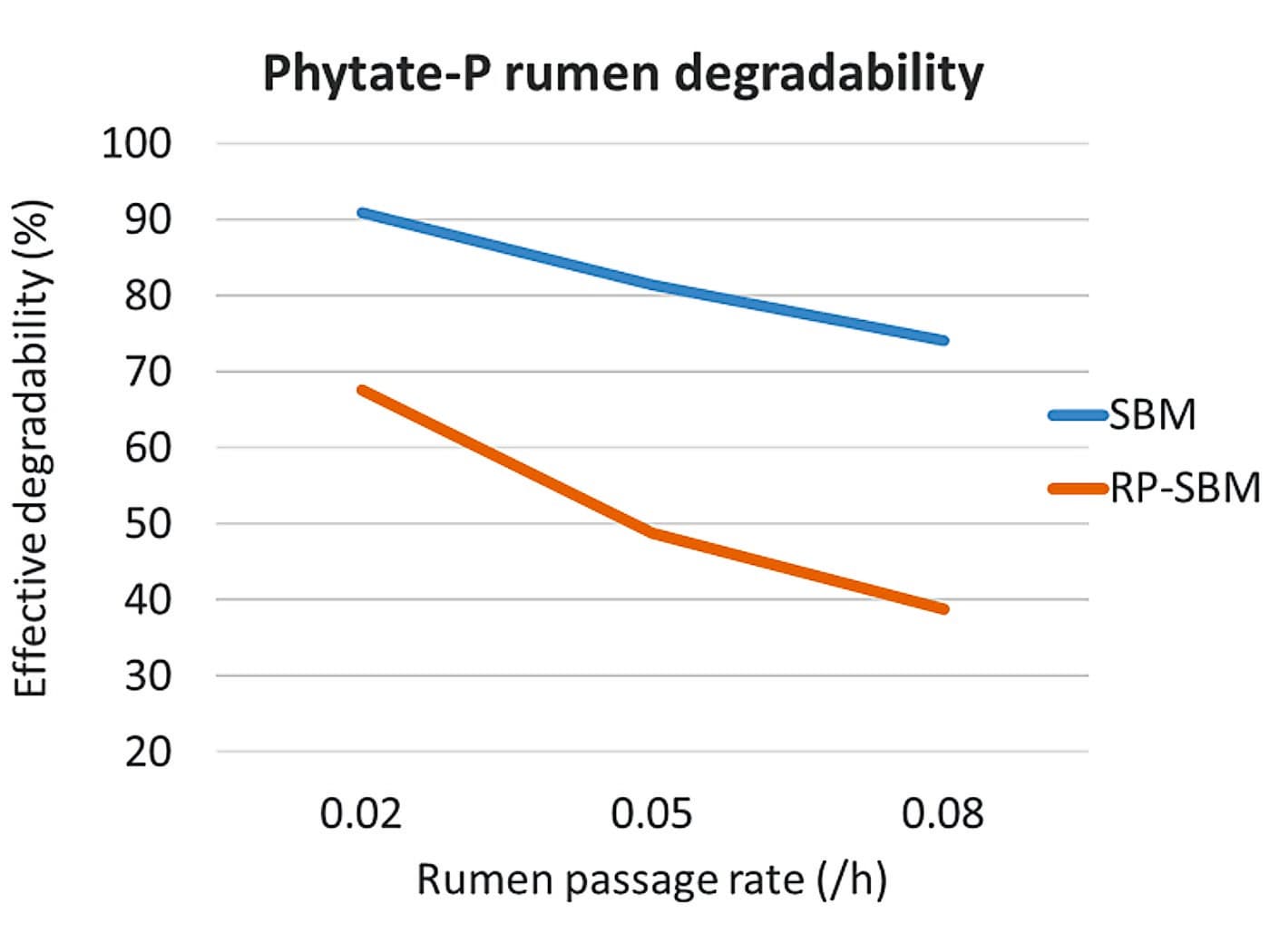
What impact can phytate have? Due to its strong negative charge, phytate can bind positively charged proteins, amino acids and minerals. Whilst rumen microbes can degrade phytate, the process is not always complete. Published data show wide variation among feed ingredients, especially when a faster passage rate is considered due to high feed intake. Any phytate that escapes rumen degradation continues through the digestive tract where it can block the availability of key nutrients to the animal.
Figure 1 – Phytate P rumen degradability of soybean meal (SBM) and rumen protected soybean meal (RP-SBM) produced by chemical treatment with formaldehyde. Source: Park et al. (1999).
Why incomplete rumen breakdown matters
Incomplete phytate degradation means that whilst a ration can be balanced on paper, the reality is that key nutrients remain unavailable to the animal. This can encourage the use of additional protein or mineral inputs and may increase nitrogen and phosphorus excretion.
The nutritional importance of phytate is, therefore, much broader than just phosphorus supply. Improving phytate breakdown can help release additional key nutrients already present in the diet and improve nutrient use efficiency.
Targeted action
Phytate can be degraded enzymatically using Omni-Bos PHY: a phytase enzyme developed specifically for ruminants. The enzyme addresses the issue of phytate that has escaped rumen degradation, resulting in improving nutrient use efficiency in modern dairy cow production systems. Research in lactating cows has demonstrated significant improvements in nutrient digestibility when Omni-Bos PHY was included in either total mixed rations or concentrate feed.
The value of Omni-Bos PHY should be assessed as part of the complete ration rather than as a stand-alone solution. This is because ingredient choice, and feed processing conditions, among other factors, all influence the amount of phytate that escapes ruminal degradation.
From formulation to true nutrient availability
Precision formulation remains essential, and understanding phytate is an important part of it. By helping nutritionists better utilise nutrients already present in feed ingredients, it contributes to greater precision and efficiency in diet formulation.
By considering phytate alongside factors such as passage rate and ingredient processing, nutritionists can gain a clearer understanding of nutrient availability. As dairy production systems continue to pursue greater efficiency, understanding nutrient availability becomes just as important as understanding nutrient supply. After all, the value of a ration is determined not only by what it contains, but by how much of those nutrients can be accessed and utilised by the cow.