In the middle and latter part of 11, in China’s livestock and poultry farming sector, the live-pig market has recently taken a “welcome turn,” with prices showing a long-awaited “late rally.” Driven by sentiment, as farmers hold back sales in an effort to support prices, alongside a marginal recovery in demand, pig prices have climbed from their lows. However, over the past two days, although prices have risen “stubbornly,” the gains have narrowed noticeably, and the market has once again entered a period of consolidation and fluctuation. Supply and demand are pulling in both directions. Bullish sentiment remains, but pressure persists! Will this rally in pig prices peak and then reverse? An analysis follows:
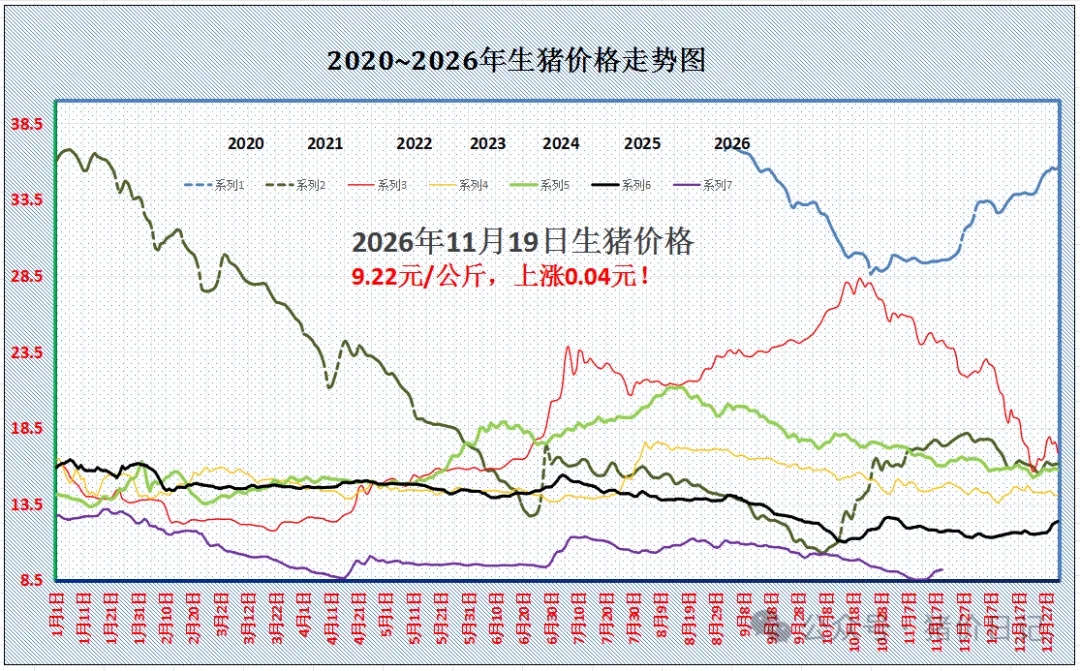
As of 11 19, today the average national price for slaughter-ready lean-type pigs in China’s livestock and poultry farming sector is 9.22 yuan/kg, up 0.04 yuan from yesterday. Pig prices have risen by a cumulative total of 0.7 yuan/kg in this rally, substantially easing farmers’ losses. However, prices are still down 21.7% year on year and remain at a seasonal “bottom.” The prolonged loss-making situation in farming is difficult to reverse, and the live-pig market will still need to trade time for room to recover! Fortunately, the breeding sow herd fell to 3602 ten thousand head in the third quarter. In theory, pig prices may improve significantly in the second half of next year.
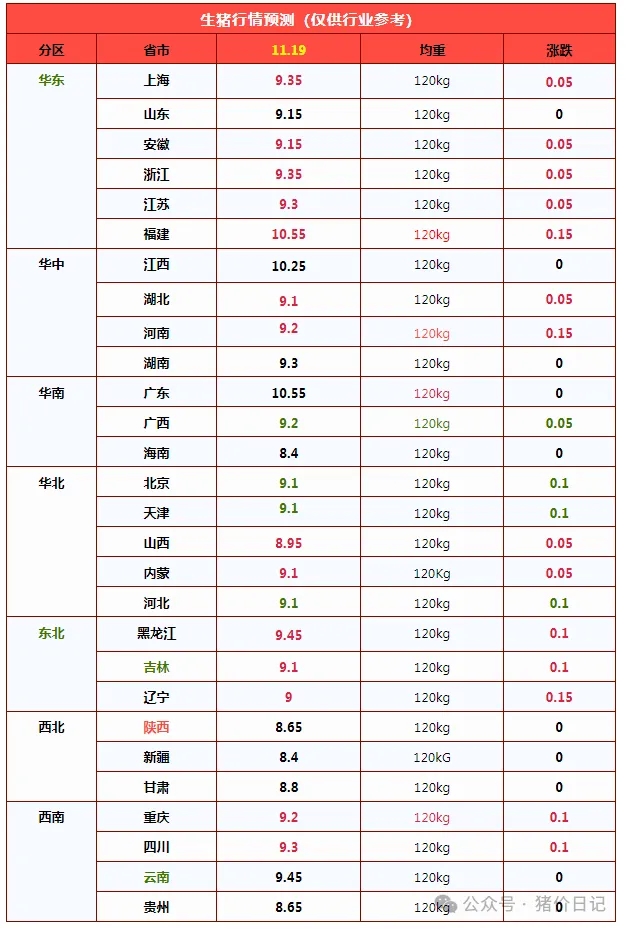
By region, across the 28 northern and southern regions under national key monitoring, the national average price for slaughter-ready lean-type pigs is close to 9.2 yuan/kg in Guangxi, Henan, and Chongqing. Live-pig prices in the north and south are 8.4-10.55 yuan/kg, with Xinjiang at the lowest and Fujian and Guangdong at the highest! The domestic market continues to see more increases than declines, and some regions, including the Northeast, are seeing catch-up price gains.
In traditional production and sales markets, hog prices in traditionally low-priced regions have currently risen to 9.0-9.45 yuan/kg in Heilongjiang, Jilin, and Liaoning; prices in Shanxi and Hebei are 8.95-9.1 yuan; and prices in Shaanxi and Gansu are 8.65-8.8 yuan/kg. In southern markets, prices are currently 9.2-9.3 yuan in Sichuan and Chongqing, 9.15 yuan in Shandong and Anhui, 9.3-9.35 yuan in Jiangsu and Zhejiang, 9.2 yuan in Henan, and 9.2-10.55 yuan/kg in Guangdong and Guangxi!
Currently, the center of hog prices has moved upward, and the market is showing a steady recovery. However, the market fundamentals have not yet turned around, pressure from production capacity and supply remains considerable, and market demand is still divided in its follow-through. With pressure from both supply and demand, support for further hog price increases has weakened, and prices may briefly remain range-bound. However, if marginal support from demand strengthens further, domestic hog prices will continue to trend upward amid fluctuations, guided by market sentiment!
On the supply side, pressure from hog supply persists. After all, the supply of market hogs in 11 is ample. This month, leading hog farming companies have increased their planned marketings by nearly 2.6%. During the month, active sales by independent producers and secondary fattening operators, along with the concentrated culling of low-priced sows in some production regions, have left leading hog farming companies with an ordinary marketing pace; delayed pressure on the supply side remains. At the end of the month, leading hog farming companies still face the risk of rushing to meet marketing targets. The market weight of hogs continues to increase, and the share of large hogs in market inventories is rising. Pork supply capacity is being further strengthened, adding pressure that constrains a rebound in hog prices!
In terms of demand, demand enters its peak season in 11 month. However, there are no holidays during the month to drive demand, and demand follow-through is generally moderate. In particular, due to shipments of frozen pork and an increase in the average slaughter weight of live pigs, downstream market demand absorption capacity is limited. In recent days, slaughterhouse operating rates have fallen, and average daily slaughter volumes have declined. To date, the operating rate of the sampled slaughterhouses is 32.83%, so demand-side support is relatively limited!
Based on this analysis, there is currently pressure from live pig supply, and hog prices face downside risk. However, because of differing views among producers on the pace of marketings, some are still selling at higher prices. With supply and demand sentiment cautious, hog prices are expected to maintain a pattern of “rises and falls” over the next 1-2 days, and further increases may face pressure! Attention should be paid to changes in marginal demand at month-end. In particular, the pickling season in southern regions may regain momentum at month-end, and marginal consumption is expected to improve significantly, leaving domestic hog prices with an opportunity to fluctuate upward!
Hog prices in a winter slump; capital buys the dip
Current hog prices have fallen to a rarely seen low in recent years, and an interesting phenomenon has emerged: in wet markets, some pork prices are slightly higher than egg prices but lower than green pepper prices.
For ordinary consumers, this means they can now afford pork with ease. But this saving at the dinner table marks a long, difficult winter for the live pig farming industry.
In the first three quarters of 2026, the combined attributable net losses of 24 A-share listed pig farming companies exceeded 280 billion yuan. No clear signs of a recovery in hog prices have emerged, and pressure from industry losses continues. Full-year losses are expected to grow further.
The industry's darkest hour is precisely a window of opportunity for capital investment. Industrial and financial capital have entered the sector in succession, investing across the industry chain through participation in bankruptcy restructurings, equity acquisitions, asset mergers and acquisitions, and other means. A wave of mergers and acquisitions in the hog industry is quietly unfolding.
Hog prices bottoming out, M&A wave rising
On 11/16, the national average price of three-way crossbred live hogs rebounded to 9.02 yuan per kilogram, returning to the 9-yuan range. However, hog prices remain near their lows of the past 10 years.
At the market stall, you can buy a small piece of lean meat for 5 yuan and pair it with green peppers to easily enjoy stir-fried pork with chili peppers.
But pig farming companies are in an exceptionally difficult position. Industry statistics show that in the first three quarters of 2026, excluding Shuanghui Development, whose main business is meat products, the combined attributable net loss of the 24 A-share-listed pig farming companies reached as much as 281.15 billion yuan.
Since 1 this year, the hog selling prices of these companies have continued to decline. In 10, the hog selling prices of almost all leading companies in the industry fell below 10 yuan per kilogram.
Muyuan Foods, Wens Foodstuff Group, and New Hope, the industry's top three companies, had hog selling prices in 10 of 9.64 yuan per kilogram, 9.78 yuan per kilogram, and 9.54 yuan per kilogram, respectively.
Industry estimates put the current fully loaded hog farming cost at around 12 yuan per kilogram, leaving pig companies in a position where the more they sell, the more they lose.
According to CITIC Futures, pressure from the supply of hogs for slaughter nationwide remained high in the fourth quarter of 2026, and the pressure on slaughter volumes is expected to ease only next year.
Hog prices have continued to bottom out, but capital has shown an exceptionally keen sense of opportunity and is accelerating its entry into the market. Several mergers and acquisitions have taken place in the industry since the beginning of this year, with both industrial and financial capital making moves.
The two most closely watched cases are the involvement of the Tongwei Group in Tianbang Foods' restructuring and the rumor that DCP Capital plans to acquire the Jinluo Group.
Tongwei Group plans to invest more than 14 billion yuan in the restructuring of Tech-Bank Food (002124.SZ). The project has now reached a key step in the pre-restructuring process.
Rumors that DCP Capital plans to acquire an equity stake in Jinluo Group for 20 billion U.S. dollars have circulated for some time, but due diligence and formal signing of the deal have yet to be completed. As a leading unlisted slaughtering and meat-products company in China, Jinluo Group has drawn considerable market attention over the future ownership of its equity.
In addition, several other notable transactions have been completed or advanced: China Cinda Asset Management invested 2 billion yuan to increase the capital of Longhua Animal Husbandry, a breeding entity under Tangrenshen; Tiankang Bio completed the integration of its equity in Qiangdu Animal Husbandry; Suining Shuofeng Ecological, as an industrial investor, advanced the restructuring of Qiquan Agriculture and Animal Husbandry; and New Hope Liuhe acquired an equity stake in the Guanglian Live Pig Trading Market.
Taken together, these cases send a clear signal: capital is seizing the window at the bottom of the cycle to buy assets related to the hog cycle at low prices.
Two types of capital, divergent strategies
Since 2026 onward, industrial capital and financial capital have been concentrated “bargain hunting” at the bottom of the hog cycle, with significant differences in the two types of capital’s investment styles.
Tongwei Group entered the bankruptcy restructuring of Tianbang Foods when the latter’s pre-restructuring process had been underway for more than two years and had stalled. This also presented Tongwei Group with an important opportunity to seek control of Tianbang Foods at a relatively low cost.
However, Tongwei Group’s goal was not simply to obtain the shell resources of a listed company. The two parties had already had extensive dealings: Tongwei Group had taken over Tianbang Foods’ feed assets, breeding assets, and equity in its breeding-stock pig breeding platform.
This restructuring opportunity to gain control of Tech-bank Food is intended to achieve industrial-chain synergies, secure downstream customers for its feed business, and develop breeding-pig assets, thereby connecting the entire industrial chain, from feed and breeding pigs to hog farming, slaughtering, and food processing, while creating synergies with its own photovoltaic business.
If the restructuring is successfully completed, Tongwei Group will gain established farming assets and add another agriculture and animal husbandry listed platform, creating dual listed platforms in farming and photovoltaics and opening up further opportunities for capital operations.
Unlike Tongwei Group’s industrial布局, CITIC Financial Asset’s capital increase and acquisition of an equity stake in Longhua Agriculture and Animal Husbandry, a subsidiary of Tangrenshen, is intended to inject capital into this core farming entity during an industry downturn, helping the company maintain its existing capacity and optimize its debt structure.
Tian Kang Bio and Suining Shuofeng Ecology have also been deeply involved in industry restructuring. In 6 month this year, Tian Kang Bio completed the integration of Qiangdu Animal Husbandry and included it in its consolidated financial statements, thereby securing hog-farming capacity, land, and other resources in Xinjiang in one move. This is an internal consolidation of existing assets by industrial capital.
As local capital in the agriculture and animal husbandry sector, Suining Shuofeng Ecology acquired Qiquan Animal Husbandry, the largest local pig farming company, at a relatively low cost, gaining pig farms and production capacity and completing its regional pig farming business layout.
Wufeng invested 5374.30 ten thousand yuan to acquire a 18.88% stake in Guanglian Live Pig Trading Market, raising its ownership stake to 83.92%. This helped consolidate its live pig trading and slaughtering cold-chain platform, improve its whole-industry chain, and connect the stages from farming to slaughtering and trading.
Overall, industrial capital tends to favor strategic positioning. By contrast, the widely discussed acquisition of Jinluo Group by DCP Capital in recent days follows a completely different investment logic.
As financial capital, DCP Capital specializes in mergers and acquisitions of consumer-oriented companies and operational transformation, and does not favor asset-heavy, highly volatile pure-play farming businesses.
During a trough in hog prices, slaughtering input costs are low and operating cash flow is stable. After acquiring a target, the acquirer will inevitably set about optimizing its channels and brand to increase the enterprise’s value, with the expectation of exiting at an opportune time over the medium to long term.
Opposite profit-and-loss dynamics
In the hog-farming industry chain, hog farming and slaughtering and meat processing have distinctly different profit characteristics, and fluctuations in hog prices have opposite effects on these two types of businesses. This is the underlying logic behind the current interest of industrial and financial capital in different types of targets.
Take Tecon Biology as an example: its hog-farming business continued to incur losses during the industry downturn. Industrial capital entered the market essentially to bet on realizing profits when hog prices recover.
In the hog farming industry, the main costs are feed, depreciation, and amortization of biological assets. The size of the profit margin depends on the difference between the selling price of hogs and the full cost of raising them.
Typically, there is a lag of 10 months between the reduction in productive sow capacity, the subsequent contraction in hog marketings, and a rebound in hog prices.
Tongwei Group acquired assets such as Tianbang Foods, a listed platform, and farming capacity at a relatively low cost, betting on continued reductions in productive sow capacity and a contraction in long-term hog supply. Once hog prices recover, the farming business is expected to turn profitable and generate earnings.
However, the risks are also real. If hog prices remain low and stagnate for an extended period, the farming business will continue to incur losses, and there is a risk that the investment may misjudge the cycle.
Jinluo Group operates downstream of pig farming, with slaughtering and meat processing as its core businesses. Profits from slaughtering come from the price spread between the purchase price of live pigs and the factory-gate prices of carcasses and cut meat. Meat processing also relies on live pigs as its core raw material.
During an industry downturn, lower live pig purchase costs increase gross profit per head from slaughtering, while expanding the profit margins of meat processing. This is also one of the important reasons financial investors favor these types of assets.
However, once supply in the live pig market contracts and pig prices rise, the purchase-sale price spreads in slaughtering and meat processing are both squeezed. Although Jinluo Group has already expanded into deep-processed meat products, it is still difficult to offset the cost pressure from rising prices for upstream live pig raw materials.
Put simply, the farming business makes money when pig prices rise, while the slaughtering and meat processing businesses earn from the spreads created by low-priced raw materials. The two types of businesses have opposite profit-and-loss dynamics, directly leading industrial and financial investors to make starkly different choices of acquisition targets during this pig cycle.
Demand structure and sentiment together have propelled Heilongjiang into a high-priced region for live pigs
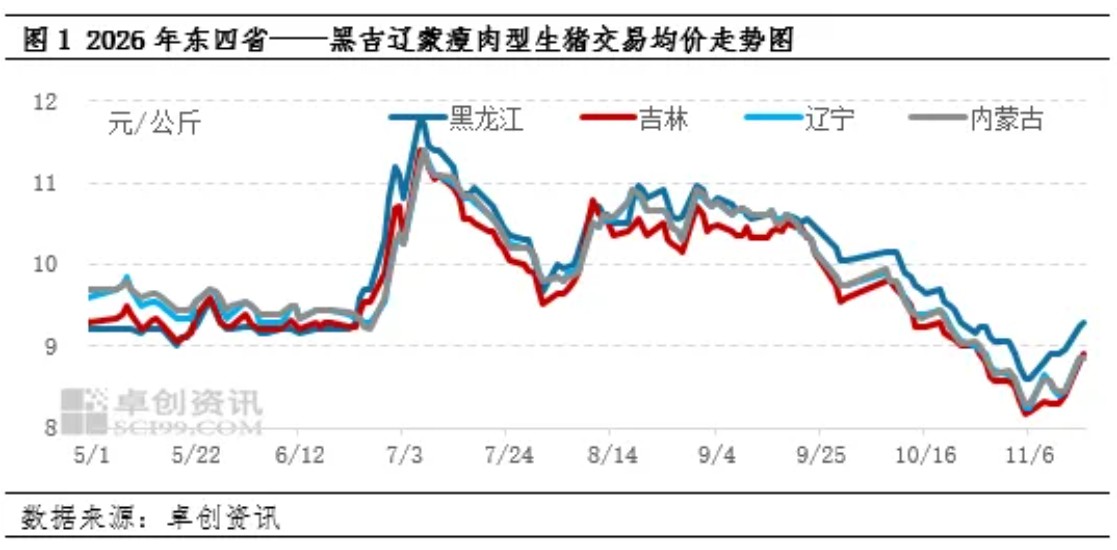
Since the end of the third quarter of 2026, the average hog transaction price in Heilongjiang has consistently been the highest in Northeast China. After entering 11, Heilongjiang’s hog price surged to become the highest in northern China and officially joined the country’s high-price regions. The main reasons for this are the relatively high share of demand for large hogs in Heilongjiang and the limited volume of hogs recently sent to market, along with sentiment favoring restocking for secondary fattening and reluctance to sell. These factors have driven prices higher and kept them at elevated levels. In the short term, prices in Heilongjiang may remain high; but once mid-term supply is released, supply pressure will increase, potentially limiting further price gains.
1. Demand structure and reduced hog shipments drive Heilongjiang to the highest price in northern China
Since 2026 9 20, Heilongjiang has consistently had the highest prices in Northeast China. From 9 20 to 11 17, the average hog price in Heilongjiang was 9.54 yuan per kilogram, 0.39 yuan per kilogram higher than in Jilin, 0.30 yuan per kilogram higher than in Liaoning, and 0.31 yuan per kilogram higher than in Inner Mongolia. After entering 11, hog prices in Heilongjiang rose by 2.76% in total, exceeding the increases of 1.72% in Liaoning and 2.31% in Inner Mongolia. Jilin’s increase reached 3.79%, boosted by Heilongjiang’s price rise and by a local reduction in hog shipments.
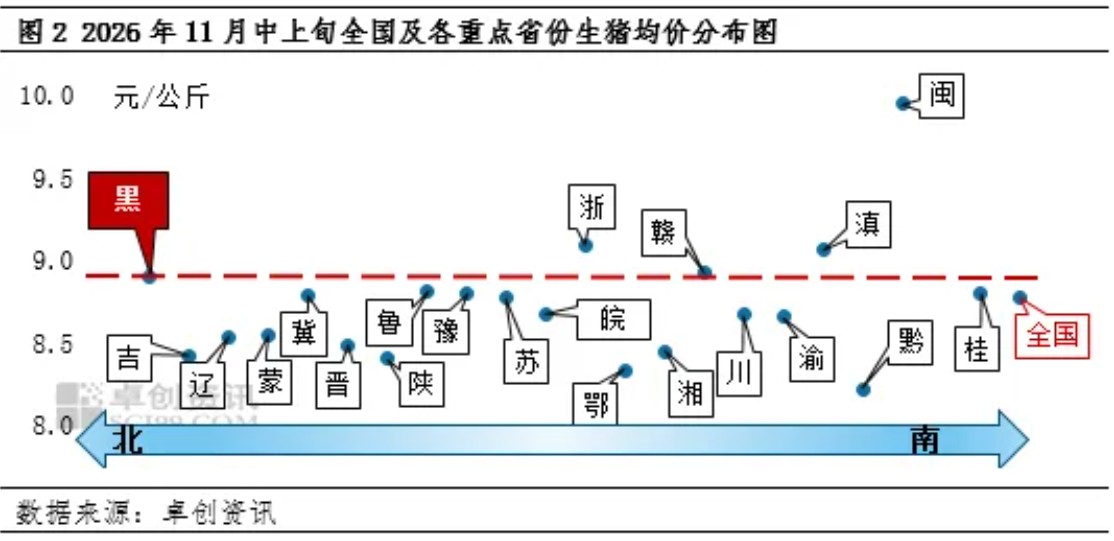
As of 11 17, the average transaction price for lean-type hogs in Heilongjiang in 11 was 8.91 yuan per kilogram, the highest in northern China and 0.13 yuan per kilogram above the national average. Among the 22 monitored provinces, only Zhejiang, Jiangxi, Yunnan, Fujian, and Guangdong had higher average hog prices than Heilongjiang. In 11, Heilongjiang officially joined the country’s high-price regions.
2. Strong demand for heavier pigs in Heilongjiang is supporting prices at elevated levels
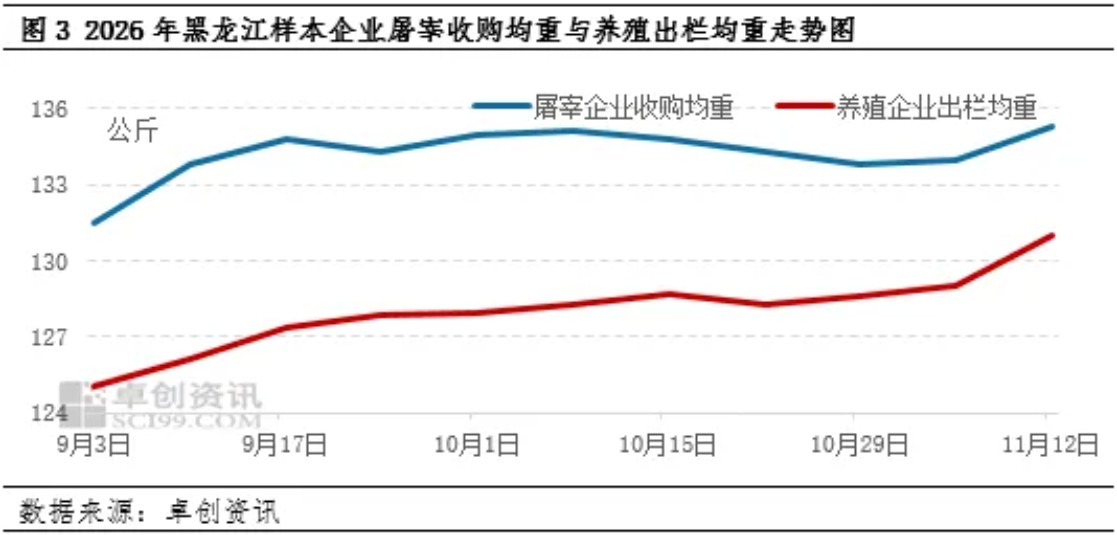
According to monitoring by SunSirs, the average purchase weight at sampled slaughtering enterprises and the average marketing weight at breeding enterprises in Heilongjiang both showed a fluctuating upward trend. According to monitoring by SunSirs, in the second week of 11 month, the average purchase weight at sampled slaughtering enterprises in Heilongjiang was 135.33 kg, a cumulative increase of 1.50 kg from the end of 10 month; the average marketing weight at breeding enterprises was 131.00 kg, a cumulative increase of 2.36 kg from the end of 10 month. Locally sold white pork carcasses in Heilongjiang are more in demand at heavier weights, and enterprises generally need pigs weighing over 130 kg. Their prices are higher than those of pigs weighing 120-130 kg.
In addition, the average purchase weight of pigs at slaughtering enterprises is greater than the average marketing weight of pigs at breeding groups, which also indicates that slaughtering operations still need some heavier pigs. These pigs come from small-scale farmers. In Heilongjiang, particularly in Harbin and surrounding areas, prices for pigs from small-scale farmers have remained higher than group-raised pig prices. Small-scale farmers are currently reluctant to sell, and slaughtering operations generally need to raise their purchase prices to maintain the average weight of pigs purchased, further pushing up pig prices.
3. Other factors, including restocking for secondary fattening, are driving a short-term rise in market prices
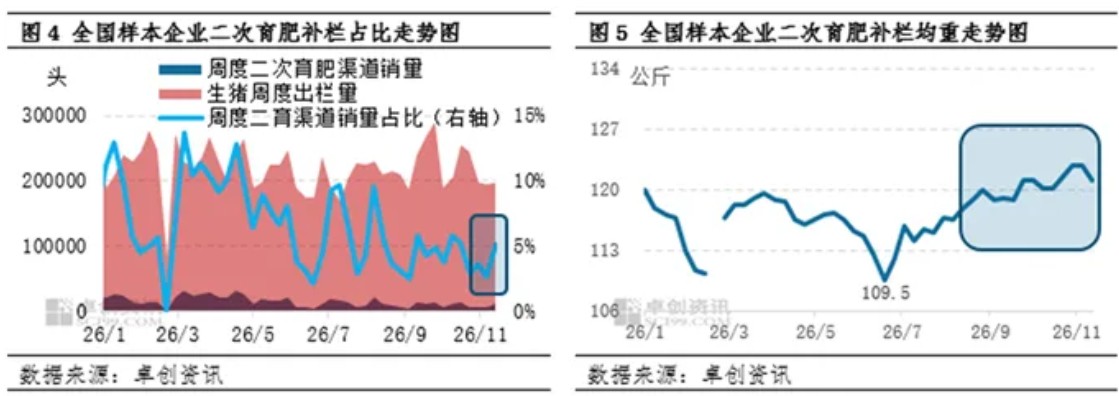
According to statistics from Zhuochuang Information, with prices for heavier hogs recovering again, the share of restocking for secondary fattening increased by 2.53 percentage points in the second week of 11 month. This week, interest in restocking for secondary fattening in Heilongjiang picked up, and the increase in the restocking share may have widened. In terms of average restocking weight, the share of secondary-fattening hogs weighing 130-150 kilograms in Heilongjiang has increased. This has created competition with slaughtering enterprises for hog purchases, further pushing up hog prices.
In addition, sentiment has also affected market prices. This group of secondary-fattening buyers is mostly optimistic about the two peaks in demand for heavier hogs in 2026 and 2027, respectively, in 12 month and 1 month. This has temporarily reduced the current supply of hogs and further fueled sentiment to hold back sales and raise prices, also boosting current hog prices.
4. The price gap between Heilongjiang and other regions is unlikely to narrow significantly for now, but supply pressure will increase in the medium term
Prices in Heilongjiang are currently higher than in other areas. The share of live hogs shipped out of the province continues to decline, while, in addition to being absorbed by slaughterhouses, an increasing number of locally raised heavy hogs are entering secondary-fattening operations. This offsets the downward pressure on hog prices caused by reduced out-of-province shipments. For slaughtering companies, the arrival of a new round of colder weather may further improve end-market demand, and the share of demand for heavy hogs may continue to rise, supporting local prices. In addition, enthusiasm for restocking secondary-fattening operations remains high. This is returning some heavy hogs to farmers' pens and encouraging small-scale farmers and small-to-medium-sized farms to hold back sales in anticipation of higher prices. Supply may decline in the short term, providing some support to the market.
With demand for heavy hogs increasing and enthusiasm for restocking secondary-fattening operations running high, the price gap between Heilongjiang and other regions is unlikely to narrow significantly for now. However, the supply reduction driven by market sentiment and restocking for secondary fattening are both actions that defer supply. If producers subsequently bring hogs to market in concentrated volumes in 2026 year 12 month and 2027 year 1 month, heavy hogs could flood the market and put prices under pressure. Meanwhile, as hog prices continue to rise, the cost of restocking secondary-fattening operations increases, and enthusiasm for restocking may temporarily cool as prices climb. Overall, Heilongjiang live hog prices may remain high in the short term, but a concentrated release of heavy hogs in the medium term could put significant pressure on the market.