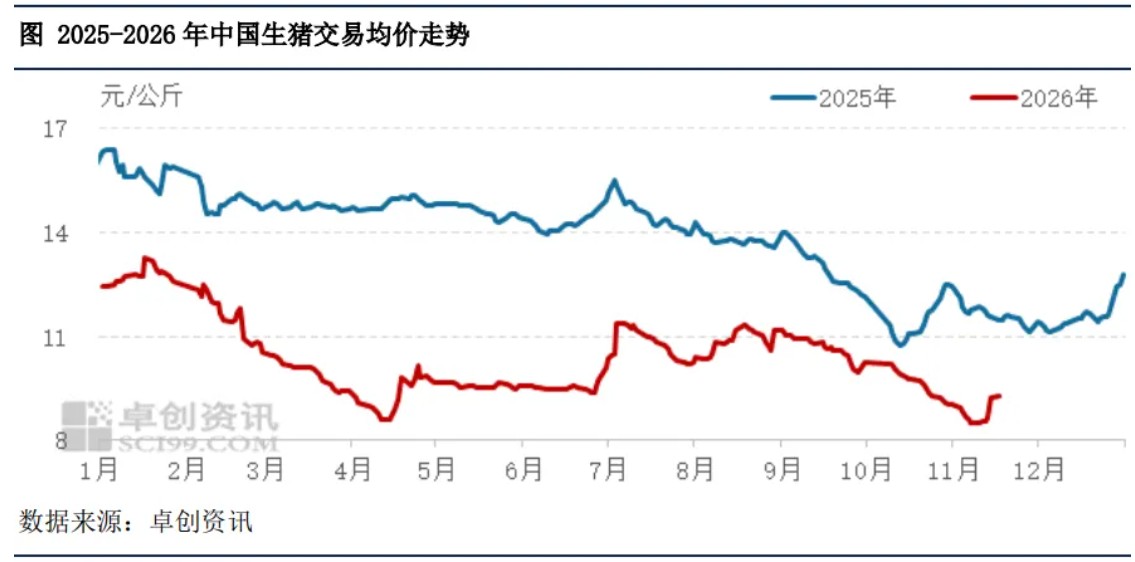
A sharp surge! Pig prices have “grown wings”—has the seasonal “turning point” arrived?
As 11 moves into its middle and latter part, pig prices in China’s domestic market have surged in recent days. After excessive price declines earlier, pig prices remained sluggish during the traditional “Golden September and Silver October” period. In early 11, the market saw a “worse-than-expected” decline, with the average price of standard pigs at market falling below the “previous low,” pushing producers into a period of severe losses. Sentiment, together with a marginal recovery in demand and producers reducing sales volumes to support prices, has driven pig prices to “grow wings” and rise. The seasonal “turning point” in pig prices has now arrived. The pig market still has room for further recovery from its bottom, but given the ample outlook for supplies of pigs and pork, the rise in pig prices may be smaller than expected.
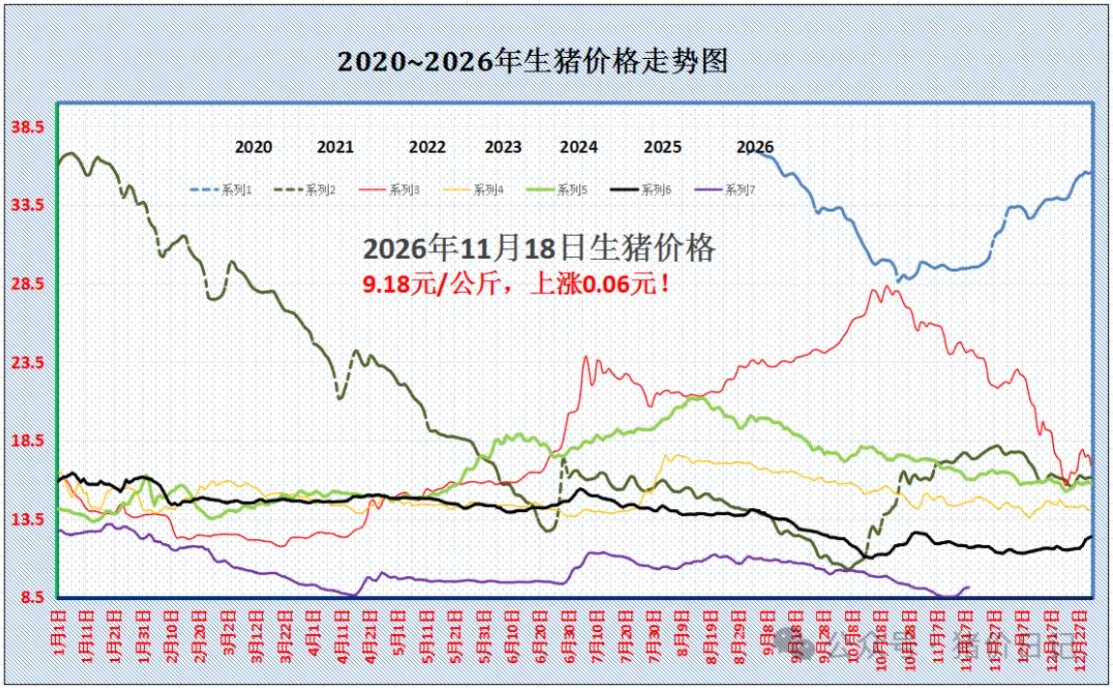
According to data monitoring, on 11 18, the national average ex-farm price for lean-type, three-way crossbred live pigs was 9.18 yuan/kg, up 0.06 yuan. Pig prices continued their “steady” recovery, with a “sharp oversold rebound” over this period. Live pig prices have risen by a cumulative 0.66 yuan, a gain of 7.75%. The market’s center of gravity has gradually shifted upward. However, the current mainstream cost of finishing pigs in China is around 11.5-14 yuan/kg, and producers’ losses remain just as severe at this stage. Compared with 11.09 yuan/kg at the beginning of 9, pig prices have fallen by a cumulative 17.22%!
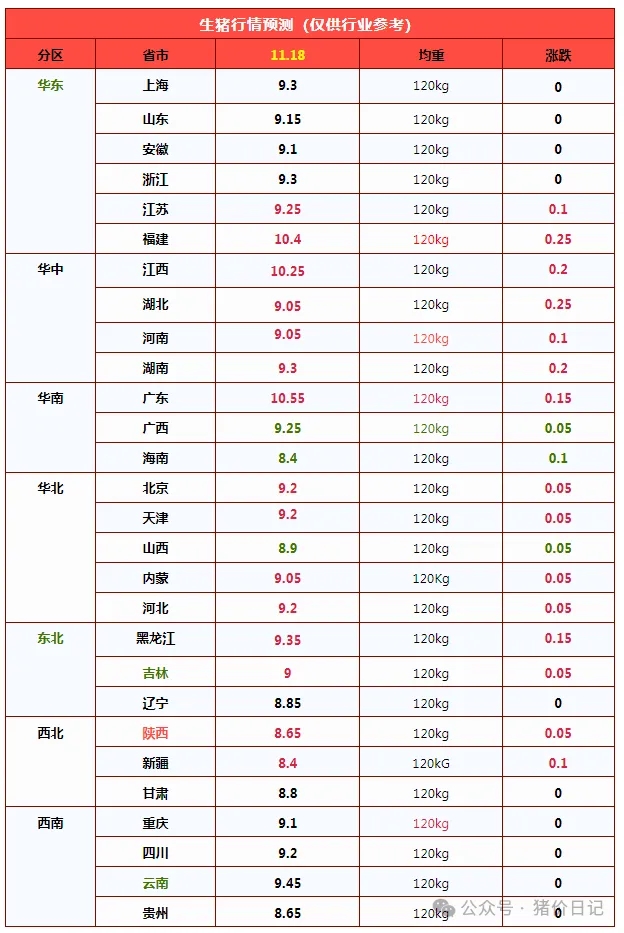
By region, pig prices continued to show a pattern of “more rises than falls” across the 7 key production regions monitored nationwide and the 28 regions for which data are available. Among them, the average ex-farm price of live pigs was close to 9.15 yuan/kg in Shandong, while live pig prices in the north and south ranged from 8.4-10.55 yuan/kg. In northern China, markets included North China, Northeast China, and Northwest China. Prices in Heilongjiang, Jilin, and Liaoning were 8.85-9.35 yuan; prices in Shanxi and Hebei were 8.9-9.2 yuan; and prices in Shaanxi and Gansu were 8.65-8.8 yuan. In southern markets, regions included Southwest China, East China, Central China, and Northwest China. Prices in Sichuan and Chongqing were 9.1-9.2 yuan; prices in Shandong and Anhui were 9.1-9.15 yuan; prices in Jiangsu and Zhejiang were 9.25-9.3 yuan; prices in Henan were 9.05 yuan; and prices in Guangdong and Guangxi were 9.25-10.55 yuan/kg!
Based on this analysis, on 11 month 18, pig prices surged “at full steam,” with the price center continuing to rise! However, the increase has eased. The market’s supply and demand situation has not yet turned around, and pig prices may enter a period of short-term consolidation and fluctuation!
On the supply side, reports indicate that group pig farming companies fulfilled only 98.25% of their planned marketings last month. Their planned marketings for 11 month rose by 2.56% month on month to 1519.67 ten thousand head, with production capacity still being released at a high level. Although the breeding sow inventory fell to 3602 ten thousand head at the end of the third quarter, breeding sows affect the supply of standard-weight pigs after 10 months, so supply pressure remains high at this stage. In particular, the marketing period in 11 month is 30 days, down 1 days month on month, while average daily marketings have increased by nearly 6% month on month. So far this month, biosecurity concerns at pig farms and losses from pig farming have strengthened farmers’ willingness to market pigs. Independent producers and secondary fattening operators have been active in marketing medium and large pigs, while group pig farming companies have been slow to market their pigs. Supply-side pressure will persist in the middle and latter part of the month;
On the demand side, reports indicate that with the arrival of the Start of Winter solar term, seasonal demand has gradually improved at the margin, and pork purchasing and sales activity has strengthened somewhat. In particular, temperatures in the north have plunged, and household demand has picked up. In some regions, the curing season has started early, boosting downstream demand for white pork carcasses, while the operating rate of sampled slaughterhouses has gradually recovered! However, the increase remains insufficient. Over the past two days, slaughterhouse operating rates have fallen. The operating rate of sampled slaughterhouses has now dropped to 32.95%, down 0.38 percentage points, with marginal support from demand still somewhat insufficient;
Based on this analysis, although the live pig market is sentiment-driven and is showing signs of bottoming out and recovery, pressure on the supply side remains, marginal demand recovery is constrained, and concerns about excess supply remain strong. Over the next 1-2 days, the live pig market is expected to remain generally weak and stable, with prices potentially facing downward pressure. Going forward, attention should be paid to changes in the pace of market buying and selling!
Live Pig Prices Fell First and Then Rose in 11; Prices Are More Likely to Rise Than Fall in the Second Half of the Month
In 11, the national price of live pigs (外三元) fell first and then rose. Ample supply and weak consumption weighed on the market in the first ten days of the month, causing prices to decline steadily. In the middle of the month, cold temperatures boosted end-user demand, while restocking for secondary fattening and firm pricing by producers contributed to a rebound after prices bottomed out. Looking ahead to the second half of the month, a slower pace of marketings and the gradual start of demand for cured meat will provide support in both directions, making prices more likely to rise than fall. Stockpiling for secondary fattening may also affect the supply of pigs for sale during certain periods.
Pig Prices Fell First and Then Rose in 11
Live pig prices followed a downward-then-upward trend in 11. As of the 17th, the national average transaction price for live pigs (外三元) in 11 was 8.78 yuan/kg, down 8.98% month on month and 24.22% year on year. The highest price on a business day during the month was 9.28 yuan/kg on the 17th. The lowest was 8.52 yuan/kg on the 9th and 10th, with a maximum difference of 0.76 yuan/kg.
In early 11, active hog sales by producers led to a price decline. In mid-month, price-supporting sentiment supported a rebound.
In early 11, producers were relatively active in selling hogs, and some companies reduced the weight of hogs before sale. Market hog supplies were ample. In addition, temperatures had not fallen to low levels, and downstream purchasing volumes had not increased significantly. The market remained in a state of oversupply, and prices continued to fall. In mid-month, as temperatures dropped in various regions, downstream demand increased slightly, and the pace of sales of terminal white-stripped carcasses accelerated. Moreover, after hog prices fell to low levels, some secondary-fattening operators considered the lower costs and resumed purchasing hogs for restocking. Producers' sentiment in favor of holding prices strengthened, making downstream procurement more difficult and forcing buyers to raise prices to secure volumes. The combined effect of supply and demand drove hog prices up rapidly. In just two days, 13-14, hog prices rose by a total of 0.58 yuan/kg.
In late 11, both supply and demand provided support, making hog prices more likely to rise than fall.
Supply: According to monitoring by Zhuochuang Information, the number of hogs sold in 11 month by 242 sampled breeding companies increased 3.52% month on month. However, according to a Zhuochuang Information survey, producers sold hogs at a faster pace in 11 month, while secondary fattening diverted some hogs that would otherwise have gone to slaughterhouses, easing overall market supply pressure. Market supply is expected to decline slightly in late month, and producers may reduce sales volumes toward month-end.
Demand side: Temperatures may gradually fall in the middle and latter part of the month. In addition, some areas may start salting and curing meat and making sausages sporadically, so demand may improve and provide some support for hog prices.
Secondary fattening: Although hog prices have rebounded, they remain relatively low. Some secondary-fattening operators may restock again in the latter part of 11 month and sell hogs in concentrated volumes during the peak curing season in 12 month to make a profit, potentially creating a short-term supply gap in the market at that time.
Overall, hog market conditions in 11 month are expected to decline first and then rise, with short-term supply-and-demand negotiations continuing to intensify. Lower temperatures and expectations for meat curing in the latter part of the month are expected to support demand. Combined with changes in the pace of restocking for secondary fattening, bullish market factors are accumulating. Hog prices may follow a pattern in which they are more likely to rise than fall. Going forward, market participants will need to continue monitoring livestock producers’ sales plans and the movement of fresh pork at the consumer end.
Optimistic, measured, cautious! Three predictions from leading hog companies on hog prices in 2027
At year-end, listed hog companies held investor meetings in quick succession. Wen’s Foodstuff Group, Muyuan Foods, and New Hope successively disclosed their views on the hog market in 2027. The three companies differ markedly in their expectations for the timing of price increases and the central price level, but agree on the overall direction of the cycle: the current round of reductions in the breeding sow population is continuing to take effect, and the industry’s cycle low is gradually being confirmed. There is a high probability that breeding profitability in 2027 will improve compared with 2026. This article examines the leading companies’ views and develops scenarios based on supply-leading indicators from the Ministry of Agriculture and Rural Affairs, the industry’s cost structure, and the effects of reserve pork and import adjustments, to discuss a reasonable central level for hog prices in 2027.
I. Analysis of leading companies’ views: Differences in expectations stem from differing assumptions about production capacity flexibility
Wens Foodstuff Group: Capacity is exiting more sharply than in historical cycles; optimistic about a higher average level for the year
Wens is the most optimistic of the three leading companies. Core view: The current round of inefficient capacity exits is accelerating, and the decline in breeding sow numbers exceeds that of previous cycles, putting supply and demand on a path of sustained improvement. Based on the transmission cycle from sow inventories, it expects the average hog price in 2027 to hold firm at 13–14 yuan/kg, with a high degree of certainty that prices will rise. Underlying assumptions: Smaller farms have weak cash flows and rising biosecurity costs, making capacity exits effectively irreversible. After prices rebound, restocking is expected to proceed slowly, allowing the benefits of supply contraction to continue throughout the year rather than emerge as a short-term spike.
Muyuan Foods: Avoids forecasting timing and price levels, anchoring its view on the trend in earnings recovery
Muyuan maintains its consistently neutral and cautious framework, offering no definitive price range and making no promises about when prices will rise. Its core position: it cannot accurately predict the pace of prices or the earnings peak, but breeding profitability in 2027 was better than in 2026, and a bottoming-out recovery trend has been established. As China's largest integrated hog producer by slaughter volume, Muyuan's assessment implicitly takes into account the hedging effects of multiple factors: the flexibility of secondary fattening, the volume of frozen pork inventory handled, reserve pork regulation, and small-scale farmers' behavior of replenishing stock in response to prices can all disrupt the price trajectory. The cyclical recovery is a gradual, volatile upward trend, rather than a one-way market trend. The company's core competitiveness rests on its cost moat, not price speculation.
New Hope: Supply transmission involves a time lag, resulting in a pattern of a weaker first half and a stronger second half in 2027
New Hope's assessment highlights the risk of a gap between expectations and reality, explicitly warning that the market should not overestimate the first-half outlook. Its base case: pressure from commercial hog supply has yet to be fully released in the first half, and hog prices will remain weak and near their bottom; the benefits of supply contraction will be realized mainly in the second half, driving a stronger rebound. The rationale: the decline in the inventory of breeding sows takes about 10 months to feed through to commercial hog shipments, and shipments corresponding to the previously high sow inventory will continue to be released in the first half of 2027; combined with the seasonal consumption lull after the Spring Festival, supply and demand in the first half are unlikely to show a significant gap, pushing the rebound window into the second half.
Summary: The three share a consensus—the bottom is clear, and profitability in 2027 is better than in 2026. Their differences fundamentally stem from different assumptions about the flexibility of restocking, the actual extent to which sow herd reductions materialize, and seasonal supply patterns.
II. Fundamental data verification: leading indicators, cost structure, and exogenous adjustment variables
1. Supply side: breeding sows are the core anchor of the cycle
The number of breeding sows in stock, as reported by the Ministry of Agriculture and Rural Affairs, is widely recognized in the industry as a leading indicator. Changes in sow inventories take about 10 months to pass through to the number of market hogs shipped. This round of sow herd reduction is the underlying driver of the current upcycle; continued reductions mean that the supply of market hogs will contract at the margin in 2027. However, book inventory must be distinguished from effective production capacity: some farms have low-yielding, aging, inefficient sows, resulting in high book inventory but weak actual supply capacity. This is also the core reason Wen's emphasizes the culling of “inefficient production capacity.” Looking only at absolute inventory levels would overestimate short-term supply. At the same time, sow herd reduction faces a countervailing constraint: once hog prices exceed the break-even point, small-scale producers and secondary-fattening operators may be driven to restock quickly and reactivate idle capacity, which would limit the scope of the upcycle.
2. Cost side: Industry costs vary by tier, determining the profit threshold
Industry costs show significant stratification:
Leading integrated self-breeding and self-rearing operators: full cost range of approximately 14.5–15.5 yuan/kg;
Small- and medium-sized self-breeding farms: full cost 15.5–16.5 yuan/kg;
Purchased piglet fattening model: the most cost-flexible model, with costs significantly higher than those of leading companies when market prices are low. The cost structure determines the key conclusion: the widely discussed market midpoint of 13–14 yuan/kg would only allow leading companies to reduce losses or make small profits, while the vast majority of small and medium-sized farms would still be in the red. The recovery in this cycle is not a return to profitability across the entire industry, but a structural recovery in profitability. Cost divergence will further accelerate industry consolidation.
3. Demand and adjustment variables: a demand surge is unlikely; policy and imports form a ceiling
Domestic pork consumption is a weakly cyclical, steady-state category. Increases in consumption mainly come from seasonal pulses such as cured meat and holidays, and there is no basis for sustained, substantial demand growth. External offsetting factors remain in play: adjustments to central and local government frozen-meat reserves, frozen pork imports, the pace of customs clearance at ports, and the “reservoir effect” of secondary fattening. During periods of rapid price increases, these factors release supply in tandem, curbing price surges and making it difficult to replicate the extreme high-price conditions seen historically.
Three. Multi-scenario analysis: projected reasonable central range for hog prices at 2027
Based on the leading assumption and fundamental constraints, three scenarios are set out, distinguishing between the average price for the full year and prices during specific periods:
Base case (aligned with New Hope’s view that prices will be lower in the first half and higher in the second half, and with market consensus expectations): Supply is released through inertia in the first half, with hog prices fluctuating in a bottoming range of 12.0–13.0 yuan/kg; supply contracts in the second half, with prices rebounding to 13.5–14.2 yuan/kg; the full-year average price is 12.9–13.6 yuan/kg. Trigger conditions: Sow herd reductions proceed at the current pace, restocking is moderate, reserve purchases provide support only at low price levels, and there are no large-scale concentrated releases.
Optimistic scenario (aligned with Wens's assessment, low-efficiency production capacity exits faster than expected): the culling of low-efficiency sows continues to accelerate, and the industry's willingness to resume production remains weak, with supply contraction persisting throughout the year; the price midpoint remains stable at 13–14 yuan per kilogram for the year, with the seasonal high in the second half of the year potentially reaching around 14.5 yuan per kilogram; the average price for the year is 13.3–14.0 yuan per kilogram. Risk constraint: once prices stabilize above 14 yuan, enthusiasm for restocking rises, increasing forward supply pressure and limiting the market's upside.
Pessimistic scenario (production resumes more than expected, external supply shocks): A slight rebound prompts small-scale farmers to restock in a concentrated manner, while large-scale secondary fattening operations enter the market, compounded by an increase in imported frozen meat. Prices remain highly volatile throughout the year, with a central range of 12.0–12.8 yuan/kg. Producers remain under sustained pressure, prolonging the bottoming-out phase of the cycle.
From the perspective of industry equilibrium: 13.0–13.6 yuan/kg is the most likely reasonable price range around which prices will center in 2027. This price range can achieve the following: continuously drive the exit of high-cost capacity, allow leading companies to earn reasonable profits from farming, and avoid triggering large-scale production resumption and the release of reserve meat. It represents a supply-and-demand-consistent equilibrium price.
Four. Core Risk List (Positive Factors/Negative Factors)
Positive factors
Effective breeding sow capacity continues to decline, while low-yield sows are being culled more rapidly;
Cash flows for small and medium-sized farming operators remain under sustained pressure, and exit is a necessity;
Low pig prices triggered reserve purchases to provide support, forming a price floor.
Bearish factors
After prices recovered slightly, idle sow capacity was quickly brought back online, offsetting the results of the earlier capacity reductions;
Concentrated holding of cattle for a second fattening phase and concentrated market releases amplify price fluctuations;
Increased imports of frozen meat and the concentrated release of reserve meat are limiting upward potential;
Consumption recovery fell short of expectations, and the seasonal demand pulse was weak.
Five. Conclusion
The information shared by the three major pig producers essentially reflects their modeling judgments on the cycle’s trajectory, based on their respective production capacity structures and cost curves. They agree that the window for an upward cyclical recovery will open in 2027, though the recovery path remains uncertain. The market needs to avoid two extreme expectations: first, betting on a one-way surge in prices in line with optimistic expectations; second, continuing to take a bearish view while overlooking the leading signal of ongoing sow herd reduction. The core tension in the 2027 market is not “whether prices will rise,” but the race between the pace at which supply contraction materializes and the flexibility of production resumption. For operational decisions, rather than forecasting specific price levels, it is more worthwhile to track two high-frequency indicators: changes in the effective inventory of breeding sows and piglet prices (which reflect willingness to restock). Given the industry’s tiered cost structure, this cycle remains a structural market in which leading companies benefit first, and cost-control capabilities remain the key barrier to weathering the cycle.