France
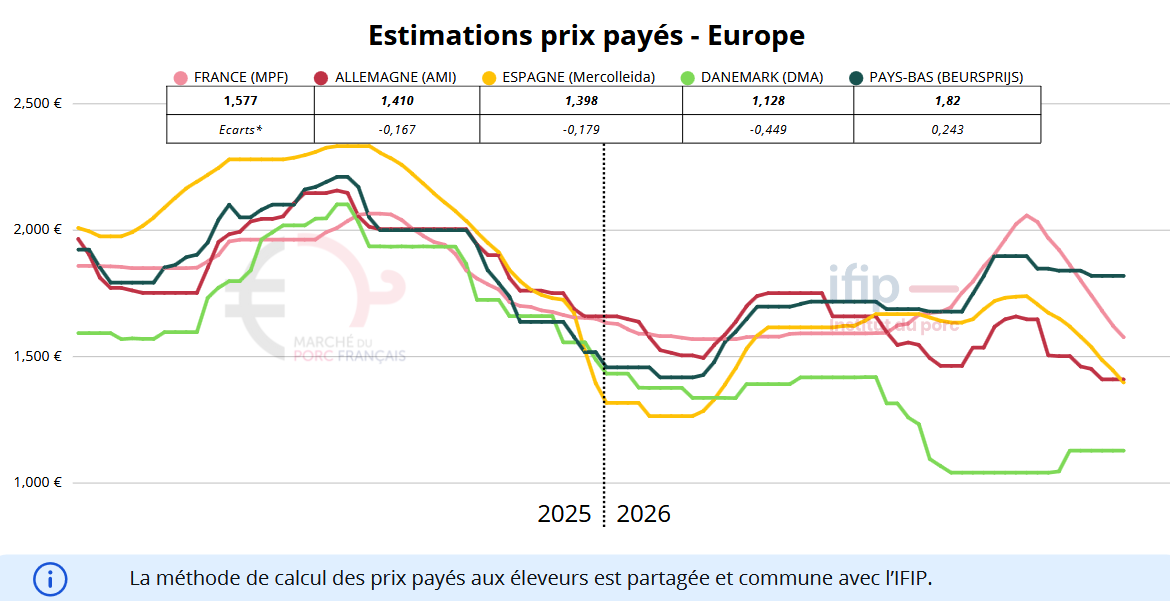
French pork market: After six consecutive weeks of maximum permitted declines, the French Pork Market recorded a slower price drop during Thursday’s session. The average price now stands at 1,401 €. During the session, buyers quickly positioned themselves between 1,400 € and 1,404 €, reflecting a convergence of their positions around a decrease of 3,1 cents, shared by all buyers.
Uniporc: Last week’s activity was reduced to four days, with slaughter volume slightly above 300 000 pigs. Unlike in previous weeks, this level is comparable to that of 2025. Meanwhile, weights are increasing very significantly, but this development remains in line with the seasonal trend, with the gap versus 2025 barely widening. However, we will have to wait until the end of this week to measure the full impact of collection delays related to the public holiday.
European Union
In Germany, the reference price remains stable at 1,32 €/kg. Supplies remain plentiful, but surpluses are gradually shrinking in some regions. Trading is even more active in the South. Weights continue to rise to 98,8 kg. By contrast, the meat trade remains subdued, despite a few additional promotions. Downward pressure persists, even as the price remains stable.
The Spanish market was severely disrupted by strike action last week. Three days of slaughter were lost, resulting in an estimated backlog of between 350 000 and 400 000 pigs on farms. Disruptions are also affecting the delivery of meat to domestic and export markets. This situation is intensifying price pressure, with a further decline of 3,7 cents.
The Belgian market continues to be characterized by ample supply, but also by strong demand from slaughterhouses seeking to maintain their activity. Pigs are therefore taken without delays in collection, apart from disruptions related to the public holiday. By contrast, slaughterhouse margins remain under pressure in the meat market. On the domestic market, only bellies fell by 1 cent/kg this week. The stable German price is allowing Belgian quotations to hold steady.
The Italian market remains under pressure, with a large supply of pigs and increased competition from imported meats, which have become particularly competitive following price declines in neighboring countries. The PDO production sector is holding up better than the conventional pork sector, but the overall trend remains negative. No recovery factors have been identified at present, and the downward trend could continue until the end of November.
The United States and China
The U.S. market records its steepest weekly decline of the year, with hog prices falling by 6,3 %, now 29 % below 2025. The value of pork cuts also drops by 3,8 %, driven in particular by declines in bellies and ribs. Slaughter reaches 2,664 million hogs, up 4 % year over year, adding to the pressure on an already weakened market.
In China, the hog market continues to face abundant supply and weak domestic demand. Competition from beef and chicken limits the prospects for a recovery in pork consumption. Despite some signs of stabilization, the imbalance between production and market outlets continues to weigh on prices, with the outlook for 2027 still uncertain.