
In the first 7 months of 2026, European pig slaughterings increased by 1,2 % in number of head compared with 2025. This trend was driven by Spain (+1,3 % over 8 months), Denmark (+8,1 % over 9 months) and Poland (+3,1 % over 9 months). Conversely, slaughter numbers remain stable in Germany (-0,1 % over 9 months) and decline in France (-0,9 %) as well as in the Netherlands (-5,7 %).
The supply of pigs is recovering in European markets
In Spain, animals whose growth slowed due to summer heat arrive on the market at the same time as pigs marketed during this period. The return of favorable temperatures stimulates animal growth and leads to an increase in carcass weights. However, these remain below their usual levels. In Germany, slaughterhouses are operating at a sustained pace despite weak demand for meat.
Price trends diverge between European countries
The France stands out for a monthly increase of 6,3% in the price received by farmers, reaching an average of 2 €/kg, a level 8,9% higher than in September 2025. This increase is explained by supply pressures this summer. However, after several increases in quoted prices, the French market began to turn around at the end of the month. Despite a balance between domestic supply and demand, the price gap with other European countries, especially Germany and Spain, is becoming difficult to maintain in the face of competition from imported meat.
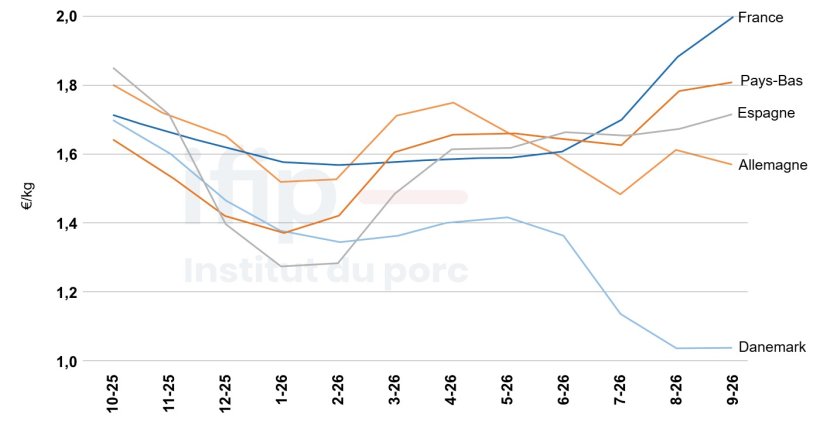 Prices received in the EU in € per kg of carcass. Source: Estimate of the average price received by farmers, calculated by Ifip based on national sources.
In Spain, the perceived price rises over the month (+2,7 %), to 1,72 €/kg, but remains 16,3 % below 2025. Spanish quotations are trending downward due to the seasonal recovery in supply and the increase in carcass weights. Slaughterhouses are also seeking to reduce the price gap with markets in northern Europe.
The Netherlands, the perceived price reaches 1,81 €/kg, up slightly month on month (+1,5 %), but down 4,1 % year on year.
In Germany, the trend remains downward (-2,6 % month on month), with a price of 1,57 €/kg, 19,9 % lower than that of 2025. The decline in German prices stems from difficulties in the meat market, hampered by insufficient demand relative to available volumes.
In Denmark, the perceived price remains very low, at 1,04 €/kg, despite monthly stability (+0,2 %). It is down 44,4 % year on year.
These price differences between European markets increase competitive pressures while export outlets remain limited. In addition, the issue of margins is becoming central for operators. Rising costs of raw materials, as well as energy, fuel and transport, are weighing on the profitability of farms and slaughterhouses. European operators are therefore seeking to market more kilos to absorb their costs.
Difficulties exporting meat to third countries, particularly from Spain and Germany, are leading to larger volumes being kept on the European market, increasing pressure on prices. Although trade in pork products is holding up, prices continue to trend downwards. The challenge over the coming weeks will be a recovery in European demand, with preparations for Christmas, which could help rebalance the meat market.
On international markets, a more tense situation than in 2025
Chinese demand remains sluggish, limiting export prospects. In addition, competition is intensifying among Brazil, the United States, and Denmark, which offer the most competitive prices on the market. These suppliers are making repeated price adjustments to gain market share in Southeast Asia, where demand is struggling to regain momentum.
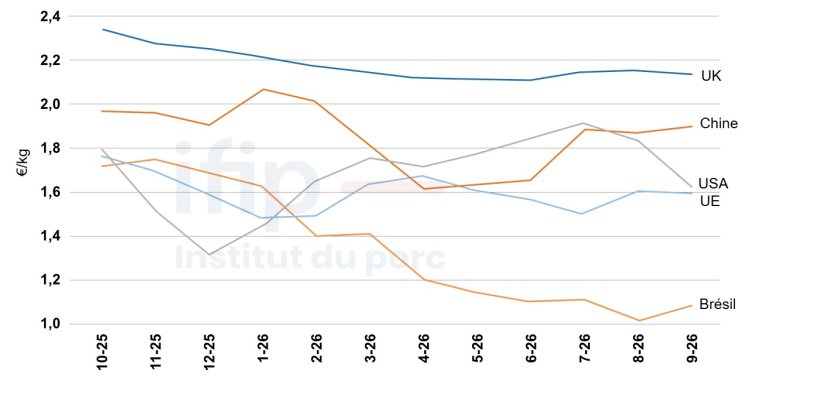 World pig prices (€/kg): EU-27: weighted average of the 27 countries USA: fip calculation based on Iowa market prices Brazil: fip calculation based on Sindicarne integration prices China: fip calculation based on prices from the Chinese Ministry of Agriculture
In September, pig prices moved in contrasting directions across countries. InBrazil, they jump by 5,5% in one month, but remain 42,9% below those of 2025. In the United States, they fall sharply (-11,5% in one month and -19,1% in one year). The China records a slight monthly increase (+0,5 %), without reversing the annual trend (-17 %).