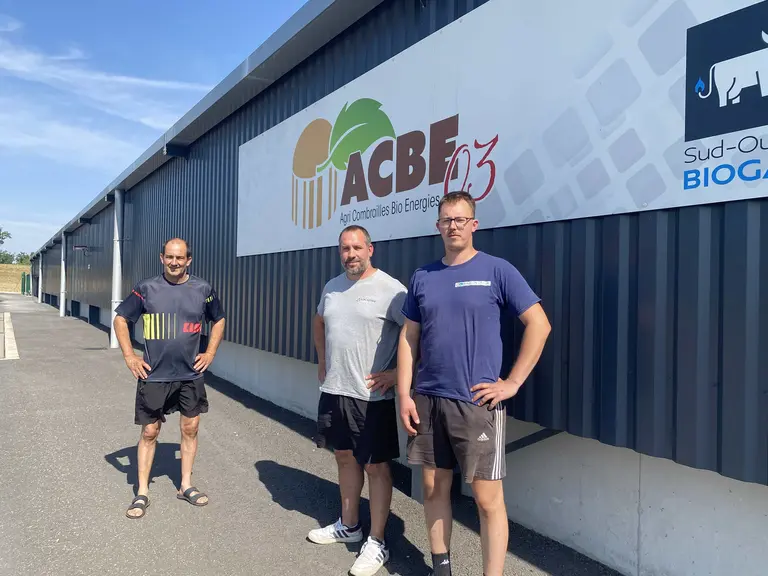
A partnership built on a longstanding habit of working together
The project grew out of a longstanding collaboration among the farmers.
“We were already used to working together in CUMA. We used to do silage work together and share equipment,” recalls Frédéric Blanchonnet, president of the collective.
Beyond providing additional income, anaerobic digestion meets a practical need: managing livestock effluent.
“All those heaps of manure you see smoking by the roadside—that smoke, we turn it into gas,” he sums up.
Now, the manure and slurry are collected at a suitable facility, then converted into biogas injected into the grid.
“The material comes in here and comes out here. We’ve just taken the gas,” explains Damien Taillardat, farmer.
An ambitious project despite the challenges
Financing was the main obstacle.
“It’s a bit of a sticking point for the project,” acknowledges Frédéric Blanchonnet. The banks were cautious about a technology that was still not very developed in the region and getting started required building up expertise.
However, the results quickly exceeded expectations. “By the third month, we were at 100 %” of the expected output, whereas estimates put it at 80 % in the first year.
The operation of the installation also relies on the training. An employee of the unit, Simon Blanchonnet had completed a specialization in anaerobic digestion before joining, a CS RUMA (Certificate of Specialization in Agricultural Anaerobic Digestion Unit Management).
“When I arrived here, I already knew the process. I’ve been here since it started up.”
A well-established organization
Every day, inputs are fed into a hopper, ground, then sent to the tanks, where they are heated and stirred to produce biogas.
Stay up to date in real time!
Follow topics, legislative projects, companies and public figures to be notified as soon as we publish an article.
Contrary to popular belief, the nuisances remain limited.
During our visit, odors were minimal. Located a good distance from homes, the site has not prompted any complaints.
The supply follows the pace of operations.
“It’s not on a daily basis; it’s by project,” explains Damien Taillardat. The priority remainslivestock feed. “If there’s a surplus, it comes here,” Frédéric reminds us.
A complement to livestock farming
Three years later, the group gives a positive assessment.
“In 2023, we had 522 animals. Today, we have 10% more,” says Damien Taillardat. For Frédéric Blanchonnet, anaerobic digestion does not replace livestock farming: “It complements livestock farming.”
The partners nevertheless point out that such a project takes time and requires a solid organization.
“You shouldn’t build a methanizer if your farm is already stretched to the limit,” warns Frédéric.
Thanks to an employee, an apprentice, and an on-call system shared among the thirteen farms, everyone contributes to its operation without disrupting their main activity.
ACBE 03 shows how 13 farmersturn an environmental challenge into an opportunity.
“Today, it’s something we know how to do,” concludes Frédéric.
An adventure proving that agriculture can combine innovation with respect for the environment.
Read also: At the Sommet de l'Élevage, a national Limousin show under the banner of youth