
Robotic egg collection: Updates from a pilot project in the US
As we often see in the media these days, humanoid robots are able to do all kinds of things now, from folding laundry to cooking to cleaning. It’s no surprise then, that robots are now collecting eggs.

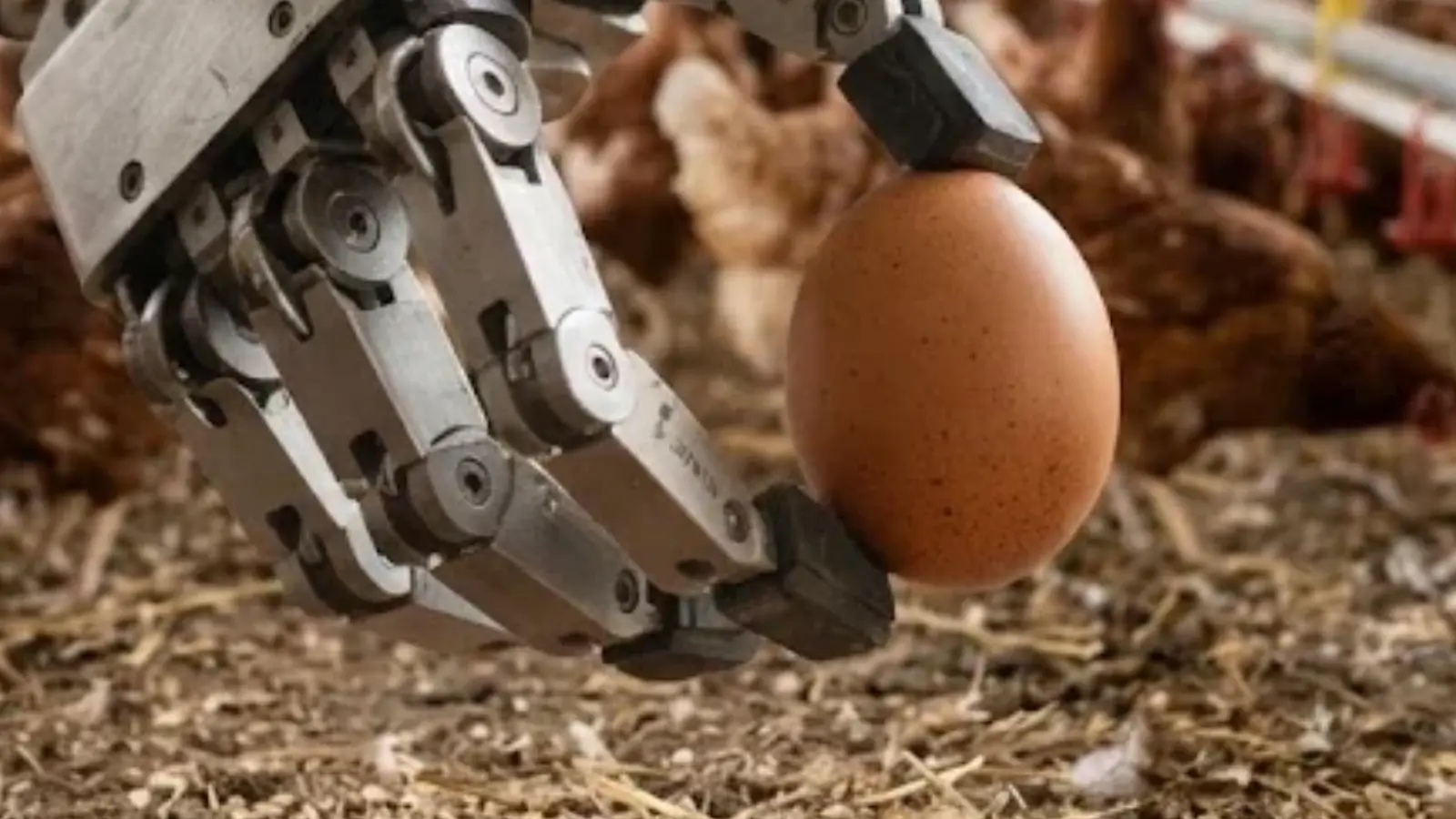
Say hello to Howl, a 4-foot-tall humanoid robot designed to collect eggs by scientists at North Carolina State University. The team is led by Dr Ramesh Bahadur Bist, assistant professor of biological and agricultural engineering and founder of the University’s Artificial Intelligence & Robotics (AIR) Lab. Beyond Howl, he and others are developing more cutting-edge technologies to address labour shortages and improve bird welfare and productivity in commercial poultry production.
Floor egg labour
Why is Howl needed? The answer has a lot to do with what happens in cage-free laying hen housing.
While egg collection in conventional cage housing is taken care of through eggs being laid onto a conveyor belt, cage-free (free run) systems require some eggs to be collected by hand – and those systems will completely replace conventional cages in years to come in the US.
At this point in the US, 10 of 50 US states have enacted bans on the production or sale of eggs from hens kept in cages. In addition, about 10 years ago, many grocery and restaurant chains committed to only selling eggs produced in cage-free systems by 2025.
According to research by Professor Tina Widowski at the Campbell Centre for the Study of Animal Welfare at the University of Guelph in Ontario Canada, as of October 2025, 46% of the national US laying hen population were housed in cage-free systems (mostly in free-run barns, with a small amount in organic and/or free range housing) and 54% in conventional cages. The percentage of cage-free housing grows every year.
ALSO READ: Putting pullet rearing at the heart of future egg production
Returning to egg collection, Bist recently noted that in free-run barns, ‘floor eggs’ (laid outside the nest, typically on the floor) can account for up to 15% of the total eggs laid. “If you’ve got around 100,000 birds,” he said, “that could mean anywhere from 2,000 to 15,000 eggs ending up on the floor each day. It takes a lot of time and labor to collect them all.”
At this stage, Bist’s graduate students in the AIR Lab are now putting the finishing touches on Howl’s programming and machine learning training. It will be able to complete egg-detection and retrieval by early 2027.
Instant in-depth answers
Bist and his colleagues are also working on ‘Poultry Talk’, a digital AI-based tool to directly address data and knowledge gaps on topics like nutrition, disease diagnosis and prevention, housing, welfare and more. It has now been sent it to poultry professionals around the country for their feedback.
“What makes Poultry Talk particularly useful is that it combines a large language model with a curated knowledge base on poultry science, so responses are grounded in open-source extension publications and peer-reviewed research rather than generic internet information,” Bist recently stated. “This helps reduce misinformation and make AI insights more trustworthy for real-world poultry farming decisions.”