
Phytogenic feed additives linked to improved meat yield and quality
Phytogenic feed additives are increasingly being used not only to support animal performance, but also to improve carcass yield, meat quality and production efficiency. Growing economic and sustainability pressures are driving interest in feed strategies that create value throughout the production chain.
Sangrovit, based on phytogenic isoquinoline alkaloids (IQs), has demonstrated its potential to support animal health and performance while contributing to overall animal welfare. The recently introduced 3rd generation formulation represents the latest innovation from Phytobiotics Futterzusatzstoffe GmbH.
It was developed through a natural breeding programme that selectively bred high-performing Macleaya cordata plants to enhance and stabilise alkaloid production, particularly canadine levels. Canadine, naturally occurring in Macleaya cordata, belongs to the group of IQs in the same way as the other 4 established alkaloids in Sangrovit.
Expanded alkaloid profile
IQs help maintain and strengthen the intestinal barrier by supporting the tight junctions between epithelial cells of the gut mucosa, thus reducing the risk of increased permeability and limiting the passage of harmful substances into the bloodstream. By reducing inflammation and stabilising the gut barrier, they also improve nutrient absorption efficiency.
Overall, these effects contribute to improved gut health, reflected in better feed efficiency and enhanced livestock performance. Standardised IQs have proven particularly effective under adverse conditions, such as heat stress, stocking density or other stress factors in livestock production.
The presence of canadine further broadens the spectrum of potential biological effects. Canadine affects muscle metabolism and muscle development. Specifically, it modulates the mTOR pathway in muscle cells through intracellular signalling mechanisms, leading to growth and protein accumulation in the muscles. Consequently, the trials demonstrated improved meat yield, a higher muscle-to-fat ratio and enhanced antioxidant capacity during refrigerated meat storage.
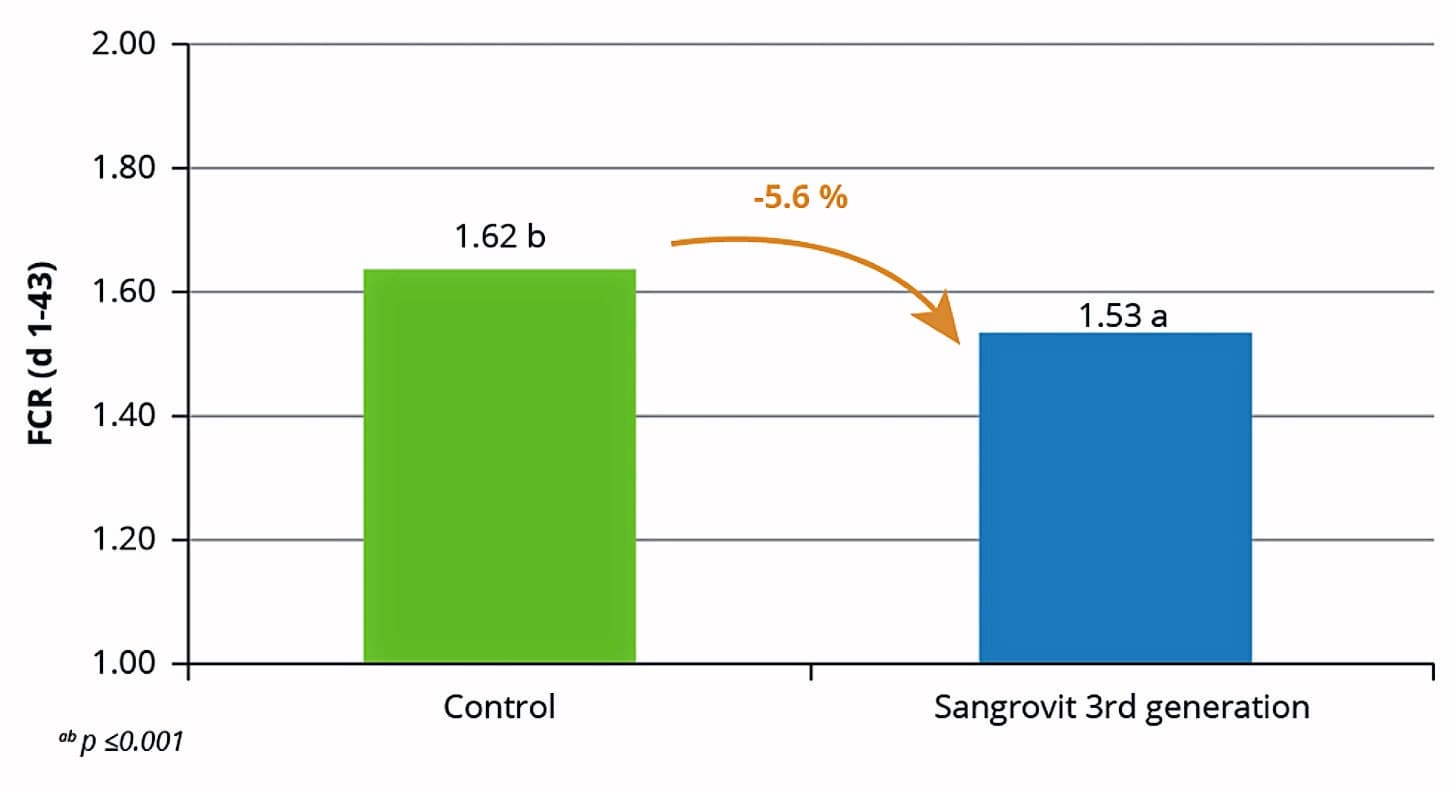
Figure 1 – FCR (d 1-43)
Canadine
A recent trial at the Agricultural University of Athens investigated the effects of the third-generation formulation in 470 Ross 308 broilers, including a defined heat stress challenge from day 36–39 followed by a resilience phase from day 40–43. In addition to performance and carcass parameters, gene expression in breast muscle was analysed, to investigate the effects of isoquinoline alkaloids, particularly canadine, on pathways related to muscle metabolism.
The results showed a significant effect on the mTOR pathway (p = 0.003), accompanied by increased expression of genes involved in muscle growth and protein synthesis and reduced expression of genes associated with fat synthesis (p ≤ 0.001). These effects were reflected in significant performance improvements. Final body weight increased by 5.1% (p ≤ 0.001), reaching +22% under heat stress conditions (p = 0.001), while FCR improved by 5.6% (p ≤ 0.001) (Figure 1) and by 13% under heat stress (p ≤ 0.001).
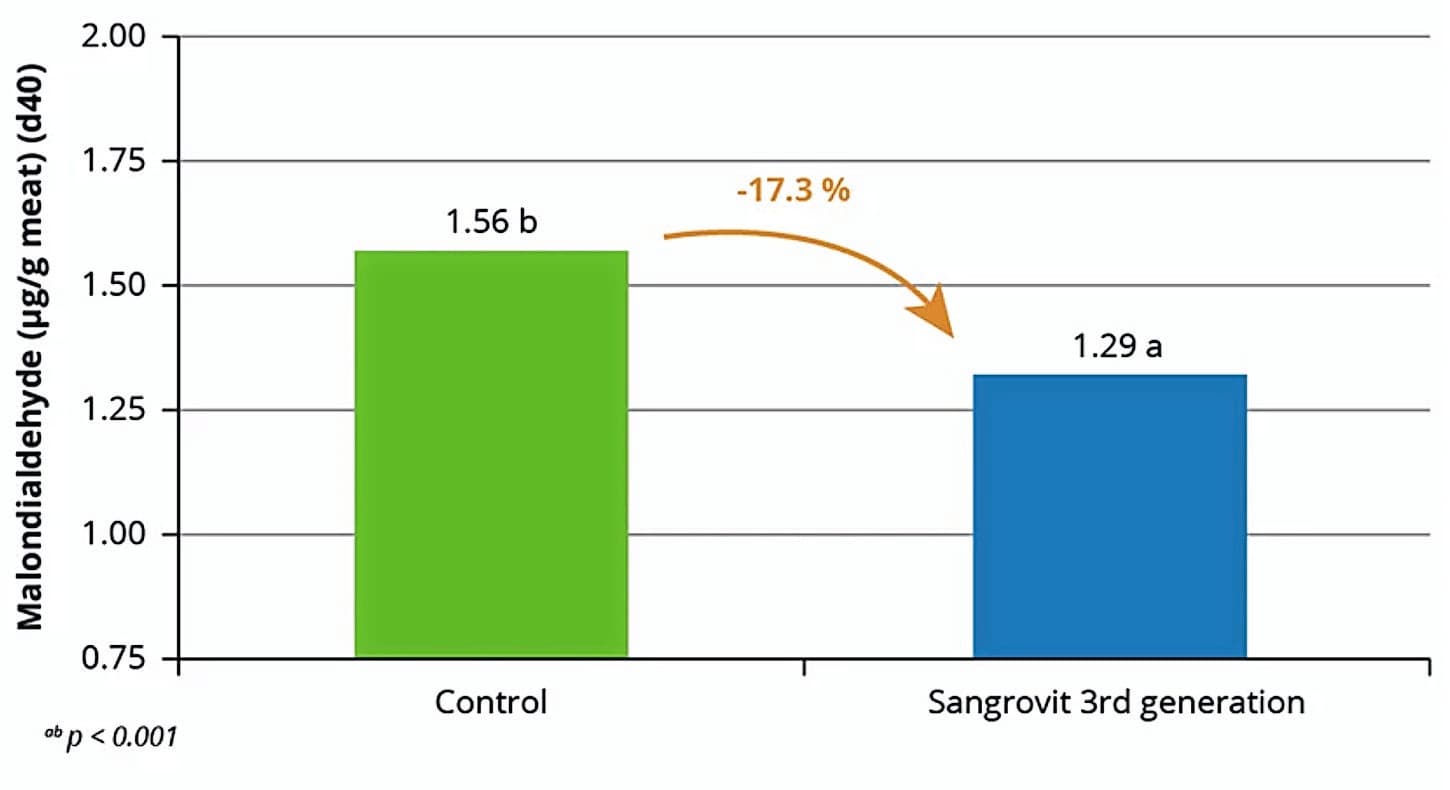
Carcass characteristics also benefited, with breast meat yield increasing by 9.4% (p = 0.05) and lean meat percentage by 5.1% (p = 0.007). Abdominal fat was reduced by 5.5%, further supporting a shift in carcass composition toward lean tissue deposition. In addition, malondialdehyde, a marker of lipid oxidation, was significantly reduced by 17.3% (p < 0.001), indicating enhanced oxidative stability of breast meat (Figure 2).
Figure 2 – Malondialdehyde (d 40)
Higher meat value
A recent study at a commercial feedlot in South Australia, conducted under the supervision of the University of Queensland, involved 300 Black Angus steers randomly allocated to control or treatment groups after individual weighing and identification. Over a 110-day period during hot summer conditions, the treatment group received a standardised formulation of isoquinoline alkaloids via a hay-based pelleted ration, while the control group received the same basal diet without supplementation.
The supplementation produced several positive outcomes. During heat waves, feed intake remained stable, and the Angus steers showed homogenous growth. In addition, steers receiving IQs achieved higher carcass weights (+9.37 kg; p ≤ 0.0001) and a higher dressing percentage (+3.6%; p = 0.05). Overall, these performance improvements resulted in a return on investment of 10 with the inclusion of Macleaya cordata-derived IQs.
Improved growth performance
A field trial in the United Kingdom involving 530 pigs evaluated the effects of IQs under practical production conditions throughout the entire wean-to-finish period. Supplementation significantly improved growth performance, with pigs achieving an 11.4% higher average daily gain and a correspondingly higher final body weight (p ≤ 0.014). Feed intake improved slightly, contributing to enhanced feed efficiency, as reflected by a 4.2% reduction in feed conversion ratio in the supplemented group (p ≤ 0.01).
The enhanced growth performance translated into improved slaughter performance, with IQ supplementation increasing carcass weight at slaughter. Carcass composition also improved, as indicated by reduced backfat thickness (−2.6%) and a higher lean meat percentage (+0.6%), suggesting more efficient nutrient partitioning toward lean tissue deposition.
Conclusion
Overall, the results demonstrate the potential of Sangrovit third generation to support animal performance and feed efficiency while positively influencing carcass characteristics. These findings highlight the value of phytogenic isoquinoline alkaloids as a nutritional tool to improve production efficiency and maximise value across the production chain.