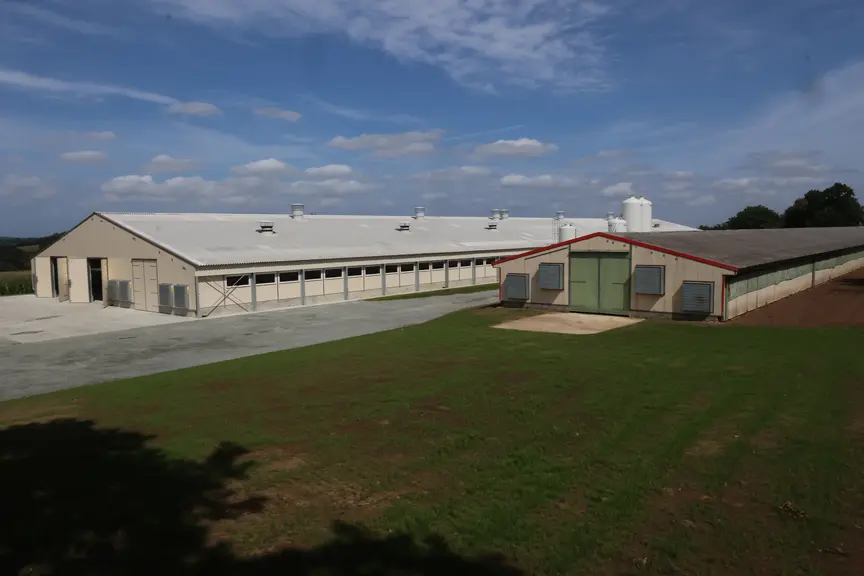
As provided for by the Agricultural Emergency Law, a draft ordinance intended to create a regime for classified installations (ICPE) dedicated to livestock farming was opened for public consultation on 6 October (the website is nevertheless under maintenance as we write).
The aim is to align French thresholds with the European regulations, while making provision for specific procedures (time limits, public inquiry arrangements...) for livestock farming, different from those for heavy industry.
Read also: ICPE: the exit from livestock farming provided for by ordinance
Four risk regimes for livestock farms
The draft ordinance on the creation of regimes for the commissioning, operation, running, inspection and cessation of activities of animal farms provides for the creation of a classification established by decree of the Conseil d’État, according to four risk regimes for pollution or nuisances (compared with three previously), namely: the declaration, the notification, thesimplified permit and the authorization.
What thresholds for the new classification?
While awaiting the entry into force of the implementing act of the European IED Directive which will change the thresholds, the draft decree submitted for consultation proposes the following thresholds for the different types of livestock farming.
Thus, for pig farms :
- The pig farms with 50 to 450 animals equivalent would be subject to declaration
- Farms with 2000 to 3000 finishing pigs, of 750 to 900 sows and other facilities with more than 450 animal-equivalents would be subject toa simplified permit.
- Farms raising more than 3000 fattening pigs and more than 900 sows would be subject to authorization.
For poultry farms:
- Other facilities holding a number of animals greater than 5 000 would be subject to declaration.
- Installations with more than 30 000 places would be subject to simplified permit
- Livestock farms of more than 85 000 broiler chickens and the farms with more than 60 000 laying hens would be subject to authorization.
For dairy farms :
- Dairy farms with 50 to 200 cows would be subject to declaration
- Dairy farms with 201 to 400 cows subject to simplified permit
- Livestock farms with more than 400 cows subject to authorization
For suckler cow farms :
Stay up to date in real time!
Follow topics, legislative projects, companies, and public figures to be notified as soon as we publish an article.
- Farms with more than 100 cows would be subject to declaration
For veal farms and/or cattle farms for fattening:
- Farms with 50 to 500 animals would be subject to declaration
- Farms with 501 to 800 animals under simplified permitting
- Farms with more than 800 animals requiring authorization
Read also: Will my poultry farm be affected by the IED Directive?
After the IED Directive enters into force, the draft decree anticipates the following changes:
- Mixed pig and poultry farms representing 380 livestock unitsl or more would be subject to notification
- Laying hen farms representing 300 livestock units or more would be subject to notification
- The poultry farms representing 280 livestock units or more would be subject to notification
Read also: Emergency Agricultural Law: toward a regulatory framework better suited to livestock farming
What are the arrangements for public participation?
The ordinance also describes the procedures associated with these regimes, including “the arrangements for public participation,” states the Ministry for the Ecological Transition, adding that the new simplified-permit and notification regimes “will include consultation or information mechanisms in particular.”
The draft ordinance provides for installations subject to notification public information by means of a notice on the website and in the town halls of the host municipality and nearby municipalities. For installations subject to a simplified permit, the public would be informed by a notice published online as well as by a notice displayed at the town hall or at the locations concerned and, depending on the importance and nature of the project, by means of a local publication fifteen days before the opening of the electronic public participation for plans, programmes and projects
Finally, for projects subject to environmental authorization, the proposal “maintains certain aspects of the consultation procedure, including its duration and the organization of public drop-in sessions.”
In June, the ministry expected that, for an authorization, the public consultation would last one month instead of three, and that the opening and closing public meetings would be replaced by a drop-in session lasting at least one day at the town hall. For the simplified permit, the public was to be consulted through electronic public participation for 30 days.
Read also: Duplomb Law and ICPE: decrees raising the thresholds for cattle, pig and poultry farms finally published