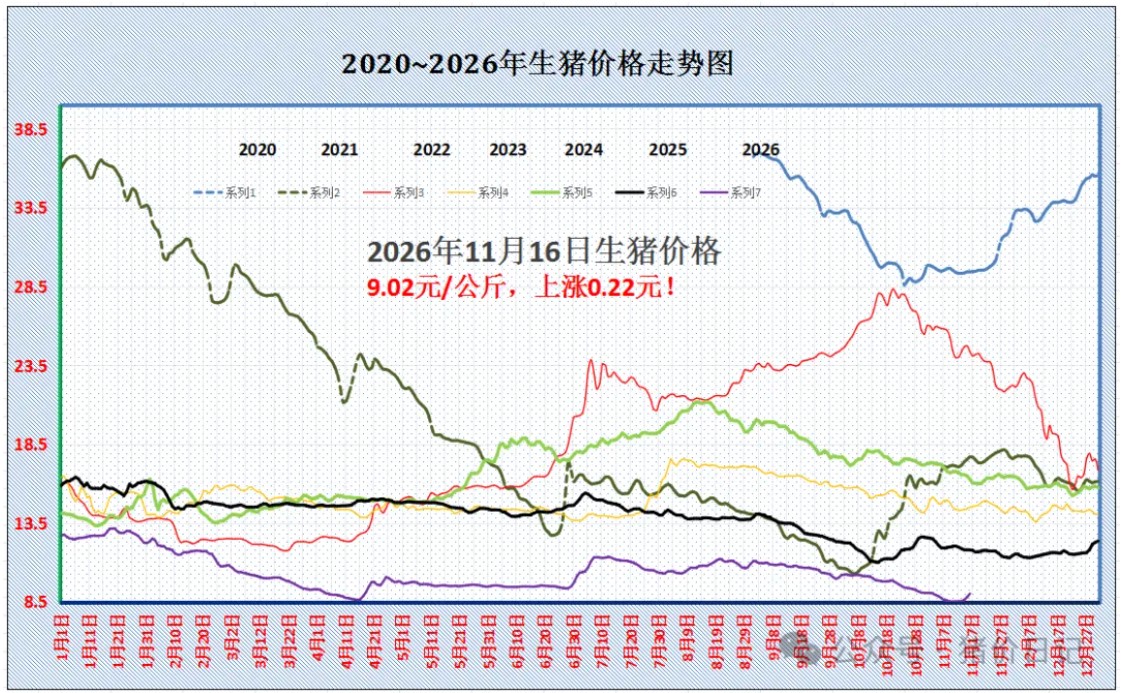
They’re up, they’re up—pig prices have surged after being “oversold,” and Brother Pig is enjoying a long-awaited “spring”! Recently, as supply pressure was released all at once, the average weight of hogs shipped continued to rise. Meanwhile, frozen pork stocks in China were gradually released onto the market. Combined with more frequent disease outbreaks at pig farms and a stronger need among producers to recover funds amid financial difficulties, multiple factors came together. The oversupply was difficult to ease, and domestic pig prices fell below rational levels! Previously, the quoted price for standard pigs of the three-way crossbreed bottomed out at 8.52 yuan/kg. Pig prices fell below the previous low (8.63 yuan/kg), setting a new low for the year. Farming losses deepened sharply, with losses for self-breeding and self-rearing at major large-scale pig companies widening to nearly 390 yuan/head. Market expectations for a recovery in pig prices rose!
However, after the Beginning of Winter, cold-air activity intensified, and temperatures across northern and southern regions have gradually fallen recently! Demand for pork has also recovered slowly. In particular, improved demand for pork at rural markets in northern regions’ domestic markets has driven up prices for large hogs in China. Price spreads between medium and large hogs across regions have widened, stimulating a recovery in bullish sentiment in China’s hog market! Pig prices have stopped falling and begun to recover, while the price center has shown a “breakout” rise!
As of 11 month 16 day, the national average ex-farm price for lean-meat hogs of the three-way crossbreed was 9.02 yuan/kg, up 0.22 yuan/kg from yesterday. Pig prices have risen by a cumulative 0.5 yuan/kg in this move, representing a short-term increase of 5.87%. The market is seeing an “all-out” surge: according to monitoring data, pig prices rose across 28 regions in northern and southern China, with the increase widening significantly!
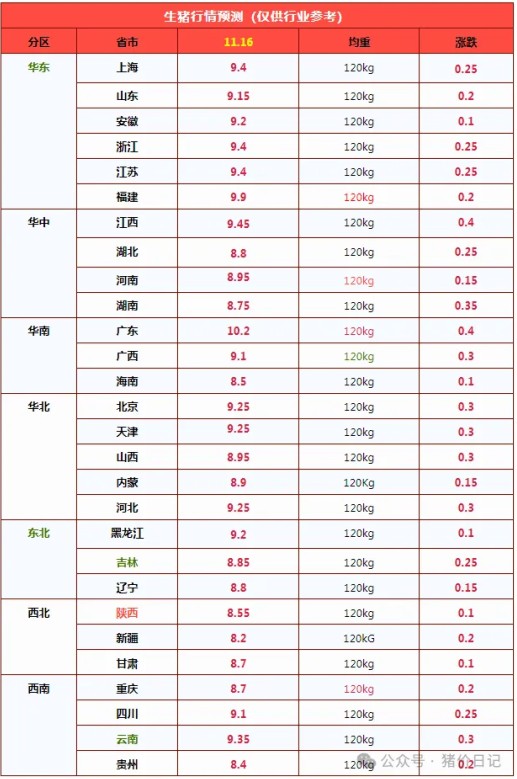
According to institutional monitoring and analysis, at present, among the 7 production regions and 28 provinces and cities covered by domestic sample data monitoring, the average hog price at farm gate is close to 8.95 yuan/kg in Henan and Shanxi. Hog quotes in both northern and southern markets have risen to 8.2~10.2 yuan/kg! In the northern region, Heilongjiang quotes have risen to 9.2 yuan, Hebei quotes are 9.25 yuan, Jilin quotes are 8.85 yuan, Shanxi quotes are 8.95 yuan, and Gansu quotes are 8.7 yuan. In the southern market, Sichuan quotes are 9.1 yuan, Yunnan quotes are 9.35 yuan, Shandong quotes are 9.15 yuan, Jiangsu and Zhejiang quotes are 9.4 yuan, Henan quotes are 8.95 yuan, and Guangdong quotes are 10.2 yuan/kg!
Based on this analysis, on 11 month 16, hog prices surged like a “rocket,” with the market showing a pattern of “generalized increases” across the north and south. Moreover, the center of hog prices rose by more than 9 yuan/kg, highlighting a phased recovery from the market bottom!
Regarding the reasons for the rise in hog prices, as I have noted several times before, the main cause of this oil price increase was that, after the Beginning of Winter, temperatures fell and the weather turned colder in the north. Residents’ purchases and sales of pork in the domestic market strengthened, and demand for fatty pork increased. Prices for medium and large hogs strengthened first, driving up prices for standard-weight hogs! As demand at the margin declined, producers became more inclined to proactively control sales volumes, while individual producers and large-scale pig companies were reluctant to sell and held hogs back, further increasing the difficulty for slaughterhouses in procuring hogs! With slaughterhouse profits recovering and operating rates rising, higher prices stimulated increased hog supply, and domestic hog prices showed signs of bottoming out and recovering!
However, market opinions differ on whether this round of pig price increases can be sustained. Farmers are relatively optimistic, but mainstream institutions believe this is a “technical rebound after an excessive decline” rather than a seasonal reversal. Supply and demand pressures remain considerable, particularly as supply remains high!
According to institutional analysis, although the number of breeding sows declined 10 months ago, improved sow productivity has offset the benefits of the reduction in sow numbers! In addition, last month, consumer demand provided insufficient marginal support, and more large-scale pig companies were compelled to delay marketing. The pressure from overlapping marketings intensified in 11; this month, the sample pig companies’ marketings increased 2.56% month over month. As temperatures fell, fattening weight gain accelerated, and the average liveweight at marketing climbed to 125.87 kilograms, further strengthening pork supply! Combined with high domestic frozen pork inventories and the gradual release of frozen pork stocks, supply capacity remains high! As pig prices have recovered from their lows, losses in farming have eased. Since large-scale pig companies may fall short of their planned marketings for the month, some farming operators still have an opportunity to market pigs when prices are high!
Capital Reshapes the Hog Industry Chain: Risk-Control Lessons for Frontline Pig Farms Amid a Wave of Restructuring and Mergers and Acquisitions
In 2026, China’s hog industry was in a stage of structural market clearing toward the end of a downward cycle. Debt pressures accumulated from earlier high-leverage expansion continued to mount. Combined with repeated shifts between pig farming profits and losses, matters involving pre-restructuring, judicial restructuring, asset disposals, and equity acquisitions of listed farming companies were implemented in rapid succession. Unlike previous capital moves centered on expanding production capacity, this round of industry consolidation is distinctly characterized by industrial capital taking over restructuring targets, targeted integration of high-quality existing assets, and prioritizing the filling of gaps in the industry chain over expanding the scale of marketings. Equity and asset adjustments on the capital side are not isolated events involving listed companies; they will be transmitted downstream through channels such as contract farming, hog procurement, centralized feed purchasing, and slaughtering and distribution, directly changing cooperation terms, counterparty credit, and marketing channel structures for large-scale farms and family farms.
Looking at macro industry indicators, the Ministry of Agriculture and Rural Affairs’ inventory of breeding sows has continued to decline in stages, and production capacity regulation continues to take effect. Data monitored by Zhuochuang Information show that in 2026, the year-over-year number of announcements concerning asset disposals, investor recruitment, and equity acquisitions by A-share listed companies in hog farming, feed, and slaughtering rose significantly. The industry’s competitive paradigm has shifted from “scale first” to “cash flow security, whole-chain coordination, and prioritizing the efficiency of existing assets.” For frontline operators closely tied to contract-farming models run by leading companies and reliant on a single major company’s hog procurement channel, tracking the restructuring progress, changes in control, and plans to divest business segments of their partners has become essential to operational risk management.
I. Judicial restructuring as the main theme: clearing risks for highly leveraged entities, industrial capital entering the picture, and channel stability as the core variable
The companies targeted in this round of restructuring generally possess core tangible assets such as existing land, breeding facilities, slaughtering qualifications, and regional livestock procurement networks. However, prolonged losses have put pressure on liquidity and debt structures. In terms of market selection, industrial capital with the ability to coordinate across upstream and downstream sectors is gradually replacing purely financial investors. The core objectives of restructuring plans are to put existing production capacity back to use and stabilize regional supply and distribution systems, rather than to quickly liquidate assets.
Tianbang Food: Tongwei Group becomes the controlling shareholder, with the performance stability of the farming business as the primary concern
Tianbang Food is the industry restructuring target that has attracted the most attention this year. The company has formally signed an investment agreement with Tongwei Group. Tongwei will obtain controlling rights by injecting capital in exchange for shares issued through the conversion, with a relatively long lock-up period to constrain short-term capital exits and safeguard the continuity of medium- and long-term business plans. Before the plan was implemented, Tianbang went through multiple unsuccessful rounds of investor recruitment. Earlier, prospective industrial investors and financial investors successively terminated their cooperation frameworks. The company also applied to extend its pre-restructuring period, leaving a window for negotiations on the plan and the sorting out of creditor claims. The disposal of supporting assets for the restructuring is proceeding in parallel. The company has transferred low-efficiency, non-core assets, including its slaughtering and processing subsidiary, to external parties, generating cash inflows and further concentrating resources on its core hog farming business. Key concerns on the industry side center on the contract farming system: whether settlement rules for contract farming, piglet supply plans, guaranteed-price hog recovery mechanisms, and contract farming deposit management policies will change after the change of control is the primary indicator for assessing risks to existing contract farms.
Longda Meishi: Pre-restructuring enters investor selection stage; Aonong-affiliated consortium joins the process; slaughterhouse hog procurement chain under pressure and being monitored
In the middle of 2026, Longda Meishi was ordered by a court to begin pre-restructuring proceedings and publicly solicit investors. A multi-party consortium was ultimately selected as the restructuring investor, with an Aonong-affiliated entity contributing capital and participating indirectly in implementing the restructuring. The company’s business spans hog farming and slaughtering and processing. In Shandong, a major production area, it has established a stable live-hog procurement network that serves as an important outlet for local farmers to sell their hogs. Investor selection has now been completed, but the draft restructuring plan still requires a vote at the creditors’ meeting and a court ruling before it can take effect. The industry’s key risks lie in whether hog procurement volumes at the slaughtering end, procurement pricing mechanisms, and settlement periods can remain stable during the restructuring window. Any contraction in procurement capacity would directly alter the regional spot-market circulation of live hogs and heighten the risk that farmers may choose an unfavorable time to sell.
II. Equity M&A Strategy: Acquisition Rationales for Two Types of Assets Diverge, with Profitable Farming Assets, Feed Production Capacity, and Distribution Nodes Becoming Key Investment Priorities
This year, M&A rationales across the industry chain have clearly diverged into two main directions. First, acquire established farming assets with a track record of stable profitability and compliant feed production capacity, avoiding the challenges of high capital expenditure for new projects, long ramp-up periods before production, and stringent environmental assessment and land-use constraints. Second, invest in pig trading markets and associated slaughtering capacity to provide farming operations with an outlet for spot sales and build a buffer between production and sales, hedging against cyclical price risks. In M&A assessments, the sustainability of asset profitability, strategic value of regional positioning, and synergies with the parent company’s existing businesses carry more weight than incremental slaughter volume.
Bo’en Group: Acquires three feed companies in northern China from CJ Group for cash; existing production capacity replaces self-built projects
On 9 month 15 day, Bo’en Group announced that it would acquire, for 1.125 billion yuan in cash, 100% of the equity in three feed subsidiaries of CJ International in Shenyang, Tianjin, and Liaocheng. The three target entities recorded combined operating revenue of 6.24 billion yuan and net profit of 398.16 ten thousand yuan in 2025. At the same time, the company terminated investment projects to build two new feed mills. This transaction is a typical example of a shift in investment logic in the feed sector: returns on investment in new capacity are declining, and the industry is shifting toward acquiring existing factories with established customer bases, production qualifications, and stable production lines. Partner pig farms in the north should pay close attention to continuity in feed formulation standards, supply fulfillment capabilities, and credit payment terms during the transition period following closing, and guard against supply chain disruptions.
天康生物: Acquiring a controlling stake in 羌都畜牧, securing high-quality, profitable production capacity in the northwest, and completing an integrated closed loop
On 6 month 3 day, Tecon Biology completed the industrial and commercial registration change for its acquisition of a 51% equity stake in Xinjiang Qiangdu Animal Husbandry, with a transaction consideration of 12.75 hundred million yuan. Qiangdu Animal Husbandry has planned hog production capacity of 150 ten thousand head and achieved profitability for six consecutive years from 2019 to 2024. Its net profit was 5.71 hundred million yuan in 2024 and 3.09 hundred million yuan in the first half of 2025. Unlike the bottom-fishing model of acquiring loss-making capacity at low prices at the bottom of a cycle, this transaction essentially brings in a highly stable, profitable asset and integrates it into Tecon’s feed, veterinary vaccine, and slaughtering and processing system. It fills a gap in its presence in the Northwest’s main production areas, strengthens regional self-circulation synergies, and reduces the impact of cross-regional transportation and price cycles.
New Wufeng: Increased its stake in a live hog trading market, securing a position at a distribution hub and strengthening an outlet for shipments from southern production regions
New Wellful is advancing an equity acquisition in a regional live-pig trading market, which will substantially increase its shareholding after completion. The target assets include supporting compliant slaughtering capacity and an offline live-animal trading platform, making them a core regional distribution hub. This transaction does not constitute a major asset restructuring. It has been approved by the board of directors, and the closing process is proceeding in an orderly manner. For businesses in Hunan and surrounding production areas, the addition of a trading and slaughtering node will help reduce dependence on a single purchaser and optimize the regional spot-pricing ecosystem. New Wellful continues to expand into slaughtering and distribution, aiming to establish channels that can handle both its self-raised live pigs and externally sourced live pigs, connecting the value chain from farming to end-market meat products.
Bright Meat Industry: Internal equity restructuring within the group, completing full ownership of Bright Farming and Animal Husbandry and streamlining the regional breeding, farming, and processing chain
In late 4 month, Guangming Meat Industry acquired the 49% equity interest in Guangming Agriculture and Animal Husbandry held by Yimin Food for a consideration of 1 yuan. Guangming Agriculture and Animal Husbandry simultaneously acquired a 100% equity interest in Shanghai Mingjin Animal Husbandry for a transaction consideration of 940.45 ten thousand yuan. Upon completion of the transaction, Guangming Meat Industry obtained full ownership and control of Guangming Agriculture and Animal Husbandry. This transaction is an internal optimization of the Group’s business structure. Its scale is small, and its primary purpose is to clarify the responsibilities and rights of the entities engaged in breeding and meat processing in the Shanghai region. Its impact on the national hog industry landscape is limited.
Kingkey Smart Agriculture: Planning to acquire control of Huibo Robot and develop a second growth curve in intelligent livestock equipment
At the beginning of 3, Jinjizhì Nóng announced its plan to acquire HuiBo Robotics and obtain control of the company. The exclusive negotiation period was extended to 3月31日. The transaction represents a strategic attempt by a leading pig farming company to move beyond its core farming business. Its underlying driver is the industry's long-term demand for cost reduction, using intelligent equipment to improve labor efficiency and lower meat production costs. It is a forward-looking move in the technological side of farming.
III. Integrating the underlying drivers: the structural nature of cyclical clearing and the restructuring of industry rules
The intensive restructuring, asset divestitures, and mergers and acquisitions are a concentrated effort to work through the aftereffects of the leverage expansion during the previous upcycle. Constrained by the orderly reduction of breeding sows, wide fluctuations in hog prices, and high financing costs, leading companies have converged on a strategic shift in their operations:
Liquidity-first principle: proactively divest non-core assets that continue to incur losses, reduce ineffective capital expenditure, and safeguard the minimum threshold for cash flow security;
Industry capital-led restructuring: Investors value resources that cannot be reset, such as premises, qualifications, and channels, and pursue long-term industrial synergies rather than short-term financial arbitrage;
Shift value chain positioning downstream: expand the presence of slaughtering operations and live-animal trading markets, secure export outlets, and mitigate the risk of spot price fluctuations for live hogs;
Shifting from incremental expansion to unlocking the value of existing assets: prioritize acquiring mature, profitable assets to avoid the uncertainties around land use, environmental impact assessments, and commissioning associated with new projects.
Four. Business implications: Frontline pig farms should establish a tiered risk-control framework to hedge against the risk of changes in their cooperative partners.
There is a lag between a change in control at the capital level and its transmission to production. Operating entities should not take a linear, pessimistic view, but should establish a routine counterparty-tracking mechanism:
For contract farming partners undergoing restructuring, focus on reviewing the legal validity of contracts, arrangements for safeguarding security deposits, and obligations to supply piglets and collect finished pigs; exercise caution when extending credit for new partnerships;
For large-scale farms with highly concentrated sales channels, leverage newly added regional slaughtering and trading hubs to proactively build a combination of sales channels and reduce reliance on a single buyer;
If a feed supplier undergoes a change in equity ownership, initiate small-batch trial supply validation; track changes in formula specifications, delivery lead times, and payment terms, and maintain a pool of alternative suppliers.
The underlying supply-and-demand fluctuations of the hog price cycle have not disappeared. This round of consolidation is not the end point of industry clearance, but a stage in the restructuring of capacity, channels, and the rules governing cooperation agreements. As the restructuring plans are successively approved and equity transfers are completed, the trading ecosystem across the industrial chain will continue to evolve. Whether listed industry leaders or small and medium-sized pig farms, the key to weathering the cycle lies in keeping asset efficiency under control, maintaining cash flow security, and diversifying transaction structures.