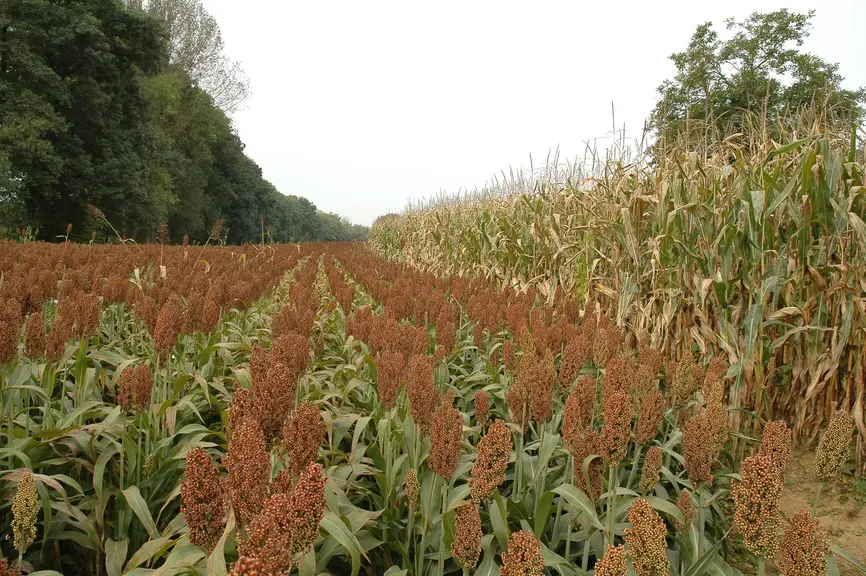
The global warming will have an “overall positive” impact on sorghum yields in Europe, according to the findings of a team of researchers from Inrae and AgroParisTech. The study, published on October 5 in the journal Earth’s Future, shows that sorghum could even replace 90% of the corn currently used for animal feed by the end of the century. This projection assumes that sorghum is grown 1 times every 3 years in crop rotations, equivalent to 33% sorghum on arable land. The scientists obtained these predictions using a model that makes it possible to project sorghum yields based on climate data. The study shows that with climate warming, Southern Europe would become less suitable for growing this cereal. Conversely, sorghum yields would increase in Northern and Central Europe by the end of the century, up to 3 more tonnes per hectare.
Read also: Drought 2026: faced with scarce maize, operators looking for alternatives
Obstacles to overcome for sorghum cultivation in Europe
“Sorghum is generally considered a good alternative to maize, due to its resilience to high temperatures and water scarcity », Inrae emphasizes in a press release dated 6 October on the study’s findings. Growing this cereal is therefore presented as an « interesting option for adapting European agriculture to climate change.”
Stay up to date in real time!
Follow topics, legislative projects, companies, and public figures to be notified as soon as we publish an article.
However, sorghum is currently only grown to a very limited extent in Europe, where it accounts for approximately 0,1 % of the area, the study indicates. Developing this crop would requireovercome many barriers, warn the scientists, of a sociotechnical and agronomic. The study notably cites the development of earlier-maturing varieties and exhibiting better cold tolerance, and the local adaptation of sowing calendars and harvest. The sorghum sector will need to be developed at the European level, the researchers explain, both in terms of seed supply, the services of advice, but also for its integration into the animal feed market sector. The study calls for developing a “planning at the European level” dedicated to sorghum to coordinate markets and policies across different regions.
Read also: Drought: “Standing crops and sorghum allowed me to maintain grazing until 15 August,” in Eure