
Pork prices are surging, rising “like a force breaking through bamboo”!


  Time flies, and 11 is nearly halfway over. Recently, domestic pork prices have staged an “oversold rebound”! Previously, seasonal peak demand fell short of expectations. Demand during the traditional Mid-Autumn Festival and National Day holidays provided insufficient marginal support. Changes in dietary habits have increased market substitution; changes in the domestic population structure and labor-intensive industries have also contributed. Under the combined impact of these factors, demand could not absorb the available hog supply! Producers faced pressure to hold hogs back involuntarily. Over the preceding two months, major pig companies’ monthly slaughter plans increased month on month, but actual completion of those plans was poor, further delaying capacity utilization!
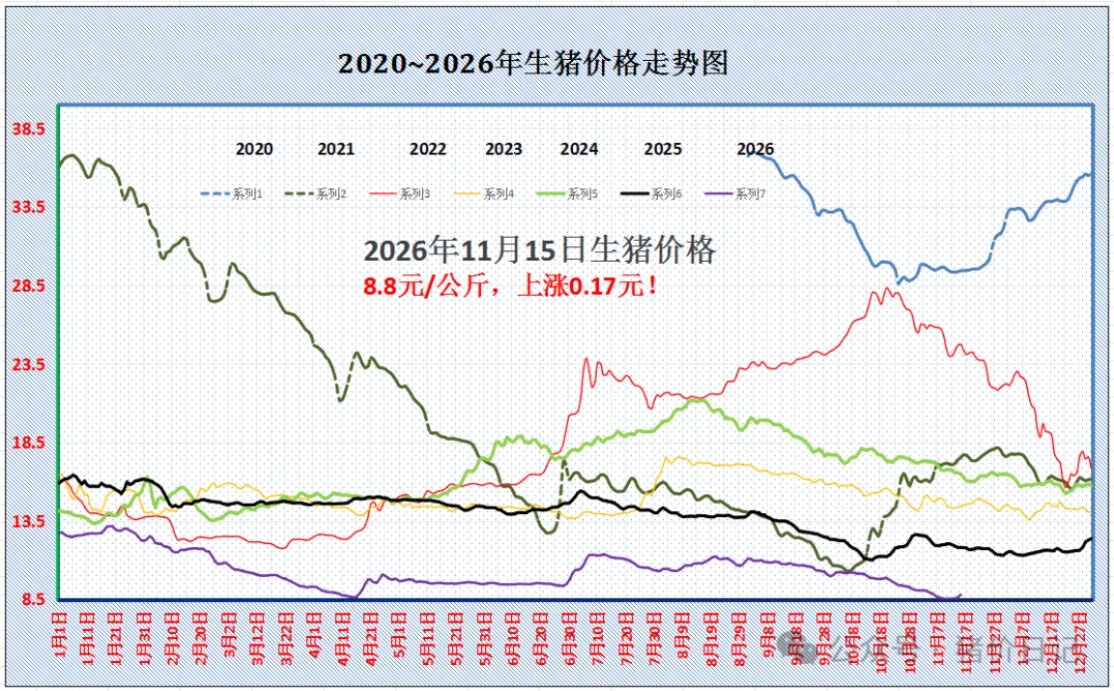
  In particular, in 11, large-scale pig companies planned to slaughter 1519.67 ten thousand head, with the average daily slaughter volume increasing by nearly 5.96% month on month, creating substantial supply pressure. Weak replenishment of piglet stocks and deepening losses in sow farming led producers to actively reduce production, with more sows being culled. In addition, disease risks at pig farms increased, and producers faced the risk of running out of funds. With these factors combined, hog producers were eager to sell their animals, making it difficult for pork prices to stop falling. Prices hit their lowest level in nearly 10 years!
 
  However, in recent days, the hog market has shown signs of “recovery from the bottom.” In particular, price gains have widened over the past two days, and market sentiment is gradually “heating up.” Pork prices may see a modest recovery, with the price level expected to rise above 9 yuan/kg soon!
 
  On the supply side, with the southern pickling and curing season approaching, marginal support from demand enthusiasm has gradually improved in recent days. Changes in the pace of sales from farms have reduced the number of standard-weight pigs being offered for sale, and some large-scale hog enterprises have tried to reduce sales volume and push prices higher. As temperatures fall, trading enthusiasm for heavier pigs has strengthened, domestic prices for medium and large pigs have recovered, and the price spread between standard-weight and heavier pigs has widened in many areas, further bolstering market sentiment in favor of holding prices firm. Sentiment among independent pig farms to wait and see for prices to rise has strengthened. Large-scale hog enterprises are maintaining their normal sales plans, although some have tried to push prices higher.
 
  On the demand side, support from demand has improved in recent days, and domestic pork consumption has picked up. As of now, the operating rate of sampled slaughterhouses has recovered to around 33.7%, indicating a marginal improvement in consumption. This is mainly due to falling temperatures, which have shifted residents’ dietary preferences toward meat. Meanwhile, beef and mutton prices near the market are high, improving pork’s value for money. In some areas, residents in the north have begun pickling and curing meat ahead of the season, further improving market trading conditions.
 
  Based on these factors, hog prices are currently showing signs of bottoming out and recovering, with the market entering a bottom-repair phase. However, the extent of any rebound will still face pressure from supply. According to data monitoring and analysis, following price adjustments by slaughterhouses, standard-weight hogs are expected to be quoted at 8.8 yuan/kg on 11 month 15, up by 0.17 yuan. Watch for changes in market trading conditions; hog prices may still have room for a small rebound this time……
 
Key information on the pig industry for 2026/11/14

Pork prices are surging, rising “like a force breaking through bamboo”!

Global hog cycles are bottoming out simultaneously: cross-regional capacity is jointly in surplus, and external demand can no longer provide support — Illustration 1
 
  Table of live hog prices across provinces and regions in northern and southern China (for industry exchange and reference only)

Live pig market forecast (for industry reference only)

Region

Province/municipality

11.15

Average weight

Rise/fall

East China

Shanghai

9.15

120kg

0.25

Shandong

8.95

120kg

0.15

Anhui

9.1

120kg

0.2

Zhejiang

9.15

120kg

0.25

Jiangsu

9.15

120kg

0.25

Fujian

9.7

120kg

0.2

Central China

Jiangxi

9.05

120kg

0.2

Hubei

8.55

120kg

0.1

Henan

8.8

120kg

0.2

Hunan

8.4

120kg

0.2

South China

Guangdong

9.8

120kg

0.25

Guangxi

8.8

120kg

0.2

Hainan

8.4

120kg

0

North China

Beijing

8.95

120kg

0.2

Tianjin

8.95

120kg

0.2

Shanxi

8.65

120kg

0.2

Inner Mongolia

8.75

120Kg

0.1

Hebei

8.95

120kg

0.2

Northeast

Heilongjiang

9.1
 

120kg

0.1

Jilin

8.6

120kg

0.05

Liaoning

8.65

120kg

0.1

Northwest

Shaanxi

8.45

120kg

0.1

Xinjiang

8

120kG

0.15

Gansu

8.6

120kg

0.2

Southwest

Chongqing

8.5

120kg

0.3

Sichuan

8.85

120kg

0.3

Yunnan

9.05

120kg

0.2

Guizhou

8.2

120kg

0.15


The global hog cycle is bottoming out in sync: cross-regional capacity oversupply is resonating, and external demand has lost its ability to provide support


  Monitoring basis: On 11 month 12, the average domestic hog price at farm-gate was 8.55 yuan/kg. Unlike traditional cyclical fluctuations confined to a single country, this downturn is characterized by a combination of globally synchronized capacity release, shrinking trade channels, and weakening consumption across markets. Producers in the major production regions of China, the EU, North America, South America, and Southeast Asia have generally fallen below the cost line; only regions that proactively reduced capacity among their foundational breeding stock earlier have shown resilience in profitability. With global trade flows disrupted, external markets have no supply-demand gap and cannot provide marginal support for domestic hog prices. The cyclical turning point hinges on a substantive and sustained reduction in the global foundational breeding population.

  I. Summary table of core data on pig farming profits and losses and prices across global producing regions
 
  Note: Price and cost accounting methods vary by country. Costs in some regions include deductions for manure, depreciation, land allocation, and subsidies. The figures are intended only for comparing the direction and scale of profit-and-loss pressures; time points are as indicated in the original text.
 

Region

Price indicator

Cost / break-even line

Profit and loss situation

Core supporting data

China

11/12 Average live hog price: 8.55 yuan/kg

-

Severe losses across the industry

Muyuan's net profit attributable to shareholders for the first three quarters: - 93.2 billion yuan; Wen's net profit attributable to shareholders for the first three quarters: - 49.6 billion yuan; year-on-year change in breeding sows at the end of 9: - 10.7%; year-on-year change in hogs marketed in the first three quarters: + 1.4%, pork production: + 3.2%

European Union

Pig prices in week 44: year-on-year - 14.4%; piglet prices: year-on-year - 26.3%

-

Losses; farm operations are difficult to sustain

Pork exports to China in the first half of the year were down year on year by - 20%; slaughter company Vion reported that regional supply was saturated; Danish Crown warned that current prices were unsustainable

United Kingdom

Pig prices fell from 2025 8 pence/kg in 208 to 178 pence/kg

Full cost: 207 pence/kg

Average loss per head in the third quarter: 25 pounds sterling

Nearly half of pig farmers received notice from slaughter companies terminating purchasing contracts; 73% plan to reduce their herds or exit; the pig biological cycle is approximately 10 months, while the notice period is only 6 months

Ontario, Canada

Week of 11/6 benchmark price year over year - 30.7%

-

Profit per head in 9: 15.18 Canadian dollars; turned to a loss in 10, with a loss of 20.06 Canadian dollars per head

Soybean meal price in 10 year over year + 44.5%

Paraná, Brazil

Live hogs in 9: 5.17 reais/kg, year over year - 27.8%

Full cost: 6.13 reais/kg

Loss

9-month soybean meal spot price year-on-year + 27.5%

Vietnam

Average live pig price on 11/12: 4.8 ten thousand Vietnamese dong/kg

5.5~5.9 ten thousand Vietnamese dong/kg

Loss

-

Philippines

Farm-gate price: 140–150 pesos/kg

Break-even line: 165 pesos/kg

Loss

Total losses for domestic farms from 1–7 amounted to 279 hundred million pesos; imports of fresh and frozen pork and offal were suspended for 60 days starting on the 9 of 11

United States

USDA forecasts that the average hog price in the fourth quarter will fall by more than 15% year over year

-

In 10, per-head profit for farrow-to-finish operations, including the manure credit, was 0.34 dollars; excluding the manure credit, the per-head loss was 5.25 dollars

Since 2020 9, the breeding sow inventory has recorded only two slight recoveries; on 1 9 this year, the breeding sow inventory was down - 1% year on year

Russia

At the beginning of 11, the wholesale price of commercial pigs was up + 11% year on year

-

Profitability

Slaughter volume in the first half of the year was up + 4.3% year on year, and slaughter volume in 7 was up + 1.1% year on year; over the same period, the wholesale price of broiler chickens was up + 37% year on year

 
  II. Core drivers of the current synchronized global downturn
 
  This downturn is not driven by a single factor such as market price cuts or speculation. It is the result of four factors converging: synchronized supply cycles, relatively weak demand elasticity, rising feed costs, and compounding trade barriers:
 
  Base production capacity expanded in tandem, releasing concentrated supplies of market hogs. The previous profit cycle prompted simultaneous restocking in major producing regions worldwide. Pork production in China, the EU, Brazil, and Mexico all recorded positive growth during the year, raising the total effective supply of live hogs globally and creating cross-regional oversupply. This is the underlying premise. The characteristics of the hog breeding cycle mean that restocking decisions lag price signals significantly, resulting in a global pattern of “simultaneous expansion and simultaneous price declines.”
 
  Weak end-market demand for meat and a ceiling on protein consumption constrain the market. USDA and Rabobank both identify weak demand as a core pressure point. The macroeconomic environment is weighing on discretionary household spending, and meat consumption has limited elasticity. Combined with ample supplies of substitutes such as poultry, this means that additional hog supply cannot be absorbed by end-market demand.
 
  Global fluctuations in oil and meal prices have driven up livestock farming costs, which are rigid. Soybean meal prices have risen sharply in some regions, with substantial year-on-year increases in sampled areas of Brazil and Canada. Feed costs account for more than 60% of total livestock farming costs. Rising costs further squeeze profit margins and deepen losses.
 
Cross-border quarantine and trade protection have increased friction in circulation. The return of export supplies has intensified domestic competition. African swine fever outbreaks trigger country-specific quarantine restrictions. Following ASF-positive wild boar cases in Spain, markets such as Japan, South Korea, and the Philippines imposed access restrictions. Combined with temporary import bans, pork blocked from export has flowed back into the domestic market, and exporters are bidding against one another in a limited number of third-party markets. Global pork FOB prices are under pressure, and trade channels no longer serve as a pressure-release valve.
 
III. Validation of cyclical patterns: the lag in capacity reduction transmission and the cash-flow clearing mechanism
 
The key reference point for observing the hog cycle is the foundational breeding population (sows capable of breeding/breeding stock). Turning points in commercial hog prices lag significantly behind turning points in herd reduction, with the lag determined by the breeding cycle. The U.S. case is a typical example: after actively reducing its breeding-stock base for several consecutive years, the supply curve shifted left first; even after prices entered a downward phase, losses remained manageable. China is currently in the middle stage of cyclical transmission: the population of sows capable of breeding has entered a reduction phase, but market hogs corresponding to the breeding stock accumulated in the preceding period are still being released. This is a phase in which the breeding population is declining while market hog output is delayed; supply pressure has not yet materially eased, and a price-bottom signal has not been confirmed.
 
The UK case reveals the priority order of exits during a phase of deep losses: contract risks precede the natural exit of capacity, and cash-flow failure precedes the deliberate culling of herds. Purchase contracts on the slaughtering side are short-term commercial agreements, with a shorter adjustment cycle than the biological cycle of hogs. When slaughter companies reduce purchase volumes and terminate long-term framework orders, farmers face “hogs in the pens, but shrinking sales channels”; fixed depreciation and feed expenses continue, rapidly depleting their cash-flow safety cushion. In the current market cycle, long-term purchase agreements, stable financing channels, and a low-debt structure are the key variables in an operator’s ability to withstand risk; differences in the cost of raising hogs for sale are secondary.
 
  IV. Outlook: No shortfall in external demand; the turning point depends on the continued contraction of global breeding capacity
 
  Unlike historical domestic standalone hog cycles, this downturn is synchronized globally, with no overseas demand shortfall to drive a recovery in domestic prices. The major producing regions share the same constraints: synchronized capacity expansion in the earlier period, demand falling short of expectations, high feed costs, and increasing trade frictions. The key variable behind regional market divergence is the pace, scale, and persistence of reductions in the foundational breeding herd. In the short term, the sustained year-on-year decline in China's breeding sow population is a clear signal, but the biological cycle means that reductions in market hog output will lag, and the bottoming-out period will continue. Overseas, widening losses in the EU, the UK, Brazil, and Southeast Asia will force smaller operators to exit more quickly, and culling of breeding stock is expected to accelerate. The US breeding herd is already at a low level, so downward pressure is relatively mild. In the medium term, industry shakeout is determined not by temporary price spreads but by the ability to withstand losses. Highly leveraged operators, those reliant on fixed purchase orders, and those with weak cash reserves will be the first to exit. Only when sustained, synchronized reductions in foundational breeding herds occur across regions, leading to a systemic contraction in the global supply curve, will hog prices have a basis for a sustained trend reversal and recovery.