
 The QEW model from WEDA Dammann & Westerkamp has been awarded the silver medal of the DLG EuroTier Innovation Award 2026. This liquid feeding tank represents a generation of mixing tanks—redesigned from the ground up for liquid feeding systems to address a critical weak point in conventional livestock technology: maintenance inside the tank, an extremely complex and dangerous task.
There is no longer any need to enter the tank
Until now, maintenance and cleaning work at the bottom of liquid feeding tanks involved considerable organizational complexity: under the applicable occupational health and safety regulations, work inside the tank requires thorough atmospheric testing, active ventilation, and a second person to supervise safety during access through the upper hatch. In addition, replacing a worn bottom bearing required lifting equipment or an external technician, as the heavy agitation system had to be lifted. WEDA’s new, award-winning QEW system eliminates the need to enter the tank and allows the bearing to be replaced in just a few minutes, directly from the outside and at floor level in the building.

Floor-level maintenance access
In its lower section, the tank has a large, pressure-resistant maintenance hatch. Simply loosening a few nuts is enough to open the hatch, providing direct, ground-level access to the sensitive lower area and the support unit. To make this possible, the lower support of the agitator shaft has been completely redesigned mechanically: thanks to a special split support, the bearing can be removed sideways after loosening the bolts. There is no longer any need to lift the heavy agitator shaft together with the attached drive unit and geared motor.
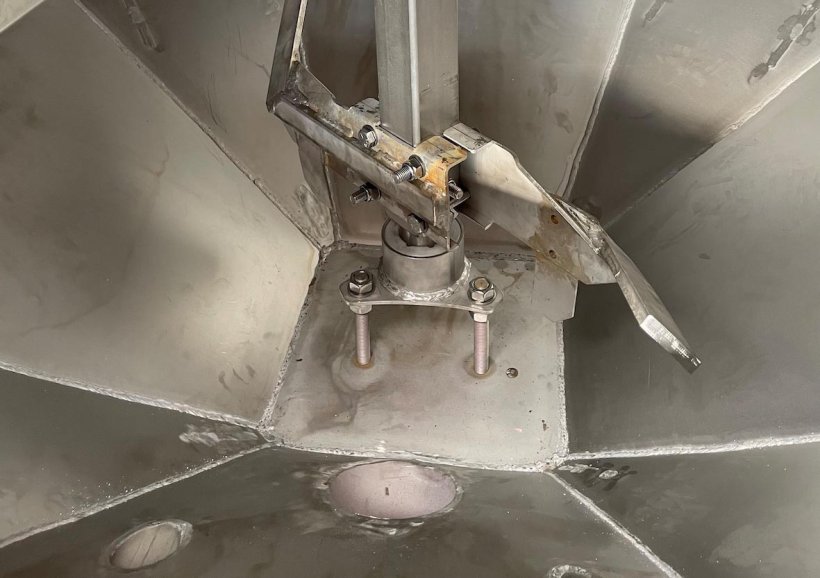 To make this possible, the lower support of the agitator shaft has been completely redesigned mechanically: thanks to a special split support, the bearing can be removed sideways after loosening the bolts.
Optimized flow geometry
The redesigned conical shape of the tank and a specially adapted agitation system improve flow behavior. The feed components are homogenized more quickly, and deposits on the tank walls are effectively minimized.
Special features and benefits at a glance
- Maximum safety and accident prevention: operators no longer need to enter the tank to carry out cleaning and maintenance tasks. This reduces the risk of suffocation from unnoticed fermentation gases.
- Significantly improved ergonomics by eliminating heavy work at height and the need to climb inside a narrow tank.
- Enormous savings in maintenance and servicing: the plant operator can replace the bottom bearing quickly and easily, without needing factory technicians or special lifting equipment.
- Maximum operational reliability: power supply system downtime during maintenance tasks is reduced to a minimum, thereby ensuring the supply to the animals.
- Thanks to the improved tank geometry and the flow-optimized agitator, mixing is improved and component separation processes are prevented.
September 2026 - WEDA Dammann & Westerkamp