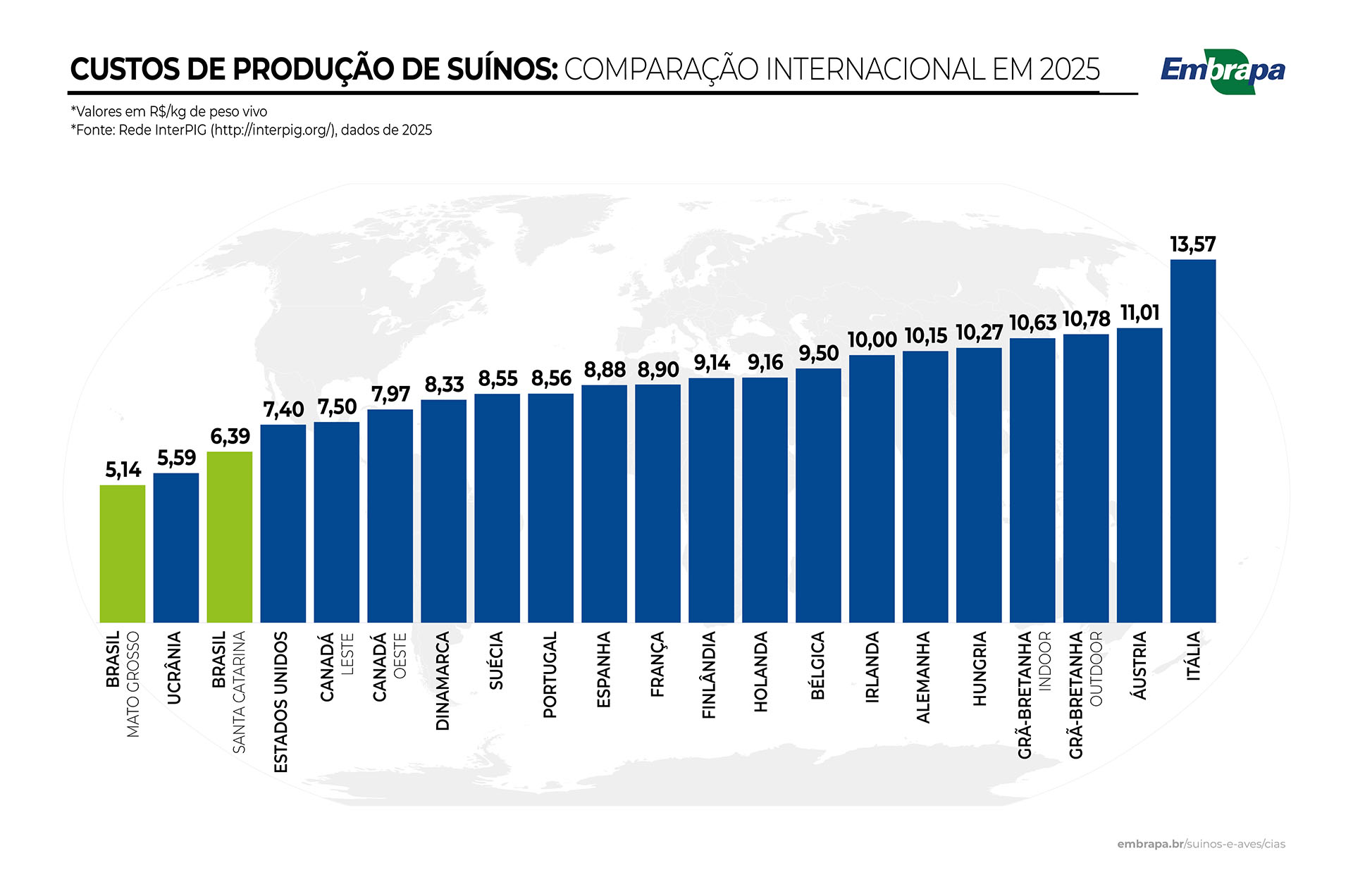
Pig farming in Mato Grosso maintained, in 2025, the lowest production costs for live pigs among the countries analyzed by the international InterPIG network. Ukraine, Santa Catarina, the United States and Canada followed. The results were presented at the network’s annual meeting, held from 7 to 9 July in Carlow, Ireland. The event was organized by the Agriculture and Food Development Authority (Teagasc), with support from the Irish Farmers’ Association (IFA).
The InterPIG network is an independent forum that brings together research institutions to compare the costs and competitiveness of pig production in different countries. Work began in 2003, and the network currently covers 19 pork-producing countries: 16 European countries, two North American countries and Brazil. Embrapa Swine and Poultry represents the country in the initiative.
According to researcher Marcelo Miele of Embrapa Swine and Poultry, the main aim of the work is to provide stakeholders in Brazil’s production chain with information on the competitiveness of its main international competitors. To make the results more accessible, Embrapa produced a report in Portuguese with cost estimates in reais per kilogram of live weight and an analysis of the data. The publication is available here.
The InterPIG network’s portal also provides cost estimates between 2020 and 2025, expressed in euros per kilogram of carcass weight, as well as downloadable data and information about the initiative.
Sources of Brazil’s cost advantage
The cost advantage of Brazilian pig farming in 2025 was based on feed prices in Mato Grosso (only higher than feed prices in Ukraine, in feed conversion in Santa Catarina), which offset feed prices close to those of major European producers, better zootechnical performance indicators than the average for other countries, as well as lower costs for facilities and equipment and labor remuneration.
In Santa Catarina and most European countries, the main factors driving up total costs in 2025 compared with the previous year were labor, variable costs not related to feed, and depreciation and interest expenses associated with the increased value of facilities and equipment. In Mato Grosso, the United States, and eastern Canada, feed prices had the greatest influence on changes in costs from one year to the next.
Exchange rate fluctuations affected the comparison of costs between countries in 2025. In Brazil, the depreciation of the real against the US dollar and the euro boosted the competitiveness of domestic production, mitigating the effects of increases in domestic prices in reais. The same occurred with the competitiveness of North American countries due to the depreciation of the US dollar and the Canadian dollar against the euro.
Partnerships ensure Brazilian data
The InterPIG network meeting takes place annually and brings together representatives of leading research institutions that study the competitiveness of pig farming in producer countries.
Embrapa Swine and Poultry prepares the Brazilian estimates for two states. In Santa Catarina, the work is carried out in partnership with the Cooperativa de Produção e Consumo Concórdia (Copérdia) and uses data from the Centro de Socioeconomia e Planejamento Agrícola (Epagri/Cepa). In Mato Grosso, the partners are the Instituto Mato-grossense de Economia Agropecuária (IMEA) and the Associação dos Criadores de Suínos do Mato Grosso (Acrismat).
10 of November 2026/ Embrapa/ Brazil.
https://www.embrapa.br