
Huatai Securities' research report stated that as of the 11 month 9 day, the national average hog price reported by Yongyi was 8.6 yuan per kilogram, falling below the previous low of this cycle. Huatai Securities believes that the recent second bottom in hog prices has exceeded market and industry expectations, mainly because industry supply and inventory pressures remain high while consumer demand is weak. It is now largely established that the hog farming industry will not see a strong peak-season market in the fourth quarter. Looking ahead, as hog andpigletPig pricesPrices have once again hit a new low. Worsening cash-flow losses across the industry may drive greater-than-expected reductions in the capacity of breeding sows, creating room for greater and more sustained upside in hog prices further out. Meanwhile, sector holdings remain relatively low. Huatai Securities reiterates the investment opportunity in the hog sector.
Full text follows
Huatai | Agriculture: A second bottoming in hog prices is accelerating capacity reductions again
As of 11 month 9, the national average hog price reported by Yongyi was 8.6 yuan/kg, falling below the previous low of this cycle. We believe the recent second bottoming of hog prices has exceeded market and industry expectations, mainly because industry supply and inventory pressures remain high while consumer demand is relatively weak. It is now largely established that the peak season for the hog farming industry in Q4 has failed to materialize. Looking ahead, as hog prices andpigletspriceshit new lows again, cash flow losses across the industry have worsened, potentially driving breeding sow capacity reductions to exceed expectations and creating room for greater magnitude and persistence in hog prices over the longer term. Meanwhile, sector holdings remain relatively low. We reiterate the investment opportunity in the hog sector.
Supply remains high while demand is weak, and hog prices are testing their lows for a second time
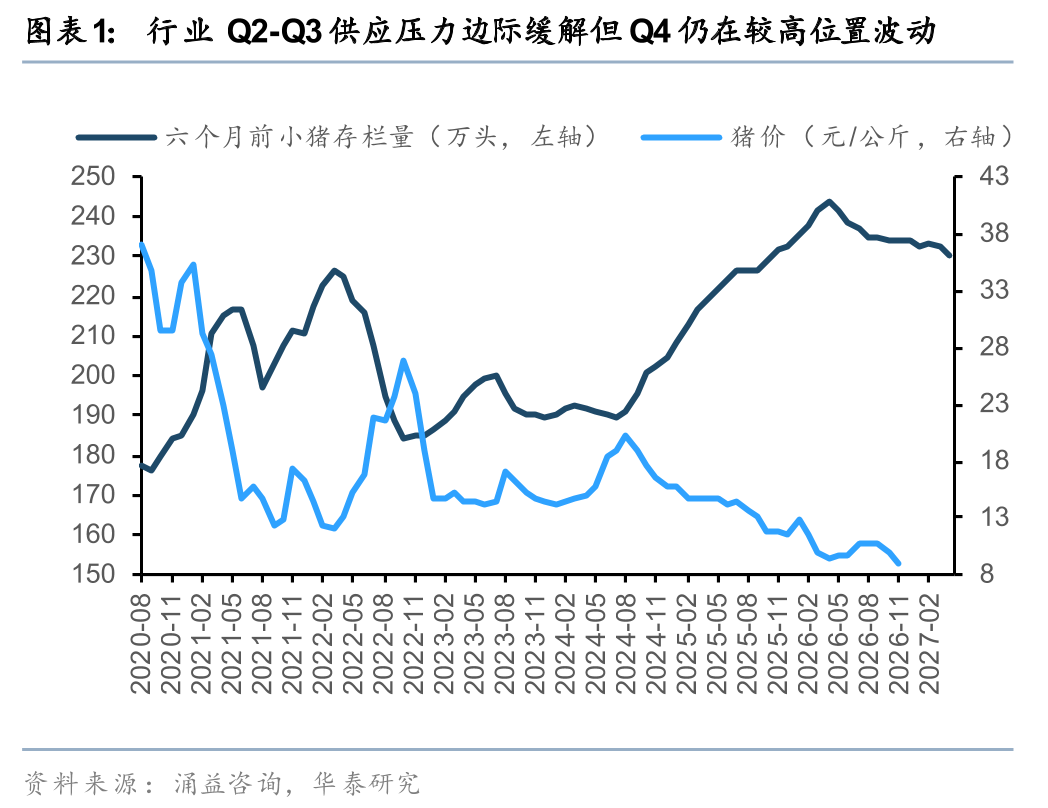
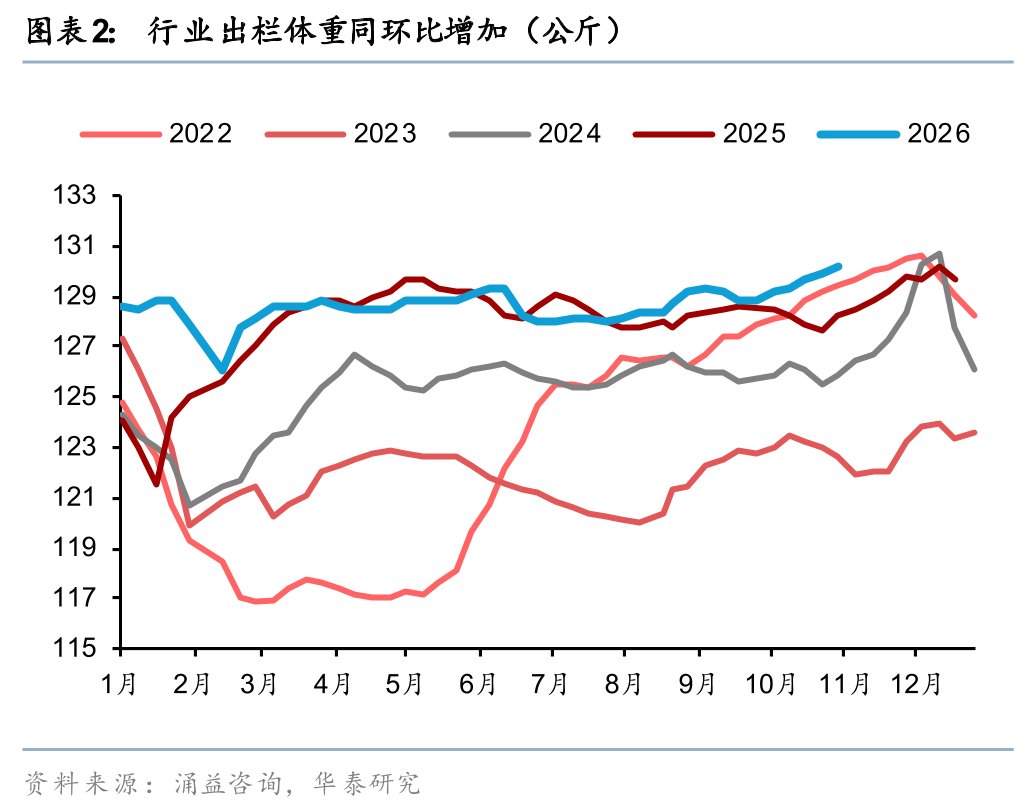
As of 11 month 9, Yongyi's national average live hog price was 8.6 yuan/kg, falling below the 4-month low of 8.7 yuan/kg (the previous low in this cycle). After the National Day holiday, falling spot prices for live hogs drove a sharp downward correction in futures prices, reflecting that the current second test of the lows in hog prices has indeed exceeded market and industry expectations. We believe that supply pressure in the industry eased marginally in Q2-Q3, but Q4 still fluctuated at a relatively high level. Combined with inventory pressures easing more than peak-season demand recovered, hog prices failed to strengthen during the peak season and tested their lows for a second time. A new round of demand support has yet to arrive after the two holidays, and industry inventories have once again accumulated involuntarily. According to Yongyi Consulting, the industry's slaughter volume from 10 to 11 9 fell 7% year over year, hog prices fell 18% year over year, and the loss per head for farrow-to-finish operations widened by 164 yuan/head, reflecting weaker year-over-year absorption capacity on the slaughtering end. Meanwhile, as prices and slaughter volumes both fell, the industry's average hog weight at sale continued to increase both year over year and month over month. As of 11 month 5, Yongyi's industry hog weight at sale was up +1.5% year over year and had increased for six consecutive weeks month over month, indicating that the industry's live inventory is still accumulating involuntarily. No bottoming signal has emerged for hog prices in the short term. We expect the industry's hog price midpoint in 26Q4-27Q1 to remain below the industry's cash cost.
Worse-than-expected losses are accelerating capacity reductions again, with potential for a strong cyclical reversal
From 10 to 11 9, hog prices were again significantly below the industry's cash cost line of 11 yuan/kg. As of 11 month 3, Yongyi's large-scale farms, 7 kgPigletPork pricesfell to 86 yuan/head, setting a new low for the past five years. The peak season for market hogs was weaker than expected, compounded by deep losses in piglets, strengthening the industry's capacity reduction rationale. The extremely lowpigletPig pricesThis also reflects the industry’s pessimistic expectations for future hog prices and tight cash flow. The larger-than-expected losses have also accelerated the industry’s capacity reduction. According to Mysteel, the month-on-month change in breeding sows in 10 was -1.6%, accelerating from -0.9% in 9. As of the end of 26Q3, the cumulative reduction in the National Bureau of Statistics’ quarter-end breeding sow inventory, measured from the peak of the current cycle, had reached 10.9% (compared with 8.3% and 9.1% on the same basis in 21 and 23, respectively). 26Q4–27Q1 is still expected to contribute a relatively greater reduction than in 21 and 23. The reduction in breeding sows over the entire cycle may be significantly greater than in 21 and 23, strengthening the upside potential of hog prices and the durability of profitability in 27–28.
Pork prices, sector valuations, and holdings remain at low levels; we reiterate the opportunity to build positions.
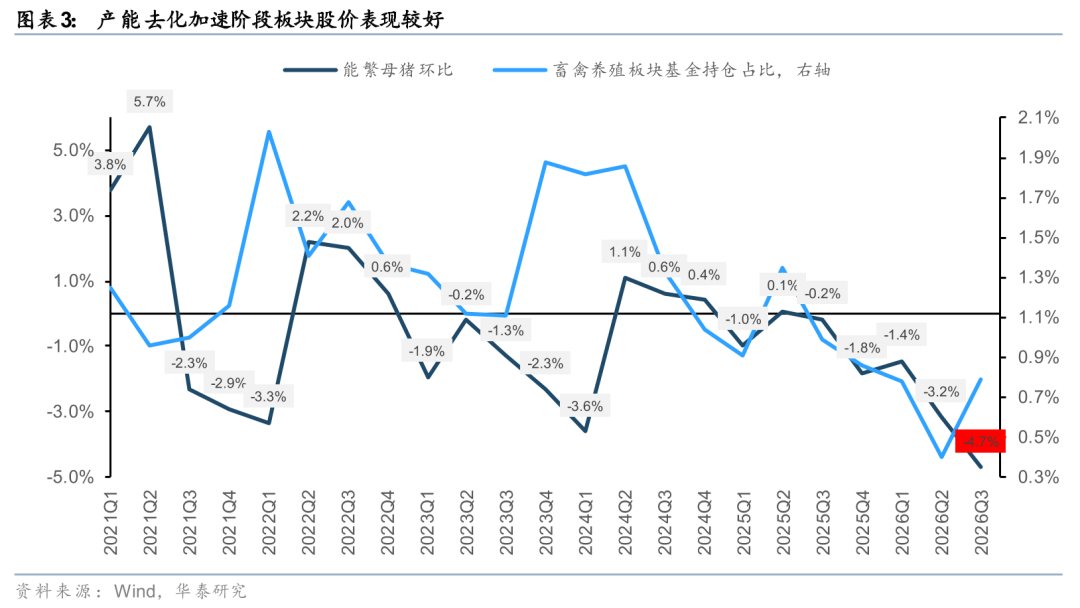
Reviewing holdings in the livestock farming sector and the pace of capacity reduction since 21, stock prices have often begun to recover ahead of hog prices, with holdings rebounding noticeably as capacity reduction accelerated. As of 26Q3, fund holdings in the livestock and poultry farming sector accounted for 0.8%, up 0.4pct quarter over quarter, though the holdings share remained at a historical low. As of 11 month 9, the five-year PB-MRQ percentile of the livestock and poultry farming (Changjiang) Index also remained relatively low at 36%. The industry’s unexpectedly renewed decline in hog prices and accelerating losses in 26Q4 are expected to further accelerate capacity reduction. The potential magnitude and durability of a cyclical reversal may further increase, and we reiterate the opportunity to build positions in the sector ahead of a recovery.
Investment conclusion
Since 10 month, hog prices have hit a second bottom, falling further than the market and industry expected. As hog prices andCarefulPig pricesThe industry has once again hit a new low, and cash flow losses have deepened. This may drive a greater-than-expected decline in productive sow capacity, creating room for future hog price elasticity and sustained gains. A review shows that sector holdings rebounded more noticeably when capacity reduction accelerated, while they remain relatively low at present. We reiterate the opportunity to position in the hog sector.
Risk warning: Risks from fluctuations in pig prices, animal diseases, slower-than-expected reduction in breeding sow capacity, capacity regulation policies falling short of expectations, and hog companies’ marketings or costs falling short of expectations.
Full text follows
Huatai | Agriculture: A second bottoming in hog prices is accelerating capacity reductions again
As of 11 month 9, the national average hog price reported by Yongyi was 8.6 yuan/kg, falling below the previous low of this cycle. We believe the recent second bottoming of hog prices has exceeded market and industry expectations, mainly because industry supply and inventory pressures remain high while consumer demand is relatively weak. It is now largely established that the peak season for the hog farming industry in Q4 has failed to materialize. Looking ahead, as hog prices andpigletspriceshit new lows again, cash flow losses across the industry have worsened, potentially driving breeding sow capacity reductions to exceed expectations and creating room for greater magnitude and persistence in hog prices over the longer term. Meanwhile, sector holdings remain relatively low. We reiterate the investment opportunity in the hog sector.
Supply remains high while demand is weak, and hog prices are testing their lows for a second time
As of 11 month 9, Yongyi's national average live hog price was 8.6 yuan/kg, falling below the 4-month low of 8.7 yuan/kg (the previous low in this cycle). After the National Day holiday, falling spot prices for live hogs drove a sharp downward correction in futures prices, reflecting that the current second test of the lows in hog prices has indeed exceeded market and industry expectations. We believe that supply pressure in the industry eased marginally in Q2-Q3, but Q4 still fluctuated at a relatively high level. Combined with inventory pressures easing more than peak-season demand recovered, hog prices failed to strengthen during the peak season and tested their lows for a second time. A new round of demand support has yet to arrive after the two holidays, and industry inventories have once again accumulated involuntarily. According to Yongyi Consulting, the industry's slaughter volume from 10 to 11 9 fell 7% year over year, hog prices fell 18% year over year, and the loss per head for farrow-to-finish operations widened by 164 yuan/head, reflecting weaker year-over-year absorption capacity on the slaughtering end. Meanwhile, as prices and slaughter volumes both fell, the industry's average hog weight at sale continued to increase both year over year and month over month. As of 11 month 5, Yongyi's industry hog weight at sale was up +1.5% year over year and had increased for six consecutive weeks month over month, indicating that the industry's live inventory is still accumulating involuntarily. No bottoming signal has emerged for hog prices in the short term. We expect the industry's hog price midpoint in 26Q4-27Q1 to remain below the industry's cash cost.
Worse-than-expected losses are accelerating capacity reductions again, with potential for a strong cyclical reversal
From 10 to 11 9, hog prices were again significantly below the industry's cash cost line of 11 yuan/kg. As of 11 month 3, Yongyi's large-scale farms, 7 kgPigletPork pricesfell to 86 yuan/head, setting a new low for the past five years. The peak season for market hogs was weaker than expected, compounded by deep losses in piglets, strengthening the industry's capacity reduction rationale. The extremely lowpigletPig pricesThis also reflects the industry’s pessimistic expectations for future hog prices and tight cash flow. The larger-than-expected losses have also accelerated the industry’s capacity reduction. According to Mysteel, the month-on-month change in breeding sows in 10 was -1.6%, accelerating from -0.9% in 9. As of the end of 26Q3, the cumulative reduction in the National Bureau of Statistics’ quarter-end breeding sow inventory, measured from the peak of the current cycle, had reached 10.9% (compared with 8.3% and 9.1% on the same basis in 21 and 23, respectively). 26Q4–27Q1 is still expected to contribute a relatively greater reduction than in 21 and 23. The reduction in breeding sows over the entire cycle may be significantly greater than in 21 and 23, strengthening the upside potential of hog prices and the durability of profitability in 27–28.
Pork prices, sector valuations, and holdings remain at low levels; we reiterate the opportunity to build positions.
Reviewing holdings in the livestock farming sector and the pace of capacity reduction since 21, stock prices have often begun to recover ahead of hog prices, with holdings rebounding noticeably as capacity reduction accelerated. As of 26Q3, fund holdings in the livestock and poultry farming sector accounted for 0.8%, up 0.4pct quarter over quarter, though the holdings share remained at a historical low. As of 11 month 9, the five-year PB-MRQ percentile of the livestock and poultry farming (Changjiang) Index also remained relatively low at 36%. The industry’s unexpectedly renewed decline in hog prices and accelerating losses in 26Q4 are expected to further accelerate capacity reduction. The potential magnitude and durability of a cyclical reversal may further increase, and we reiterate the opportunity to build positions in the sector ahead of a recovery.
Investment conclusion
Since 10 month, hog prices have hit a second bottom, falling further than the market and industry expected. As hog prices andCarefulPig pricesThe industry has once again hit a new low, and cash flow losses have deepened. This may drive a greater-than-expected decline in productive sow capacity, creating room for future hog price elasticity and sustained gains. A review shows that sector holdings rebounded more noticeably when capacity reduction accelerated, while they remain relatively low at present. We reiterate the opportunity to position in the hog sector.
Risk warning: Risks from fluctuations in pig prices, animal diseases, slower-than-expected reduction in breeding sow capacity, capacity regulation policies falling short of expectations, and hog companies’ marketings or costs falling short of expectations.