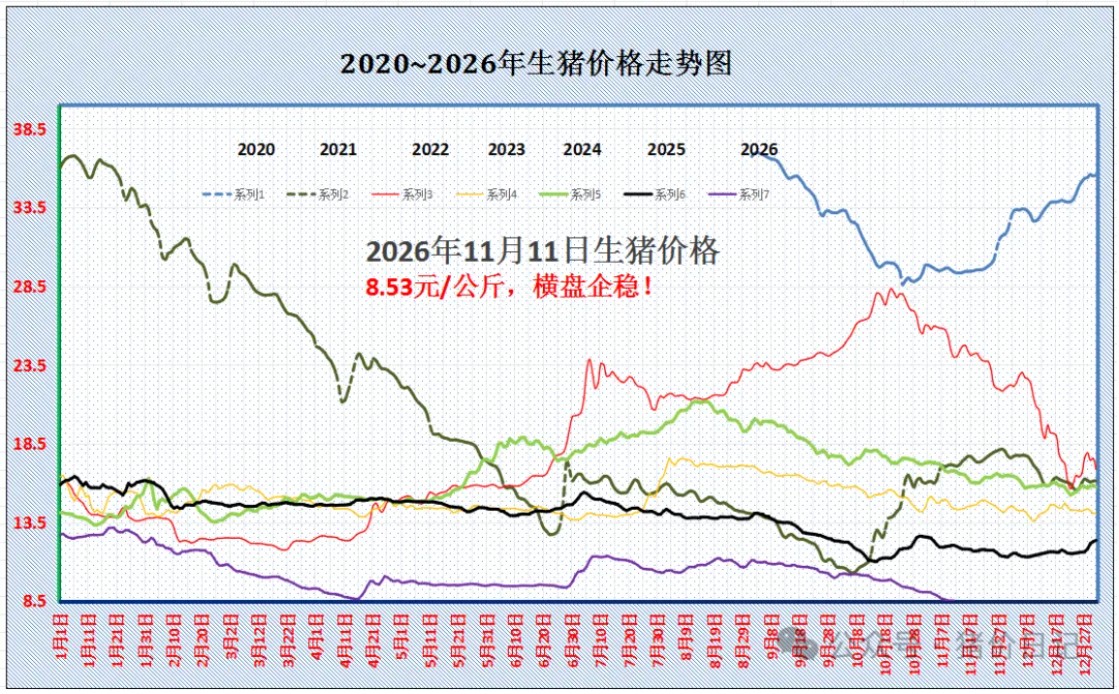
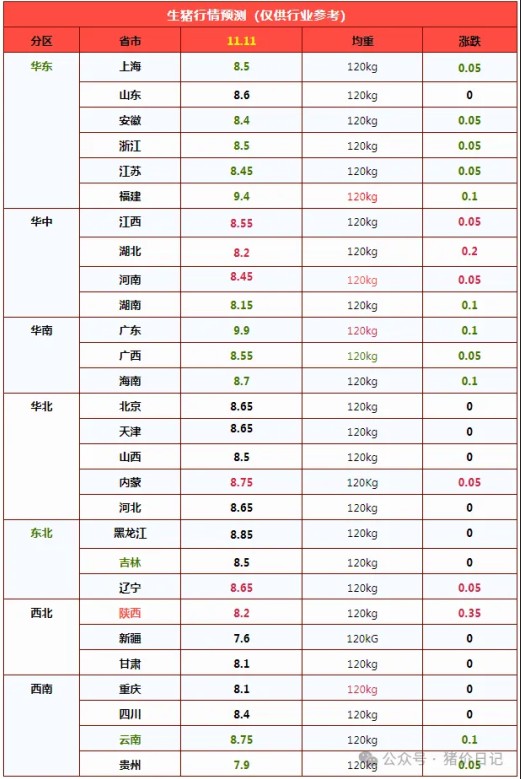
Accordingly, the current supply of live pigs is ample, but demand support at the margin is also improving slowly. With both supply and demand increasing, market sentiment has improved somewhat! The live pig market may be forming a bottom. As demand recovers further, prices may recover from the bottom, but heavy pressure on the supply side may limit the scope for a market rebound. The live pig market is unlikely to see a sharp surge after an “oversold” decline!
Domestic live pig production capacity continued to be released in 2026, resulting in an oversupply of pork and pushing fresh and frozen product prices to low levels. The domestic-foreign price gap gradually narrowed, with some products even trading at a “reverse price spread,” weakening the price advantage of imported pork. Total pork imports in the first three quarters of 2026 continued to decline, reaching the lowest level for the same period in nearly five years. Looking ahead to 2027, the ample domestic supply situation is unlikely to change, and pork imports will probably continue to contract, though the decline may narrow.
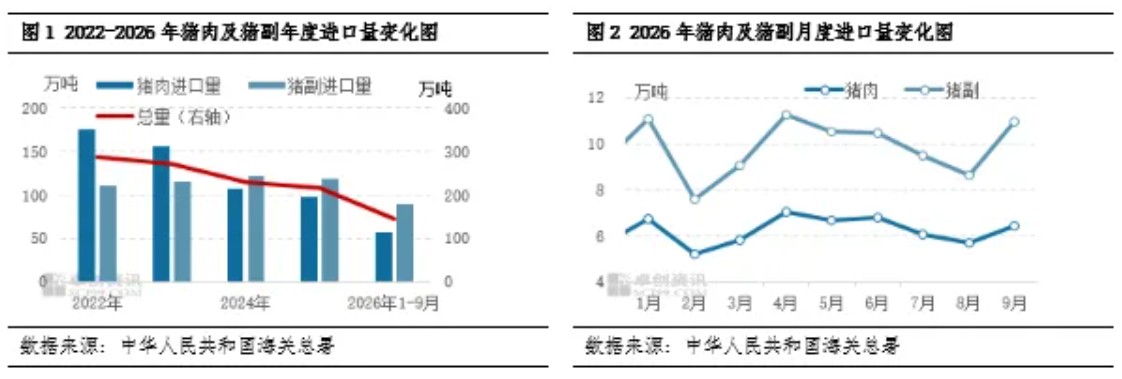
As shown in Figure 1, total domestic pork imports continued to decline from 2022 to 2026, while the pace of adjustment narrowed during the year. According to data from the General Administration of Customs of the People's Republic of China, China imported 56.48 ten thousand metric tons of pork from 1 to 9 2026, down 28.12% from the same period last year. Imports were highest in 4, at 7.04 ten thousand metric tons, and lowest in 2, at 5.21 ten thousand metric tons. Average monthly imports were 6.28 ten thousand metric tons. Total imports of pork by-products were 88.96 ten thousand metric tons, down 2.70% from the same period last year. Monthly imports were highest in 4, at 11.27 ten thousand metric tons, and lowest in 2, at 7.59 ten thousand metric tons. Average monthly imports were 9.88 ten thousand metric tons.
By month, pork and pork by-product imports from 1 to 9 2026 both followed a pattern of “increase-decrease-increase-decrease-increase.” In 1, imports edged up due to pre-holiday stockpiling. 2 coincided with the Spring Festival, when many importers and market stalls were closed for the holiday; demand was also weak after the holiday, and imports fell markedly. From 3 to 4, downstream customers such as food manufacturers and traders made concentrated purchases. Importers secured supplies in advance, and imports rose to their annual peak. Thereafter, as prices for domestically produced live pigs and fresh pork fell to historic lows, expectations of future price increases weakened across the industry, and imports of pork and pork by-products continued to decline. In 9, stockpiling for the Mid-Autumn Festival and National Day holidays led importers to maintain some expectations of rising prices, and arrivals increased again.
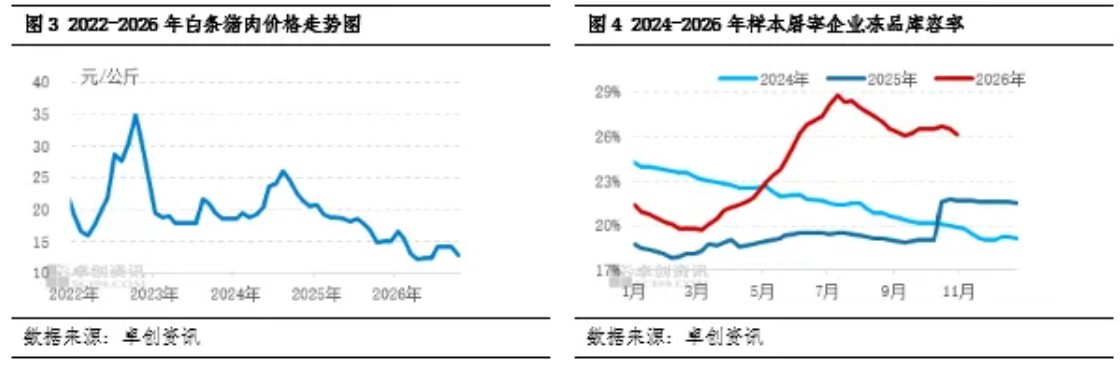
On the one hand, imports of pork and pork offal in the first three quarters of 2026 fell to a five-year low, mainly for three reasons: first, domestic pork supplies were ample, further reducing reliance on imports; second, the price gap between domestic and overseas markets narrowed or even “inverted,” while import costs rose as EU anti-dumping measures remained in place during the year, squeezing importers’ margins, with some already operating at a loss; third, end-market demand was weak, downstream customers became more cautious in their purchasing, and imported products sold more slowly. As shown in Figures 3 and 4, slaughterhouse inventories were high in 2026, while domestic prices for fresh and frozen cuts both fell to low levels. Industry expectations for future price increases weakened, further slowing the absorption of imported products. To ease inventory pressure, importers lowered prices to move volume, and import prices also declined gradually during the year.
On the other hand, since imports of pork offal exceeded pork imports in 2024, the gap between the two had widened further by 2026. This was mainly due to differences between Chinese and Western dietary habits. Major pork-importing countries and regions such as Europe and the United States generally do not consume pork offal, and local disposal would incur certain costs. As a result, pork offal has more room for price concessions than pork, leading to a smaller decline in imports of pork offal.
Internationally, according to forecasts by the U.S. Department of Agriculture, pork production and exports in countries and regions such as the United States and the European Union will both increase in 2027, which may provide some support for Chinese pork imports. In terms of domestic supply, the release of domestic production capacity will ease slightly in 2027, but overall levels will remain relatively high. Slaughterhouse frozen-product inventories are also high, and 2027 will be a year of concentrated shipments. Domestic fresh and frozen pork supplies will be relatively ample in 2027. Domestic pork prices will rise slowly from low levels but remain relatively low overall, so imported products are unlikely to gain a significant price advantage. Meanwhile, port inventories of offal and pig hocks are also high. With the main consumer group shifting and residents’ dietary preferences changing, annual frozen-product consumption is below expectations. Sales of imported products are unlikely to improve, and importers’ profitability is poor; they may purchase cautiously, constraining pork imports.
Overall, Zhuochuang Information expects that imports of pork and pork by-products in 2027 may continue to decline. Imports of pork by-products may show little year-on-year change, while pork imports may fall by 5%-10%, and the decline in total imports may remain within 4%.
Liquidity Mismatch Risks Come to the Fore: An Analysis of Debt Pressure and Valuation Divergence Among Listed Pig Farming Companies
In the third quarter of 2026, financial reports were released by 23 major domestic listed pig farming companies. Prolonged losses have continued to erode operating cash flows, passively worsening balance sheets across the industry. Rising total debt, a high proportion of short-term debt, and insufficient cash coverage of maturing debt have become the industry’s most significant constraints. The simultaneously released 2026 Hurun China Rich List confirms, from the perspective of equity valuation, the capital revaluation caused by the downturn: the combined wealth of 16 entrepreneurs on the list from the pig industry chain fell by 521 billion yuan, with the sector’s valuation correction and fundamental pressures reinforcing each other. Unlike previous cycles, in which spontaneous capacity reduction was the central mechanism, at the bottom of this cycle, access to financing, debt maturity structure, and refinancing costs have surpassed production costs alone as the key factors determining which entities survive and how market shares are redistributed.
I. Aggregate Balance Sheet Characteristics: Assets Contract Passively, Liabilities Rise Rigidly, and the Industry’s Leverage Center Continues to Move Up
This sample covers 23 major domestic listed pig farming companies, representing a range of business models, including integrated self-breeding and self-raising, “company + farmer,” and businesses with supporting feed and slaughtering operations, and is broadly representative of the industry. As of the end of the third quarter of 2026, the sample’s total assets amounted to 6483.89 billion yuan, down 10.37 billion yuan from the end of the first half of 2026; total liabilities amounted to 3910.00 billion yuan, up 10.53 billion yuan over the same period. The contraction in assets and expansion in liabilities created a gap in opposite directions, resulting from the combined effects of asset impairment, reduced capital expenditure, and the rollover of existing debt at the bottom of the cycle. Farming assets are difficult to liquidate, and depreciation on heavy assets is inflexible. Amid continued losses, companies cannot accumulate net assets through internally generated profits; instead, they rely on additional debt to cover operating net outflows and maturing debt, leading to a passive increase in leverage.
Clear leverage tiers: The average asset-liability ratio of sample companies rose from 64.18% at the end of the second quarter to 64.79%.
More than half of the entities have high leverage: 13 companies have an asset-liability ratio >60%, accounting for 56.52% of the sample; 19 companies have remained on an upward trend in their debt ratios since the beginning of the year. High leverage is a common industry characteristic, not an operational failure by individual companies;
High-risk range (debt ratio >80%): Tianbang Food, Wufeng, Jinnong, and Tianyu Bio, with Tianbang Food reaching 91.84%, close to the threshold for insolvency. Its net asset safety buffer is extremely thin, and expectations for debt restructuring and equity replenishment are strong;
Medium-to-high leverage range (60%–80%): Juxing Agriculture and Animal Husbandry, Tangrenshen (70%–80%); Da Bei Nong, New Hope, Aonong Biotechnology, Hu Tong Co., Jingji Zhinong, ST Longda, and Keming Food (60%–70%);
Risk mitigation example: ST Longda, through the implementation of judicial restructuring, saw its debt-to-asset ratio fall from above 80% in the first half of the year to 62.92%. It is a typical case in this cycle of optimizing the asset-liability structure through debt restructuring and creditor concessions, providing a reference path for highly leveraged entities.
Compared with historical cycles, during the bottom phase of the previous cycle, the average debt-to-asset ratio of leading listed hog companies was mostly stable at below 60%. In this cycle, the leverage midpoint has continued to rise. The key underlying factors are that this cycle’s bottom has lasted longer, hog prices have remained anchored near the full-cost line over an extended period, EBITDA from hog farming has continued to weaken, and operating cash flow has been insufficient to cover interest, depreciation, and capital expenditure, leaving companies reliant on external financing to maintain operations.
II. Liquidity risk at the core: short-term debt concentration is relatively high, cash coverage capacity varies, and rollover risk is prominent
Compared with the total liabilities reported on the balance sheet, the mismatch in debt maturities is currently the most prominent structural risk in the industry. The sample of 23 companies has total short-term interest-bearing debt of 2846.14亿元, accounting for 72.29% of total liabilities, with more than seventy percent of debt due within one year. The general industry risk-control monitoring threshold for the short-term debt ratio is 60%; 19 companies exceed this threshold, representing 82.61% of the sample. Breakdown by maturity structure: Muyuan Foods’ short-term debt ratio rose from 79.78% in the second quarter to 91.23%; the short-term debt ratios of Haid Group, Lihua, Jingji Zhinong, ST Longda, and Tech-Bank Food exceed 80%; those of Jinnong, Da Bei Nong, Aonong Biotechnology, and Hu Tong fall between 70%–80%.
Using the short-term debt/cash funds ratio to measure the immediate debt repayment buffer, the overall ratio for the sample was 5.92; 20 companies had a ratio >4, meaning their cash funds on the books were insufficient to cover one quarter of maturing short-term debt, indicating a significant immediate liquidity shortfall. Among the most extreme cases, Tianbang Food had short-term debt of 74.88亿元 and cash funds of only 0.58亿元, with a short-term debt cash coverage ratio of 129 times; Lihua shares had a ratio of 32.41 times; and the coverage ratios of Jinnong, ST Longda, Jingji Zhinong, and Wen’s Food were all higher than 10 times.
Underlying mechanism: Pig farming is a capital-intensive industry with highly seasonal cash flow. Under normal cycle conditions, the orderly marketing of hogs generates steady cash receipts, and companies roll over short-term debt through operating cash flow combined with bank working-capital loans and bond reissuance. An excessively prolonged loss cycle breaks this loop: the more hogs marketed, the greater the cash outflow from losses in gross profit per unit. At the same time, financial institutions become less willing to take risks with highly leveraged farming entities; credit lines are reduced, refinancing terms become stricter, and financing costs rise, weakening the resilience at the margin of the “borrow new to repay old” rollover chain.
Fundamentals outlook: The boost to consumption from cured meat is weaker than in the same period historically, and hog prices lack a basis for a sustained upward trend. In the fourth quarter of 2026, the livestock farming sector will most likely continue to experience net operating cash outflows. The scope for a recovery in internally generated cash flow is limited, and short-term liquidity pressures are unlikely to ease on their own.
Three. Valuation mapping: The Hurun Rich List reflects a revaluation of wealth in the sector, while business structure determines resilience across economic cycles.
2026The Hurun China Rich List provides cross-validation from the perspective of equity value. The combined wealth of 16 entrepreneurs associated with the pig industry chain on the list shrank by 521亿元, a decline of 8.4%. Most moved down the rankings. Wang Degen and Zhang Qiang of Dekon Agriculture and Animal Husbandry fell by more than 400 places, reflecting the capital market’s valuation discount for the bottom of the hog cycle and high debt risks.
The segment shows a clear internal hierarchy: resilience to economic cycles is strongly correlated with business diversification.
The integrated leader’s foundation remains solid: Muyuan’s Qin Yinglin and his wife Qian Ying rank 19th overall with 1550 billion yuan, retaining their position as the richest in the agriculture and animal husbandry sector; Liu Yongxing and his son of East Hope, and the Liu Yonghao family of New Hope, remain among the top one hundred, with both families’ wealth staying at the trillion-yuan level. The wealth of Qin Yinglin and his wife decreased by 325 billion yuan year on year, corresponding to a valuation reduction amid continued losses in the core livestock-farming business;
The feed business has hedging characteristics: its cash flow is significantly more stable than that of hog fattening. Haid Group’s profit for the first three quarters exceeded 29 billion yuan, and 3 entities in the sector made the list, highlighting its defensive characteristics;
Scarce positive-return assets: Twin Brothers’ couple Bao Hongxing and Yisheng Shares’ Cao Jisheng were the only entities among 16 people to record positive wealth growth, increasing by 20 hundred million yuan and 14 hundred million yuan, respectively. Their gains came from earnings in non-hog businesses such as the poultry chain, breeding stock, and feed, which offset losses.
From a cross-sector comparison perspective, valuations in new quality productive forces sectors such as AI and semiconductors are rising, in sharp contrast with valuation pullbacks in the agriculture and livestock cycle sectors. However, leading agriculture and livestock companies, supported by their industrial scale, strategic positions in the industry chain, and long-term financing channels, have not seen their capital base collapse and remain an important part of China’s private-sector industrial capital.
Four. Governance risks compound at the bottom of the cycle: internal control and compliance incidents raise financing premiums for entities
During an industry downturn, the spillover effects of corporate governance and executive personal risks are amplified, in addition to operational and financial risks. Less than a month after Zhu Wenwen, a deputy general manager of Huaitong Co., Ltd., was placed under compulsory measures by the public security authorities, the company announced Zhu’s resignation. The company stated that the matter was personal and unrelated to the listed company’s operations, and that the position handover had been completed; after resigning, Zhu continued to hold a position at another entity within the group. From a capital markets and disclosure compliance perspective, this is a typical risk-isolation measure: removing an executive from a key management role cuts off the channel through which personal legal risks could be transmitted to the listed company, reducing potential negative impacts on information disclosure, bank credit facilities, supply chain agreements, and public bond financing. This case carries significance as an industry signal: amid tighter risk controls on pig farming companies by financial institutions, any internal control deficiency, executive risk, or public opinion event can directly raise an entity’s financing premium or even trigger loan recalls or a suspension of lending. Financially vulnerable companies are significantly more sensitive to risk than during an industry upturn.
Five. Cycle outlook: This round of market clearing is driven by capital constraints, and differentiation will continue to intensify.
In previous hog cycles, the main driver of capacity reduction was voluntary contraction prompted by operating losses. The constraints have changed fundamentally in this cycle: even if companies are willing to bear temporary losses, once financing channels close and debts fall due in concentrated amounts, they will be forced to exit. Capital constraints outweigh cost constraints—this is the defining feature of the current cycle. The industry is expected to diverge along three paths:
Leading integrated player: Leveraging its credit standing and diversified financing instruments (industrial bonds, supply chain finance, equity financing, and group credit facilities) to roll over short-term debt and buy time, it gains market share as small and midsize players exit the market. However, the high proportion of short-term debt also signals increased liquidity vulnerability and continued reliance on a stable external financing environment.
Highly leveraged listed entities (debt ratio >80%, insufficient cash coverage): Their continued operation depends heavily on capital operations such as debt restructuring, debt-to-equity swaps, the introduction of strategic investors, and asset sales. ST Longda’s restructuring model will become the preferred option for similar targets; passive capacity reduction and asset disposals will become the norm;
Diversified business segments: Non-fattening-pig businesses such as feed, white-feather poultry, breeding pigs, and food processing generate a stable pool of cash flow, offsetting losses in the farming segment. Their cash flow is less volatile, refinancing is less difficult, and they have greater resilience to survive at the bottom of the cycle.
The medium- to long-term supply outlook ultimately still depends on a sustained reduction in the breeding sow population, but debt pressure will accelerate the exit of inefficient capacity. The industry’s profit inflection point will be sustainable only if two conditions are met simultaneously: first, the reduction in breeding capacity leads to a contraction in live pig supply, with pig prices recovering to above full cost; second, companies use the profitability window to replenish net assets, extend debt maturities, repair their balance sheets, and reduce the risk of maturity mismatches. Until balance sheet repair is complete, even if prices rebound temporarily, most of the gains from improved corporate profitability will be used first to pay interest and reduce short-term debt, while profit leverage will be eroded by debt costs.