
Production of compound feed in France fell in August 2026, both compared with the previous month and with the same period last year. Volumes declined by 6,3% between July and August 2026, from 1 572 600 t to 1 473 500 t. The drop in production between August 2025 and August 2026 stands at 0,3%.
Read also: Animal feed: how is production in France changing between March 2025 and March 2026?
Since the start of the 2026-2027 season (June–August 2026), compound feed production in France has fallen by only 0,1% compared with the same period in 2025, compared with a decline of 0,5% recorded over the June–July 2025 and 2026 periods. This means that the production shortfall from one season to the next is narrowing.
Increase in compound feed production for ruminants in August 2026
According to the livestocksector, production changed in opposite directions between August 2025 and August 2026: down for poultry (- 3,1% to 613 500 t) and for pigs (- 6,9% to 305 600 t); up for feed for cattle (+ 8,8 %, to 442 200 t) and for feed for sheep and goats (+ 1,8 %, 45 700 t).
Between June-August 2025 and June-August 2026, the changes follow the same trends but to a lesser extent: down in poultry feed (- 2,3 % to 1 908 000 t) and pig feed (- 5,2 % to 949 200 t); up in cattle feed (+ 7,4 %, to 1 309 900 t) and sheep and goat feed (+ 1,1 %, 151 700 t).
The pastures for ruminants have indeed suffered from drought and the summer heatwave temperatures. To feed their livestock, farmers had no choice but to use up their reserves of hay and supplement the forage with compound feed.
Bullish outlook for cattle, sheep and goat feed
This year, if production from the permanent grasslands was higher than that of 2025 through May 2026 (51,7% of the annual reference production, compared with 49,9% in May 2025), the trend has since reversed and worsened, according to the monthly economic outlook note from Agreste. Grassland production as of 31 October 2026 stands at only 57,5%, compared with 87,3% at the same time last year.
In this context, the production of compound feed for cattle and sheep-goats should continue to increase.
Increase in animal feed prices in August 2026
In August 2026, the animal feed price index (base 100 in 2020) rose overall by 1,3% month on month and by 1,4% year on year, with very contrasting trends across products, Agreste reports in its monthly economic outlook on agricultural production costs. It adds: “Prices of raw materials such as maize, soybeans and beet intended for animal feed are rising sharply, while compound feed prices are increasing more moderately and have stabilized year on year.” In detail, the price of forage maize rose by 10,2% month on month and 21,1% year on year in August 2026, following an increase of 6,7% month on month and 10,0% year on year in July 2026. Meanwhile, the price of soybean meal rose by 3,6% month on month and 8,9% year on year in August 2026, while that of beet pulp increased by 6,4% and 18,8% over the same periods.
Animal feed prices are expected to continue rising this autumn…
This increase in the animal feed price index, calculated by Agreste, is expected to continue over the coming months. Indeed, if we look at the trend in theIndex of prices of raw materials used in animal feed (IPAA), calculated by La Dépêche Le petit meunier, it can be seen that it rose from around 205 at the end of August 2026 to more than 220 in mid-October 2026 (base 100 in 2001).
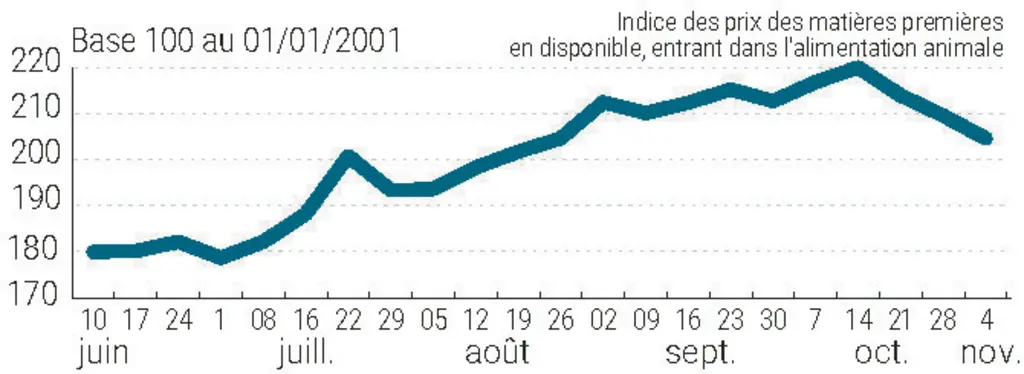
© La Dépêche Le petit meunier
This upward trend in raw material prices is confirmed by the Itavi indices (base 100 in 2020), regardless of the poultry concerned. For example, the raw material cost index for standard chicken feed rose steadily between August and October 2026, going from 125,79 to 136,99, respectively.
… before a potential decline this winter
However, the animal feed price index, calculated by Agreste, is expected to resume its downward trend at the end of this year or at least early next year, if we go by the decline that the IPAA began a month ago, following the downward reversal in prices for raw materials used in animal feed.
Read also: Grain and sugar market from 28 October to 4 November 2026 – Premiums continue to rise in response to falling Euronext soft wheat prices
A sharp drop in maize incorporation, offset by soft wheat and barley
This year’s disastrous maize harvest (-49%) led compound feed manufacturers to reduce the share of the cereal in their formulations by 30% (- 0,817 Mt, to 1,950 Mt) in 2026-2027, compared with the previous season, according to FranceAgriMer’s grain balance sheets. To compensate, they increased soft wheat incorporation by 11% (+ 0,5 Mt, to 5,2 Mt) and barley incorporation by 26% (+ 0,276 Mt, to 1,350 Mt.
Read also: French maize stocks at their lowest since 1990-1991, which could quickly be revised downwards, but comfortable reserves of straw cereals
These estimates of the use of the three main cereals by the animal feed industry were not revised by FranceAgriMer between September and October 2026.
In total (including oats, rye, sorghum and triticale), 9,150 Mt of cereals are expected to be incorporated into animal feed this season, compared with 9,173 Mt in 2025-2026, according to FranceAgriMer’s processing figures.