
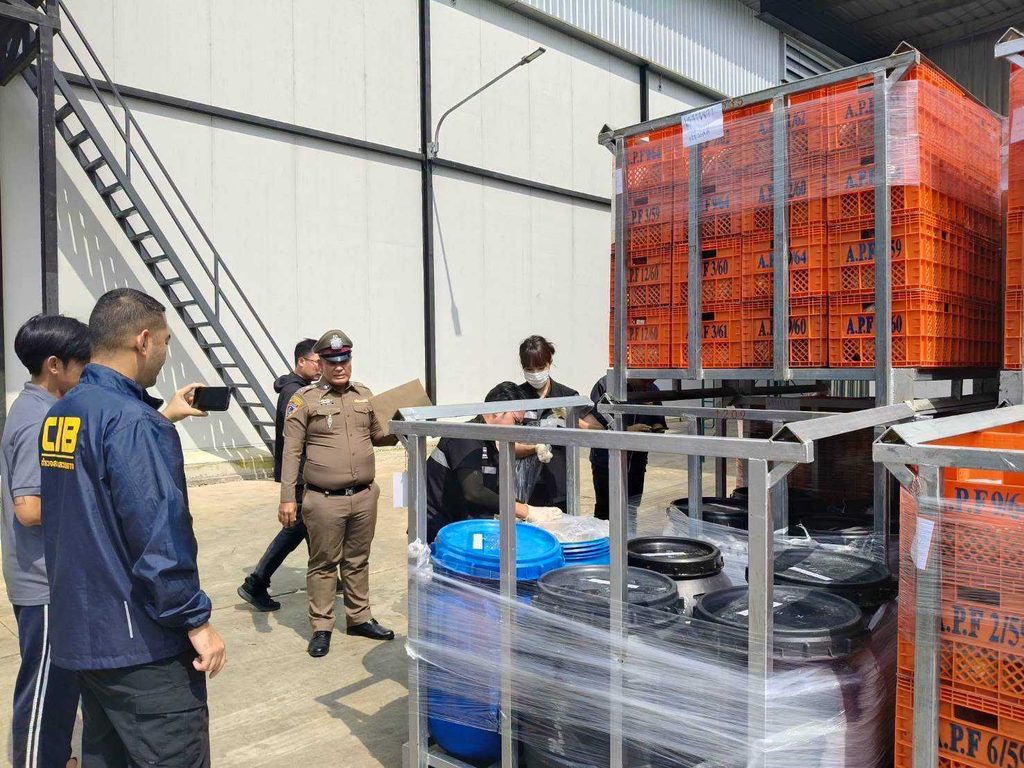
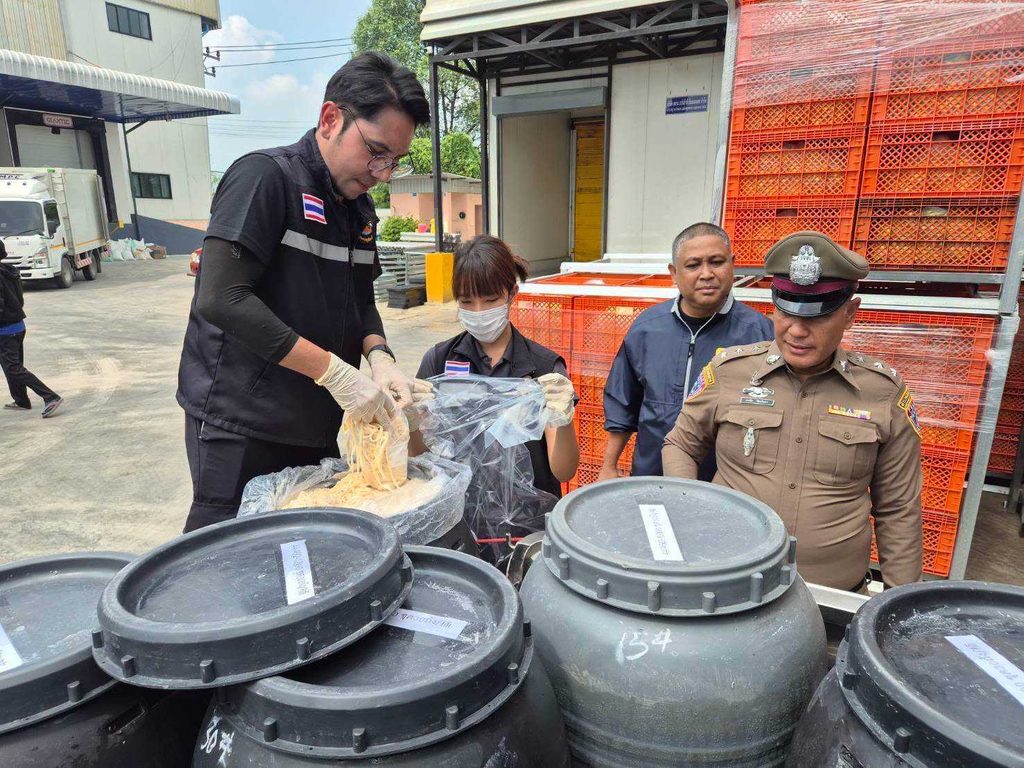
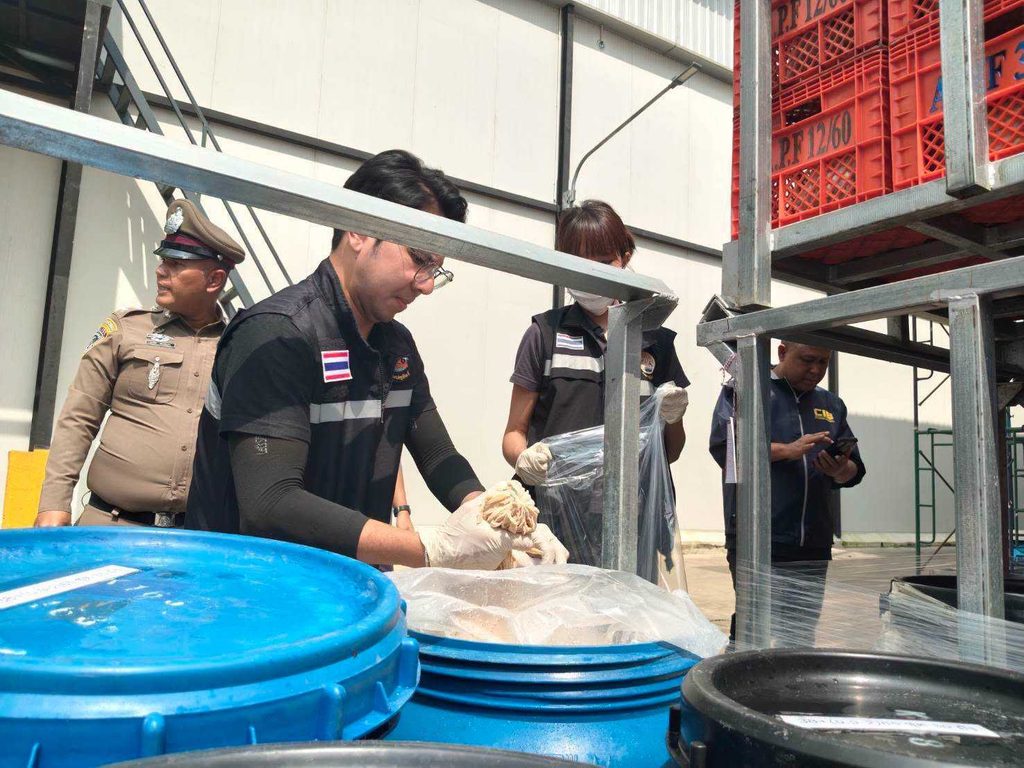
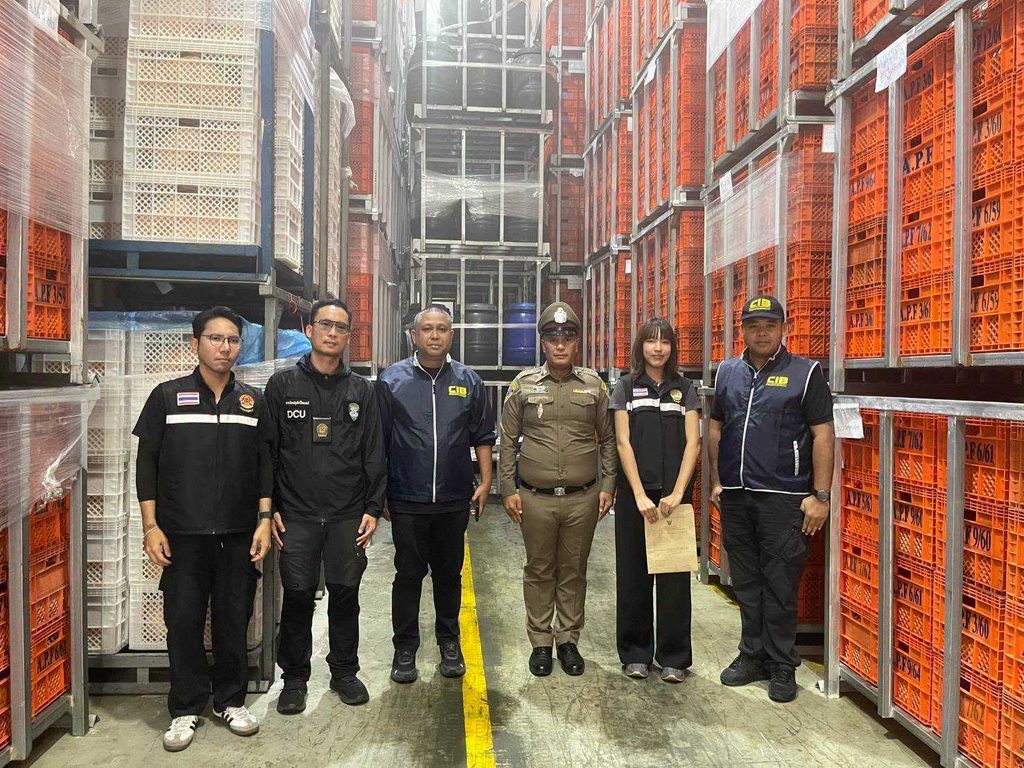
The crackdown on illegal livestock products continues. Most recently, the Phra Pirun Joint Operations Center for Agricultural and Food Security (ศพร.กษ.) ordered the Department of Livestock Development to join forces with the Consumer Protection Police Division (บก.ปคบ.) to search a cold-storage facility in Ban Ko Subdistrict, Samut Sakhon Province, after receiving a tip that illegally salt-cured pig intestines were being stored and sold there. The search uncovered salt-cured pig intestines in plastic drums: 154 drums, weighing a total of 24,640 kilograms, or more than 24.6 tonnes, worth more than 5 million baht. The person in charge could not produce a valid animal carcass movement permit or all the relevant documents.
Officials therefore ordered all the goods seized. If supporting evidence cannot be provided, legal action will be taken under the Animal Epidemics Act, B.E. 2558, and related laws. This case is another indication that illegal livestock products are not limited to frozen pork; the problem has also spread to pork products and offal, which may provide another channel for illegal networks to infiltrate the domestic market.
Over the past 4 years, illegal pork has been one of the major challenges facing Thailand’s swine industry. In 2566, authorities seized 161 containers of illegally imported frozen pork at Laem Chabang Port, weighing more than 4.5 million kilograms in total. In 2567, a network was also found to have declared the goods as fishery products to conceal the importation of pork. This led to legal proceedings against 3 importing companies, and damage to the agricultural sector was estimated at nearly 3,000 million baht. In 2568, the Department of Special Investigation (DSI) expanded its investigations into several cases, including that of more than 2,388 suspected containers, and coordinated information with 7 countries to verify the origins and trade routes.
By the year 2569, smuggling methods had begun to shift from maritime transport to the misdeclaration of other agricultural products, air transport, and movement across borders. This reflects the continued adaptation of these networks to evade inspections, requiring the government to strengthen enforcement across all channels. It must not focus solely on detection at import checkpoints, but also track goods to processing plants, cold storage facilities, warehouses, and distribution sources.
Illegal pork compounds the pressure on farmers amid high costs and recovering prices
Of particular concern is the impact on pig farmers, especially at a time when farm-gate pig prices are improving. This represents an important opportunity to restore income and liquidity after farmers have borne high production costs for an extended period. An increase in farm-gate prices does not mean farmers will immediately earn more profit; it is merely an opportunity to offset costs and keep their businesses going.
If illegal pork and offal continue to infiltrate the market, especially products sold at lower prices than goods that have undergone legally required inspection, this will create unfair competition and put pressure on domestic pricing mechanisms, affecting processors, traders, and the pig industry supply chain as a whole. More importantly, Thai pig farmers must bear the full costs and meet all production standards, while illegal products may evade these obligations.
Another issue that should not be overlooked is consumer safety. Pork and offal are food products that require strict standards throughout the process, from animal health in the country of origin, slaughter and processing, and disease testing to hygiene certification and storage and transport at appropriate temperatures. If products lack documentation certifying their origin and cannot be traced, gaps may arise in assessing the risk of contamination by pathogenic microorganisms and animal diseases.
Department of Livestock Development–Department of Customs must close every loophole, tracing the supply chain from source to destination
Given this situation, the roles of the Department of Livestock Development and the Department of Customs are crucial. The Department of Livestock Development must strictly inspect animal health, the movement of carcasses and animal products, and storage in cold facilities, while also expanding investigations to production sources and associated networks.
The Department of Customs, meanwhile, must step up inspections of imported goods across all channels—by sea, air, and land borders—with particular attention to declared product types, customs tariff classifications, origin, and the accuracy of documentation. This is to prevent goods from being misrepresented and inspections required by law from being evaded. It must also coordinate information with the Department of Livestock Development, the Central Investigation Bureau, and DSI to extend investigations to importers, suppliers, transporters, and the networks behind them, so that enforcement does not stop at the seizure of goods in individual cases.
Ultimately, the problem of illicit pork and illicit pork offal is not merely a matter of smuggling illegal goods. It is an issue connected to farmers’ livelihoods, fair trade, and consumer safety. This is especially true while pig farmers are trying to recover amid persistently high costs. Maintaining price mechanisms that reflect actual costs is therefore just as important as controlling product quality.
Crackdowns must be serious, sustained, and comprehensive from source to destination, because every product entering the market should be subject to the same rules and standards. Farmers who produce legally must be treated fairly, businesses must compete on an equal footing, and consumers must be confident that every piece of meat on their table has a clear origin and has undergone safe inspection. This is key to protecting Thailand’s pig industry so it can grow steadily and sustainably.