
|
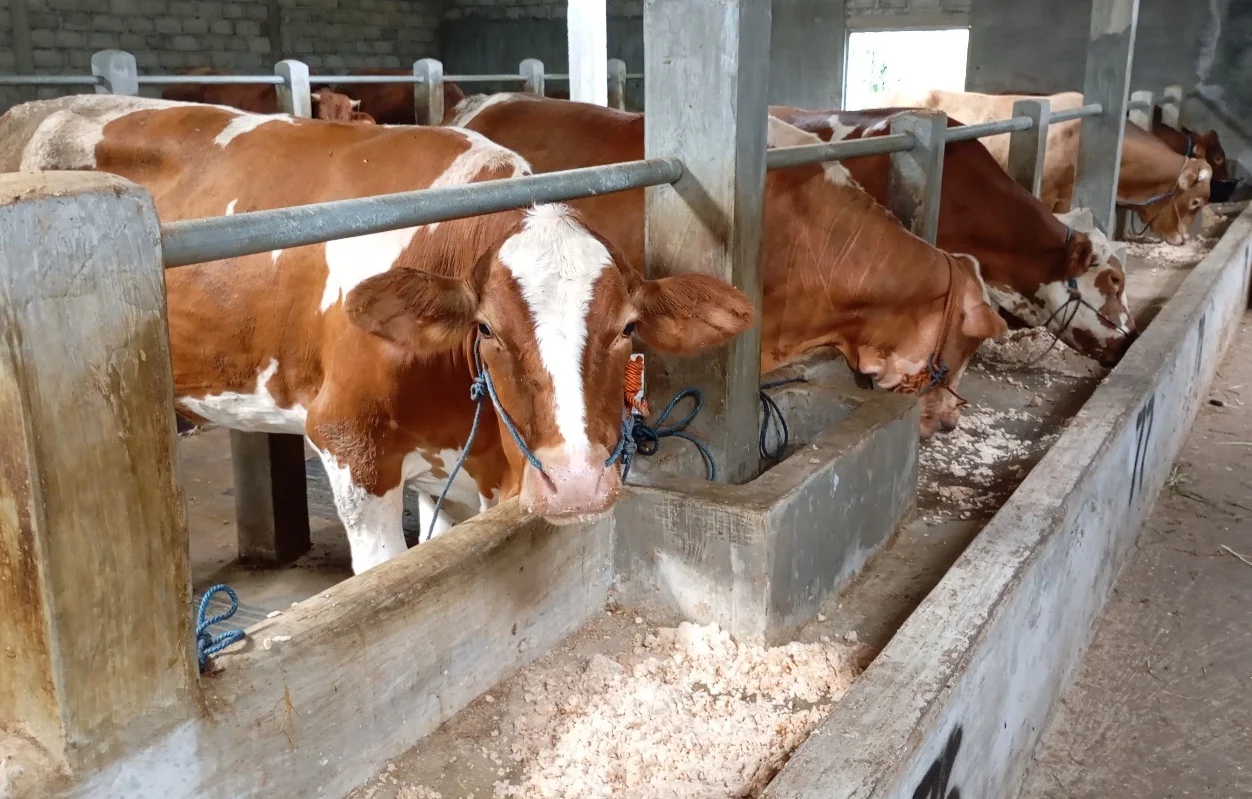
| Dairy cattle farm. (Photo: Joko Documentation) |
The impact of the foot-and-mouth disease (FMD) outbreak in 2022, which has continued and become endemic in several regions of Indonesia, has severely affected cattle productivity and reproductive performance.
FMD case surges in recent years have usually occurred from December to May, coinciding with the rainy season or the Eid al-Fitr and Eid al-Adha holidays. FMD outbreaks resulting from increased movement and the gathering of cattle, goats, and sheep with various health statuses in one population not only affect the supply of sacrificial cattle, but also affect other populations.
The direct impacts, including the deaths of breeding cows, calves, and feeder cattle, as well as culling, and indirect impacts, including a decline in reproductive performance, pose a serious threat to the sustainability of breeding local cattle in the country.
In the author’s doctoral study at FKH UGM, one of the research topics was the impact of FMD on dairy cattle and the measures taken to restore production and reproduction. The study was conducted on a population of dairy cattle affected by the FMD outbreak in Boyolali Regency. Observations of this population showed that the clinical signs still visible one month after FMD infection in 242 animals were anorexia (49,2%); hypersalivation (23,6%); fever (3,7%); lesions on the mouth or tongue (4,1%); lesions on the feet (2,9%); lameness (3,3%); abscesses (2,1%); and mastitis (3,3%). Field data showed a decline in the dairy cattle population at the study site. The initial population before FMD was 330 animals; the population after FMD was 242 animals, a decrease of 88 animals (26,7%).
The FMD outbreak caused the population to decline by 88 animals (26,7%). The three main factors contributing to the population decline were culling (8,5%); deaths of cows (7,6%); and deaths of calves (10,6%). The FMD outbreak at the study site resulted in culling (compulsory slaughter or sale at a low price) of up to 8,5%. Low milk production was also a reason for culling. Dairy cows were culled because of acute disease, infertility, low milk production, and stage of lactation. Clinically diagnosed diseases that may be considered grounds for culling on a farm include milk fever (milk fever), retained placenta, metritis, ketosis, left dysplasia abomasum (LDA), cystic ovaries, lameness, clinical mastitis, and FMD.
Higher mortality occurred because the outbreak spread very rapidly and preventive measures such as vaccination had not yet been implemented. Calf deaths occurred in both pre-weaning and post-weaning calves. FMD transmission to calves occurs through direct contact, aerosols, and consumption of colostrum or milk from infected dams. FMD poses a risk of myocarditis (inflammation of the heart muscle), especially in calves under six months of age. Myocarditis is considered a fatal form of FMD that occurs without vesiculation in calves known as “tiger heart”.
The FMD outbreak caused... Read more in the October issue of Infovet Magazine 2026.
Written by:
Dr. Drh. Joko Susilo, MSc, APVet
Infovet journalist for the Lampung region