
Broiler chickens are not distributed evenly throughout their living environment.
Some broiler chickens may gather along walls, near equipment lines, or at other boundaries, while other areas appear relatively empty.
This distribution pattern does not necessarily mean there is a problem.
Broilers do not use space randomly; they tend to congregate near the side walls of the broiler house.
This behavior is called thigmotaxis, meaning a tendency to stay near walls (Figure 1) or other vertical surfaces.
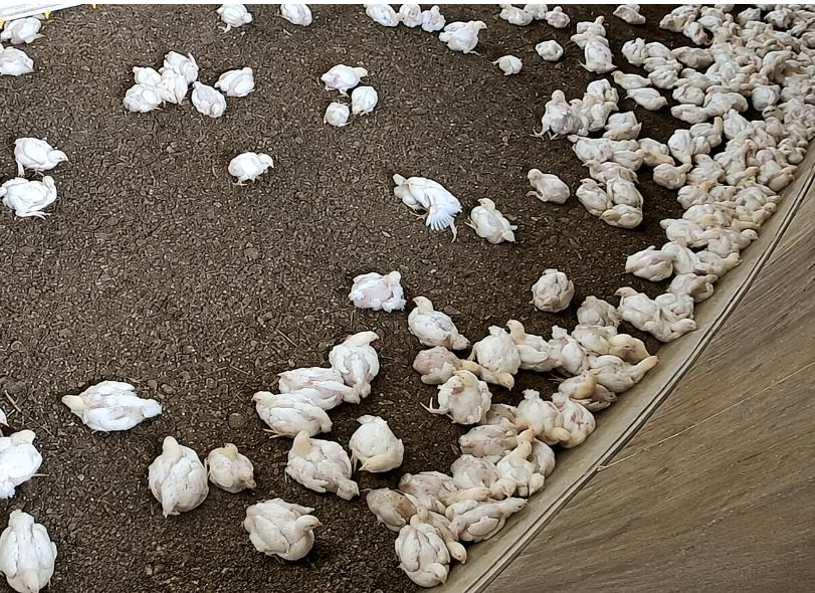
Figure 1, broilers congregating along a side wall inside a commercial poultry house. Image source: Shawna Weimer.
What is wall-hugging behavior?
Factors influencing where broiler chickens choose to stay are not limited to the space available to each bird.
Broiler chickens use edge areas more than would be expected based solely on the available floor area.
This distribution pattern has a natural evolutionary background.
The wild ancestor of domestic chickens, the red junglefowl, lived in dense forests with vegetation that provided natural cover.
Of course, an observation point worth paying attention to for farm staff is:
When you ask yourself, “How much space do my chickens have?” you should also ask, “How are my chickens using the space available to them?”
Why do broiler chickens choose spots along the walls?
Where broiler chickens stay varies with environmental conditions, resource locations, stocking density, age, time of day, and social interactions.
Temperature and litter conditions
Temperature and litter conditions vary in different areas of the broiler house.
Heating, cooling, and ventilation systems create temperature gradients within the house, and temperature differences increase as the broilers grow.
For example, solar radiation can warm the side walls of the poultry house, while cold air entering through the inlets creates cooler areas near the side walls.
Litter moisture content is related to the equipment, and is often higher around the drinking lines.
Broilers may avoid areas with wet litter (Figure 2); therefore, observing flock distribution can help assess litter conditions.
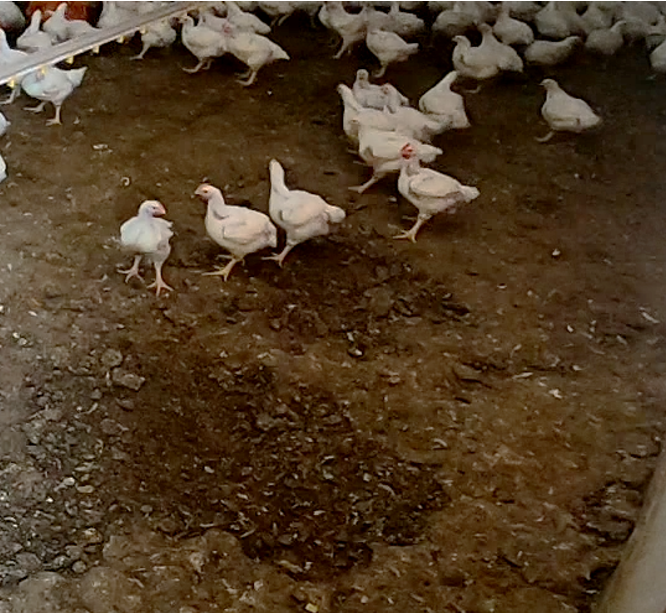
Figure 2, broiler chickens kept away from damp areas inside a commercial poultry house. Photo credit: Shawna Weimer.
Resource location
Chickens will remain near areas where feed, water, welfare facilities, or other resources are available.
Stocking density and the location of feeders and drinkers affect how chickens use the space.
At lower stocking densities, chickens tend to stay near feeders and drinkers; however, at higher stocking densities, they move farther away from these resources, possibly because competition and disturbance around resource areas increase.
Welfare facilities also further influence space utilization.
Visual barriers, vertical partitions, and platforms can encourage broilers to use areas where they might otherwise spend less time.
Compared with unobstructed areas, domestic chickens make greater use of visually sheltered areas and show more resting and preening behavior in sheltered locations.
Depending on the facility design, resource locations may help explain why chickens congregate in certain areas of the house, including near the side walls.
Age in days and time of day
Broilers’ use of space follows a day–night pattern and changes as the birds grow.
Compared with the control group without environmental enrichment facilities, broilers in pens with platforms installed along the side walls occupied the side areas more often, especially during the dark period at a young age (Figure 3).
During the dark period in the early-age stage, platform occupancy reached a maximum of 80%, while the control group was below 40%.
This distribution pattern may be due to younger chicks being more inclined to seek protection.
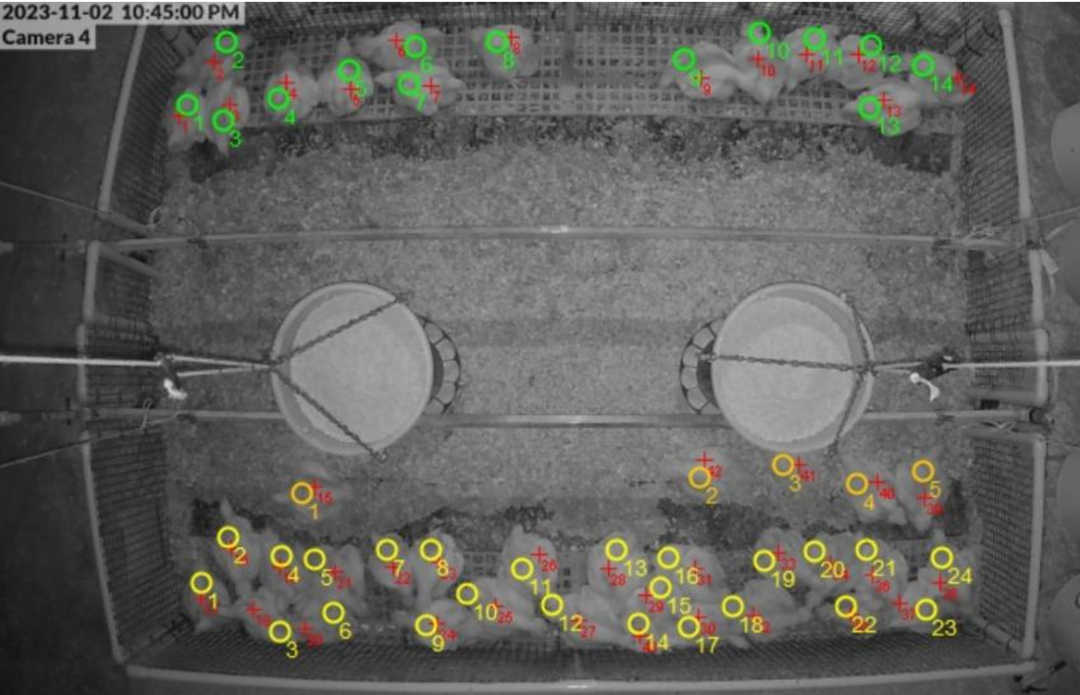
Figure 3, overhead view of broilers on the platform in the dark period. Colored circles and number labels indicate the total number of birds (red) and the birds’ locations within the pen: east platform (green), west platform (yellow), and litter area (orange). Images were measured using ImageJ. Adapted from Weimer et al. (2026).
Social environment
Broiler chickens are social animals, and the presence of other chickens affects where they choose to stay.
Broiler chickens tend to stay near flockmates. This social attraction may cause chickens to congregate in an area even when there are no physical features in that area that attract them.
Preference for positions against the wall is also related to reduced disturbance from neighboring chickens, especially when local density increases.
What implications does this have for the broiler rearing environment?
The rearing environment for broiler chickens involves more than just the available floor area.
Broiler chickens interact with boundaries, resources, lighting, litter, welfare facilities, flock mates, and environmental conditions; these factors affect where they choose to spend time.
For producers, regularly observing the distribution of the flock can provide useful clues about how the birds use their environment.
The aim is to understand flock distribution patterns and help identify management measures that can help ensure chicken welfare.
Wall-hugging behavior should not be directly regarded as an indicator of good or poor welfare without also considering the surrounding environment and other welfare indicators.
Understanding how broiler chickens use space, as well as the factors that drive their behavior, can help producers and researchers consider and provide housing environments from the chickens’ perspective.
Summary
Broilers do not necessarily use all available space uniformly; wall-hugging behavior, or thigmotaxis, is a type of spatial behavior.
Spatial distribution is affected by boundaries, resource layout, stocking density, flock behavior, age, and different times of day.
A particular spatial distribution pattern does not necessarily indicate poor welfare or a production problem; it should be interpreted in the context of the overall environment and other chicken welfare indicators.
Observing where chickens choose to stay helps producers think about the rearing environment from the chickens’ perspective.
Note: This article is from the Modern Poultry website. Author: Shawna Weimer, PhD, University of Arkansas.
Source: ploutry times