
In winter poultry farming, everyone knows that ventilation and heat retention must be balanced. So, one seemingly reasonable approach is to reduce the fan speed or run a small fan continuously, supplying a small amount of fresh air to the house.
However, in actual production, some poultry houses have experienced problems after doing this, such as chickens near the walls getting chilled, poor air quality in the middle, and large temperature differences within the house.
What is the problem?
Winter ventilation is not just about “how much air to exchange”; it is also about “where the air enters and where it goes after entering.”
For poultry houses using negative-pressure sidewall inlets, where winter ventilation demand is low, especially on sites with some air leakage, properly managed intermittent ventilation often makes it easier to organize airflow than continuous ventilation at a low airflow rate. However, this depends on the fans, inlets, and controller working together.
I. Keeping a low airflow running continuously does not necessarily deliver fresh air where it needs to go
Ideally, in winter, cold air enters through the inlets, moves along the ceiling into the house, mixes with the warm air above, gradually warms up, and then enters the area where the birds are active.
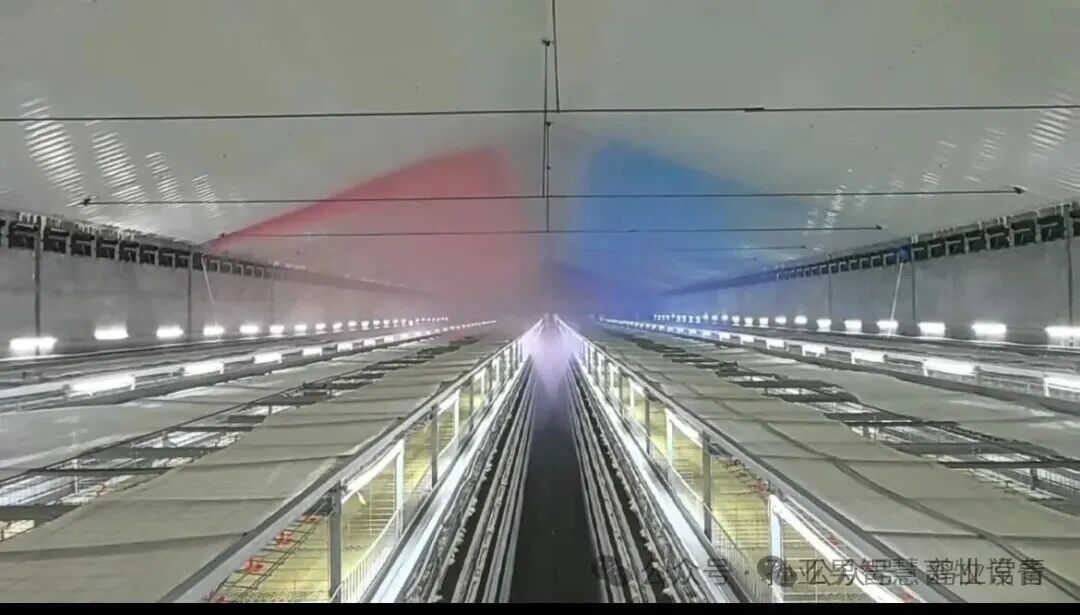
To achieve this process, the air discharged from the small opening must have an appropriate velocity, direction, and jet thickness.
In practice, it is difficult to make a poultry house completely airtight. Gaps around doors, joints in the walls, louvers on idle fans, and areas where evaporative cooling pads are blocked off can all become additional air inlets.
When the exhaust airflow is very low, air leaks through just these gaps can account for a large proportion of the total. As a result, the fans keep running, but the house cannot establish the appropriate negative pressure, and air entering through the normal small inlets also lacks sufficient velocity.
Cold air enters directly through gaps at low levels, or sinks as soon as it comes through the small inlet window, reaching the chickens before it has had a chance to mix thoroughly.
“The average ventilation rate may not seem high, but the local drafts experienced by the flock can be quite noticeable.” Technical materials from the University of Georgia in the United States also point out that air leaks in real-world poultry houses are an important reason why small fans running continuously cannot maintain normal airflow through small inlet windows.
二、The value of intermittent ventilation is that it ensures suitable conditions for every air intake
The principle of intermittent ventilation is to provide sufficient exhaust capacity while the fans are running, allowing effective air jets to form with the small inlets at a reasonable opening, and then control the average air exchange rate through the fan downtime.
An example for illustration of the principle only:
Assume that a group of fans has an airflow rate of 30,000 cubic meters/hour under the actual operating negative pressure, and runs for 1 minutes and stops for 4 minutes every 5 minutes. The theoretical average ventilation rate is therefore 6,000 cubic meters/hour.
It has the same average air exchange as a fan continuously supplying an airflow of 6,000 cubic meters per hour, but the small window’s air intake conditions when open may differ significantly.
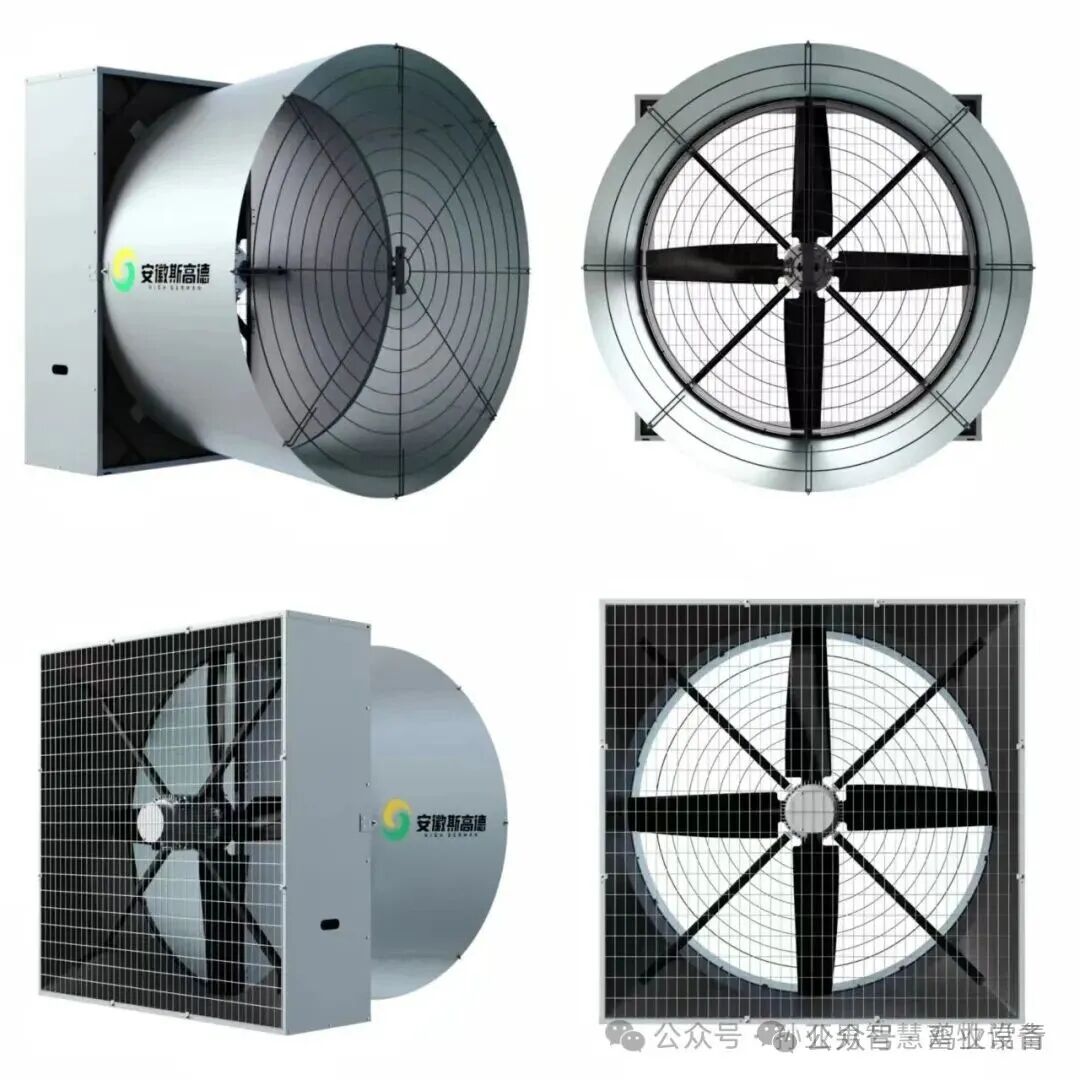
Intermittent ventilation separates the two tasks: use the airflow while the system is running to direct airflow, and use the on/off duration to control the average ventilation rate.
Aviagen's ventilation materials explicitly list this as an advantage of intermittent ventilation: running a larger fan capacity for a short time can establish the required negative pressure while maintaining a reasonable small-inlet opening.
However, intermittent ventilation cannot replace sealing leaks. When a poultry house has severe air leaks, simply increasing fan output will only draw more cold air in through the gaps. The first step in adjusting ventilation during winter is still to check the seals.
Three. High negative pressure does not necessarily mean the air jet will travel far.
Some poultry farms find that cold air drops too early, and their first reaction is to narrow the air inlets and increase negative pressure.
This does not always solve the problem.
After the small window is closed down, the air inlet speed may increase, but the jet also becomes thinner. If the opening is too small, it may also change the direction of the air leaving the small window, affecting airflow along the ceiling of the building.
Therefore, jet distance should not be assessed based on negative pressure alone; the following should also be considered:
The actual opening of the small window and the thickness of the jet;
The direction of the deflector, and the relationship between the air outlet and the barn roof;
Indoor-outdoor temperature difference, poultry house width, and obstructions on the roof.
During periods of low ventilation rates, depending on the system design, some small inlets can be activated in evenly distributed groups so that the inlets in use remain at an appropriate opening, rather than compressing all the inlets into a narrow slit. However, the air supply throughout the entire house must be checked for uniformity to avoid leaving dead spots in ventilation.
For caged poultry houses, also pay special attention to how the upper-tier cages, beams, and equipment affect airflow. Normal floor temperature does not mean the upper-tier birds are not being directly exposed to cold drafts.
Four. Intermittent ventilation is not just a matter of connecting a timer to the fan.
The fan starts quickly, while the small-window actuator operates relatively slowly. If they are not properly coordinated, each startup may involve a period of poor air intake.
If the small window opens too late, the instantaneous negative pressure may become too high, actual exhaust may be restricted, and more cold air may enter through gaps. If the small window opens too wide or too long in advance, cold air may sink naturally before the fan has established negative pressure.
Therefore, the controller needs to coordinate the entire operating process:
Before startup: Adjust the small windows to suitable startup positions based on the fan groups enabled for this run and the small-window operating speed. Whether to pre-open them, and by how much, should be determined according to the equipment design and on-site commissioning.
During operation: Make adjustments based on negative-pressure feedback within a reasonable opening range to prevent frequent back-and-forth movement of the small windows, which would cause continuous changes in inlet air speed and direction.
When shut down: Coordinate fan shutdown, small-window return, and fan check-valve operation to reduce uncontrolled cold air entering after shutdown.
These are the basic requirements for control logic; specific parameters cannot be copied directly. During commissioning, observe the entire process from startup to shutdown rather than looking only at a single negative-pressure reading while the fan is running steadily.
Five. Periodic changes in negative pressure are normal; large fluctuations in temperature and air quality are what should be avoided.
During intermittent ventilation, the fan starts and negative pressure is established; when the fan stops, the negative pressure gradually decreases. This change is inherent to the operating mode.
What really needs to be controlled is whether there is overshoot at startup, whether operation is stable, how long it takes to establish effective airflow each time, and whether there are significant fluctuations in temperature and air quality in the bird area.
If the system remains off for too long, moisture, carbon dioxide, and other factors will gradually build up; subsequent intensive ventilation may then cause substantial temperature fluctuations.
However, a shorter cycle is not always better. If each run is too brief, the fan may have only just started and the small window may have only just reached its position; if the system stops before airflow is fully established, ventilation may appear frequent, but the actual results may not be ideal.
The Cobb Broiler Management Guide uses 5 minutes as a common cycle reference and emphasizes that the on-time should be long enough to promote mixing of warm and cool air. Here, 5 minutes means “on-time + off-time,” not 5 minutes of downtime, nor a fixed answer that every poultry house must follow.
In actual operation, both of the following conditions should be maintained:
Each activation should provide enough effective operating time, while each shutdown should not be so long that air quality deteriorates noticeably.
If the average ventilation demand is very low and the existing fans provide too much air exchange whenever they are switched on, consider adjusting the fan combination or equipment configuration. Do not simply shorten the operating time excessively, or try to solve the problem by continually extending shutdown periods. Excessive fan capacity can itself exacerbate temperature and air quality fluctuations within each cycle.
Six: To assess whether the settings are right, observe the chickens and airflow over a complete cycle.
In winter, when inspecting the poultry house, it is recommended to observe at least several complete ventilation cycles.
When the fans have just started, do the chickens near the walls and on the upper tier show any obvious avoidance? After running for a while, does the cold air drop prematurely? Does the distribution of the flock change before and after the fans stop? Do temperatures at different locations and heights inside the poultry house change in sync?
You can also place lightweight streamers along the ceiling in front of representative small windows to observe the airflow direction and how far it reaches. Be sure to check when outdoor temperatures are lower, especially in the early morning and at night, because an air jet that works well during the day may not be suitable at night.
The average temperature on the controller is only a reference. More important are temperature changes at the birds’ level, humidity, carbon dioxide, bird behavior, and localized dampness.
Finally, it is also important to clarify the limits of applicability: **Continuous ventilation at a low airflow rate is not necessarily bad.** If the poultry house is well sealed, the fans still have sufficient static pressure capability at low speed, and the small inlets maintain good airflow distribution at a low airflow rate, continuous ventilation can also provide a stable environment. Cobb’s technical materials also recognize this approach, but emphasize that it requires high standards for the fans, air inlet system, and control level.
For many existing poultry houses, the practical purpose of intermittent ventilation in winter is to let limited fresh air enter along a predetermined path, mix thoroughly, and then reach the area around the flock.
The fans exhaust air, the small inlets guide it, and the controller coordinates them. When all three work well together, “on for a while, off for a while” can truly provide effective air exchange and keep the flock comfortable.