
When building a modern multi-tier cage-layer house, people often pay close attention to the fans: whether the total airflow is sufficient, whether power consumption is high, and whether winter exhaust fans should be installed on the gable wall, side wall, or roof, as is done in Europe. By comparison, small air inlets are easily treated as ordinary accessories, with as few installed as possible.
But when autumn and winter arrive, some problems arise: as soon as the fans turn on, the chickens on the top tier get chilled first; if the airflow is increased even slightly, the small inlets are no longer sufficient; and although the house is clearly not short of airflow, the temperature is still uneven.
Ventilation is not just about exhausting air. You also need to consider where the cold air outside enters, where it goes, and whether it has warmed up somewhat by the time it reaches the chickens. The small-inlet configuration is designed to address these issues.
Fewer small windows are installed, and problems often arise when the seasons change.
In winter, less airflow is needed, so it may seem that installing fewer small windows will work. But the number of small windows should not be determined solely by the coldest weather.
In spring and autumn, or when temperatures rise around midday in winter, the house needs more air exchange. But it is still not warm enough outside to let air blow directly across the birds. At such times, it is best to bring fresh air in through small sidewall inlets, allowing it to mix above the birds before reaching their level.
If there are too few small inlets, and more fans are switched on while the inlets are already fully open, the incoming air speed may be too high, the negative pressure may be too high, or the amount of incoming air may be restricted. The manager has no choice but to open the tunnel inlets early. The birds do not yet need such pronounced wind chill, but the equipment configuration has already pushed the house into tunnel mode. Problems with the birds often arise at just this point.
As a result, the chickens near the air inlets may feel cold first, while those farther back may not necessarily feel cool. The cage rows can also block airflow: the aisles may be quite drafty, while some areas inside the cages remain stuffy. When temperatures and air speeds are uneven, management becomes more difficult.
Tunnel ventilation certainly has its purpose and is needed when the weather gets hot. What we need to avoid is being forced to switch at an unsuitable time because there are not enough small inlets. The money saved by using a few fewer small inlets may mean having to make repeated adjustments every time the seasons change.
How many should you install? First, consider how much of the job they need to handle.
The number of small windows should not be determined solely by “how many were installed in someone else’s building.” During design, first decide how much ventilation the sidewall windows are expected to provide before the system enters tunnel mode, then determine how much air each small window can admit under actual operating conditions.
One thing to keep in mind is that the maximum airflow stated in a product description is not necessarily the airflow after installation in a poultry house. The exterior wind hood, bird netting, and wall thickness all affect airflow. Having enough units is not the only consideration; they also need to be distributed appropriately along the poultry house. They should not be crowded into one section while another section lacks air inlets.
Some people may worry: “If we install a lot of them, won’t too much air come in during winter?” The number installed and the number opened at the same time are two different things. When the required airflow is low in winter, they can be opened in groups according to the design, keeping the working small inlets at an appropriate opening rather than opening every small inlet just a narrow crack.
A good small window is about more than just being able to open and close.
When choosing a small window, besides asking about the price and dimensions, you should also ask the manufacturer: When it is opened slightly, where does the airflow go? After it is opened wider, does the airflow direction change? When it is colder outside, will the cold air drop as soon as it enters the house?
Negative pressure does affect incoming air speed, but it cannot simply be understood as “the higher the negative pressure, the farther the air will travel.” If the small inlet is closed further and further to increase negative pressure, the incoming airflow will also become thinner and may not reach the intended location.
With the same small inlet at the same opening, operation may work well during the day, but on a cold night, cold air may also sink sooner. Therefore, the performance of the small inlet should be assessed by considering negative pressure, opening, wind direction, and the temperature difference between indoors and outdoors together, rather than focusing only on one number on the controller.
It is even better if the small-window manufacturer can provide tests of airflow volume and air supply distance at different negative pressures and opening sizes. But once you are on site, you still need to use smoke or ribbons to see how the air actually moves. No matter how attractive the airflow arrows look on the drawings, the airflow still has to work inside the chicken house.
Above the cage tops, leave a little space for the cold air to “warm up.”
As the cage racks in multi-tier cage poultry houses get higher, the installation position of the small windows must also be reconsidered. Don’t look only at how high they are above the ground; it is more important to consider their relationship to the chickens on the top tier.
For small windows that direct air along the ceiling, the airflow path should be above the top of the cages, with enough clearance. The purpose is straightforward: prevent cold air from outside from blowing onto the top-tier chickens as soon as it enters the house.
Ideally, the cool air first travels along the ceiling into the poultry house, mixing with the surrounding warm air as it moves. It reaches the vicinity of the birds only after its temperature has moderated and its speed has decreased.
If the cage racks almost reach the roof, this mixing space is squeezed out. The cool air can easily hit the cage racks or crossbeams and descend prematurely. By then, it may be difficult to get the settings right even by adjusting the negative pressure and opening.
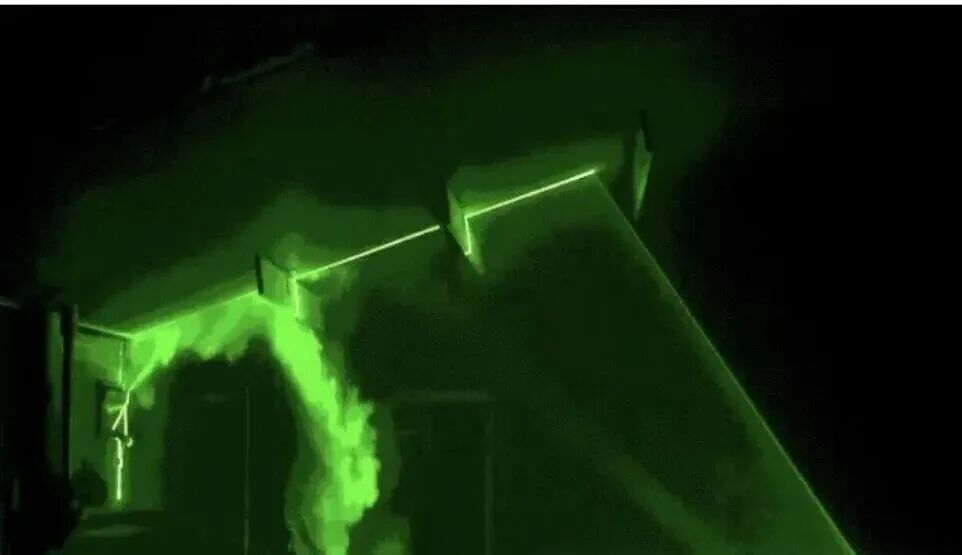
The image shows a smoke test by Denmark’s SKOV company, demonstrating that fresh-air flow is blocked by the purlins, then refracted and redirected to blow directly toward the top-tier chicken cages.
Therefore, when building the poultry house, do not focus only on adding another cage tier; you also need to leave space for ventilation. The height of the small windows above the cage tops should be determined based on the house width, roof shape, cage height, and local winter temperatures. The same dimensions cannot be applied to every poultry house.
More overhead space is not necessarily better. The key is to ensure that airflow can pass through and mix well; where necessary, use circulation fans to bring the heat down from above. Finally, check whether fresh air actually reaches the middle and lower levels instead of continually circulating at the top.
During acceptance, pay more attention to the airflow around the chickens.
Installing a small window is not complete just because it can be opened and closed and the negative pressure can be displayed; it still needs to be adjusted.
Check at minimum ventilation and again after increasing the airflow; check during the day and especially on cold mornings. See whether cold air is blowing directly onto the top-tier birds or being deflected downward by beams, whether temperatures vary too much between tiers, and whether the small windows and fans are working in coordination.
Poultry house ventilation ultimately serves the flock. Providing enough small windows, installing them in the right positions, and adjusting the airflow properly helps fresh air reach where it needs to go without exposing the chickens directly to cold drafts. Thinking these things through when building the house is often less trouble than constantly adjusting equipment to chase problems after production begins.
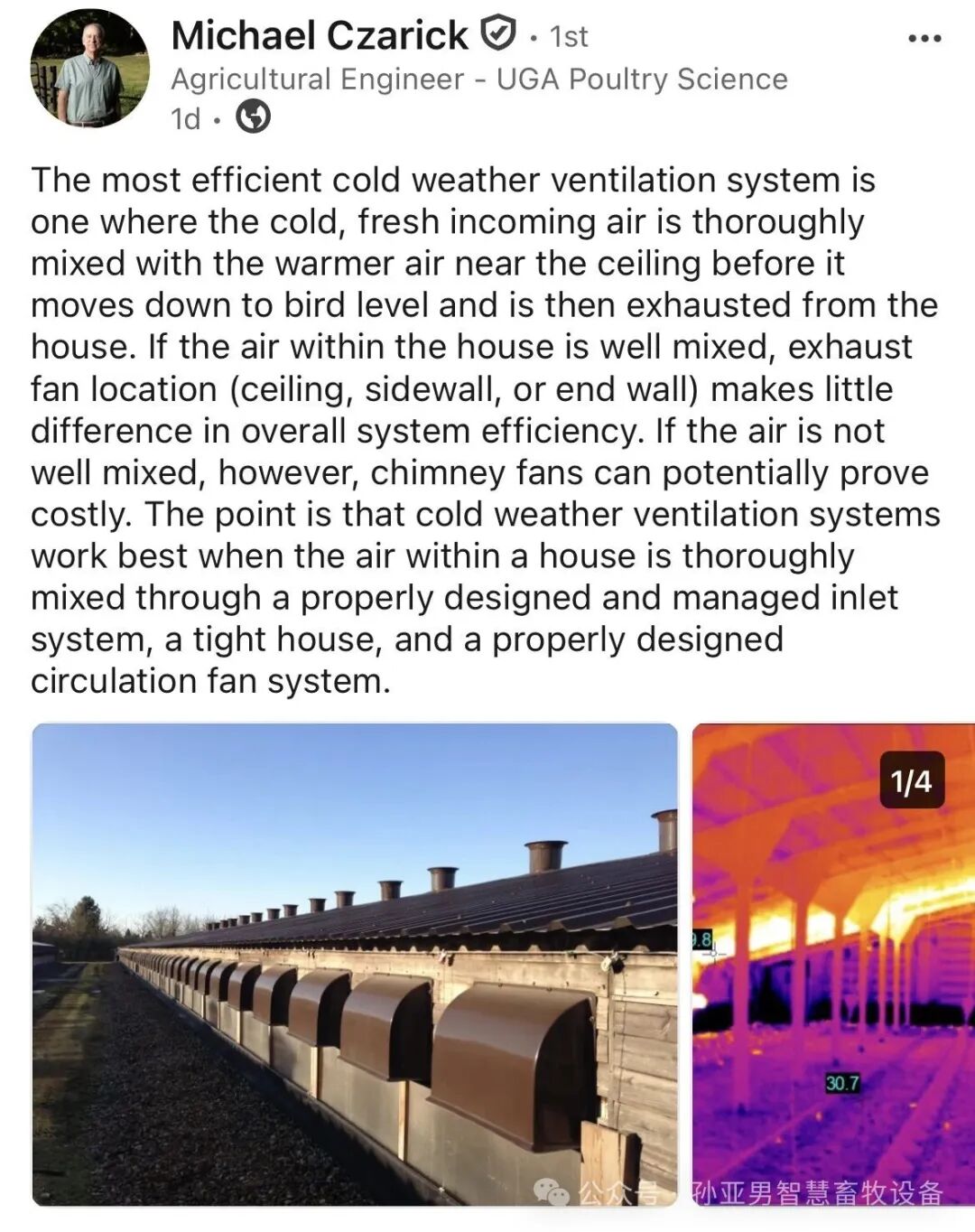
Author: Michael Czarick
Workplace: Department of Poultry Science, College of Agricultural and Environmental Sciences, University of Georgia (UGA), USA; Professor of Extension
Content translation:
For efficient ventilation during the cold season, the cold air entering the poultry house should first mix thoroughly with the warm air near the ceiling, then descend to the level of the flock, and finally be exhausted from the poultry house.
If the air inside the building is well mixed, whether the exhaust fans are installed in the ceiling, side walls, or end walls has little impact on the overall system efficiency. But if the air is not well mixed, using chimney-style exhaust fans may result in higher operating costs.
The key is to design and manage the air intake system well, maintain good airtightness in the chicken house, and combine this with a properly designed circulation fan system to thoroughly mix the air inside the house. This allows the ventilation system to perform at its best during the cold season.