
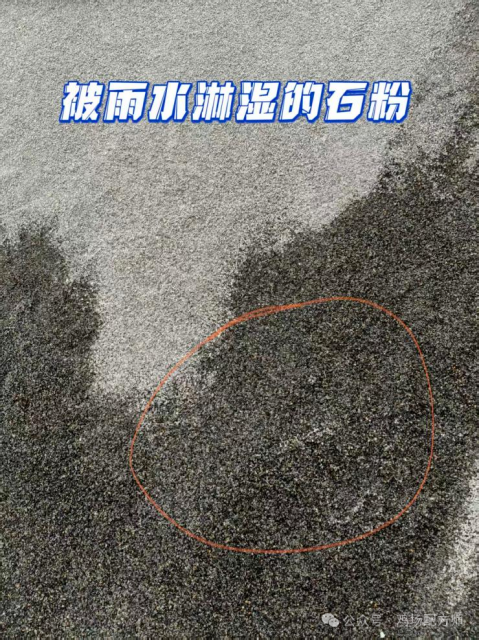
During technical service, we found that many layer farms (households) often store stone powder outdoors in an arbitrary manner. Even after it has been wetted by rainwater, it is still directly mixed into feed. To encourage farms (households) to store stone powder properly and warn of the harm caused by directly mixing large proportions of damp stone powder into layer feed, the related effects are described here.
Step 1, corn becomes a perishable raw material once it has been ground
Corn kernels have a glossy outer layer that prevents moisture loss and the entry of microorganisms. Grinding destroys this natural protective layer, making the corn highly susceptible to absorbing moisture and becoming moldy. The lipids inside are also prone to oxidative deterioration (the corn germ accounts for 10% ̄14% of the whole kernel's weight; the germ contains about 35% fat, accounting for more than 70% of the total fat in the whole kernel. Corn also has a relatively high unsaturated fatty acid content, so ground corn is prone to rancidity and deterioration), making it unsuitable for long-term storage. Even under normal storage conditions, in actual production the storage period for ground corn is limited to 10 days, and its moisture content must not exceed 14%. Cracking the kernels increases the surface area over which fat is exposed to oxygen in the air, making rancidity more likely and increasing the likelihood of a higher fatty acid value.
The key mechanism is: crushed corn comes into close contact with wet stone powder → enzyme activity increases and metabolism intensifies → dry matter is consumed more rapidly → storage stability decreases and the fatty acid value rises → quality deteriorates; fat is highly prone to rancidity in high-temperature, high-humidity storage conditions—conditions suitable for mold growth are a moisture content above 14%, a temperature above 20℃, and a relative humidity of 70%–80%; Aspergillus can grow when corn moisture reaches 14.3%, and Penicillium can grow when it reaches 15.6%–20.8%. In other words, crushed corn is already in a critically vulnerable state at this point—only a small amount of additional moisture is needed to trigger quality deterioration.
2, Characteristics of stone powder after it gets wet
The main component of limestone powder used in layer feed is calcium carbonate. It has a microporous structure and can adsorb moisture from the air. When its moisture content exceeds 3%, it tends to form hard lumps; in humid environments, microorganisms such as mold may grow. When limestone powder gets wet or damp, three key changes occur: first, its physical structure changes as moisture enters the gaps between particles, disrupting its free-flowing properties; second, once clumped, it is difficult to mix evenly into feed; third, mold may grow in humid conditions. Poor flowability makes limestone powder prone to clumping, resulting in uneven calcium content in feed. Therefore, limestone powder should be stored properly: do not store it outdoors or expose it to rain or dampness; keep it in a dry, clean warehouse.
3, the multiple adverse effects of wet limestone powder being mixed into feed: combining the two types of factors described above creates a quality deterioration chain of 1+1>2.
3.1 directly introduces additional moisture, pushing the ground corn to the threshold for mold and rancidity:
The free water brought in by the wetted stone powder is rapidly absorbed by the ground corn and the complete powdered feed. Because the cornmeal has lost its protective layer and is highly absorbent, this extra moisture raises the moisture level in parts of the mix. Since corn mold growth is strongly correlated with moisture and temperature, mold growth may begin once the moisture level reaches around 14.3 percent, and Penicillium can grow at levels above 15.6 percent. This is fully consistent with the mechanism by which high humidity increases enzyme activity and respiration and raises the fatty acid value.
3.2 accelerates oxidative rancidity and increases the fatty acid value:
The combined effects of moisture during storage or increased ambient temperature will intensify fat oxidation, increasing free fatty acid content and fatty acid values. Ground corn is already prone to rancidity, and wet limestone powder creates conditions that accelerate oxidation, causing the feed to develop a rancid odor and lose palatability more quickly.
3.3Clumping and uneven mixing lead to an uneven distribution of calcium content:
When limestone powder gets wet, it clumps together and becomes less flowable, making it difficult to disperse evenly when mixed with ingredients such as cornmeal. This causes the calcium content to vary throughout the feed batch. This directly affects the consistency of calcium intake in laying hens: insufficient supplementation can lead to poorer eggshell quality and more soft-shelled and broken eggs, while excessive supplementation increases the burden on the hens’ gastrointestinal tract and may even cause gout.
3.4Mold and toxin risks compound:
Moist conditions can themselves encourage mold growth. More importantly, stone powder can accelerate the absorption of aflatoxins, and stone powder in moldy feed may become a hidden source of harm. Corn is also a raw material that is highly susceptible to aflatoxin contamination; the main contaminating toxin is aflatoxin B1. Together, these factors provide a toxin-producing substrate, a moisture-absorbing carrier, and a toxin-absorbing carrier, increasing the risk of harm from mycotoxins.
3.5 speeds up heating throughout the entire batch of feed and shortens its safe storage period:
Crushed cornmeal particles have small gaps, poor ventilation, and poor heat conduction. The temperature of the meal itself is relatively high after crushing, generally 30–50℃. After moist stone powder is mixed in, moisture is unevenly distributed locally, making the typical chain reaction of localized condensation—heating—mold growth extremely likely. During grain storage, condensation, heating, and mold growth raise the grain temperature and increase the fatty acid value, ultimately greatly shortening the safe storage period for the quantity originally intended to last 10 days. This is also fully consistent with the mechanism whereby increased enzyme activity under high-humidity conditions intensifies respiration and raises the fatty acid value.
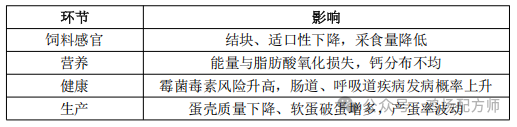
4, downstream consequences for egg production
5, prevention and control recommendations
5.1 stone powder must be strictly protected from moisture and rain: store it in a dry indoor warehouse, use double-layer packaging with an inner plastic layer and an outer woven layer, follow the first-in, first-out principle, and avoid long-term stockpiling; if caking is found, promptly break it up and sieve it.
5.2Do not use damp stone powder directly: dry it separately by air-drying or heating, break up any clumps, and use it only after testing confirms that its calcium content and hygiene indicators meet requirements. Do not mix the entire batch directly into feed.
5.3 controls the turnover of crushed corn: limit each batch to approximately 10 days’ worth of feed requirements. Store corn preferably as whole kernels, with moisture content not exceeding 14%.
5.4 Moisture and mold prevention for compound feed: Keep the warehouse dry, shorten the storage period for finished feed, and use mold inhibitors appropriately when necessary.
5.5Strictly control moisture indicators: Properly controlling the moisture content of raw materials and feed is key to ensuring safe storage and feed quality.
Conclusion: Crushed corn has become moisture-sensitive because its protective layer has been damaged and its unsaturated fats exposed. Wet limestone powder is also a water-bearing, porous, hygroscopic material. When the two come into contact, they can accelerate mold growth and oxidative rancidity at the same time. They can also cause uneven calcium distribution through clumping, increasing the risk of mycotoxins. Therefore, wet limestone powder must be properly treated before use and must never be mixed directly into layer feed.