
Souzhu.com Live Hog Futures Watch
2026 Year 10 Month 29 Day
Key Views
The signal that spot prices had stopped falling and stabilized has been broken again. The national average fell below9.2yuan/per kilogram, hitting a record low; futures plunged across the board, with the most-active contractLH2701plunged3.39%approached9550yuan/per ton, but trading volume contracted significantly from yesterday, indicating insufficient willingness among bulls to buy the dip. Although bears have the upper hand, their momentum to add to short positions is also waning. The short-term range-bound bottoming pattern continues, and the logic of capacity reduction remains valid in the medium to long term, but the market needs more substantive signals to confirm a bottom.
I. Spot market data and trends monitored by Sogou.com on the day
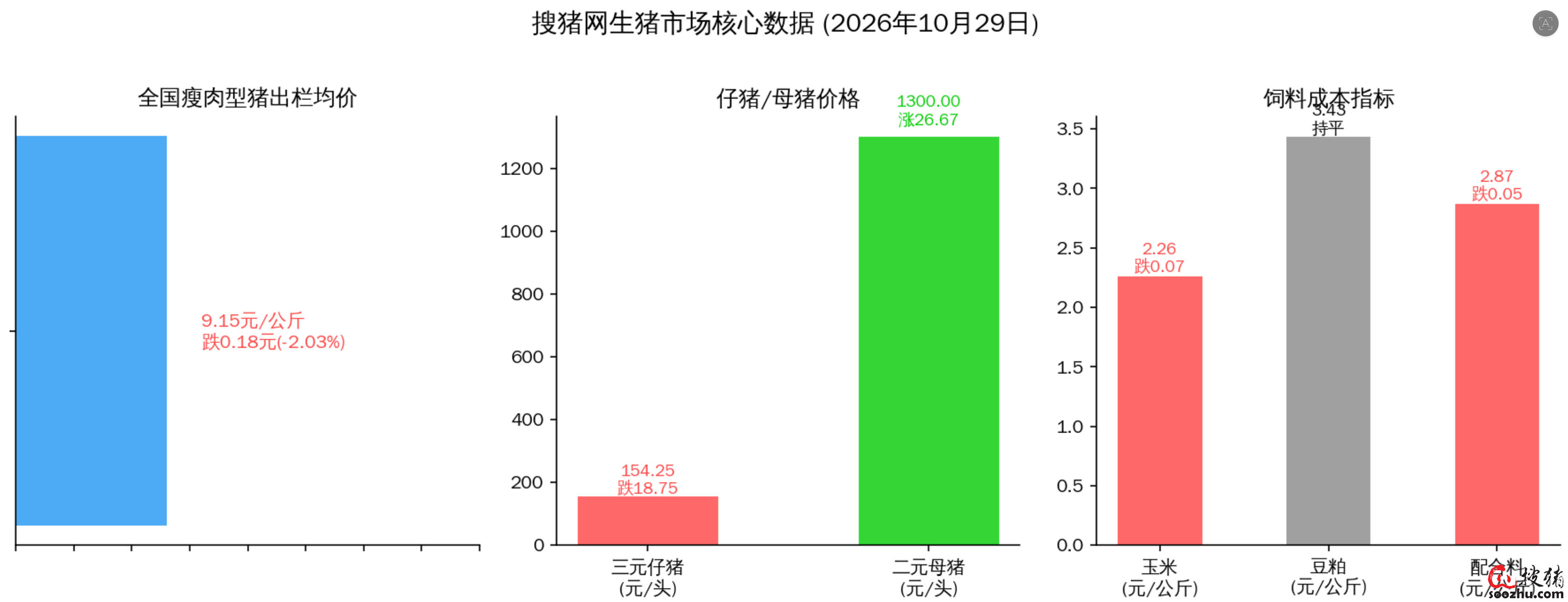
Today (2026year10month29day), the latest monitoring data from Souzhu.com shows that the national average price for lean pigs sold for slaughter was9.15yuan/kg, compared with the previous trading day (10month28day) of9.23yuan/yuan per kilogram fell0.18yuan/per kilogram, down2.03%The signal of a bottoming out and stabilizing that had just appeared yesterday was quickly breached today. The spot market fell to a new recent low once again.
Key spot market data
|
Indicator |
Price |
Rise and fall |
|
National average price of lean pigs sold for slaughter |
9.15yuan/kilogram |
-0.18yuan/kilogram(-2.03%) |
|
Average price of three-way crossbred piglets |
154.25yuan/head |
-18.75yuan/head |
|
Average price of a two-yuan sow |
1300.00yuan/head |
+26.67yuan/head |
|
corn purchase price |
2.26yuan/kilograms |
-0.07yuan/kilograms |
|
soybean meal purchase price |
3.43yuan/kilogram |
0.00yuan/kilogram |
|
feed price |
2.87yuan/kilogram |
-0.05yuan/kilogram |
Regional trend details
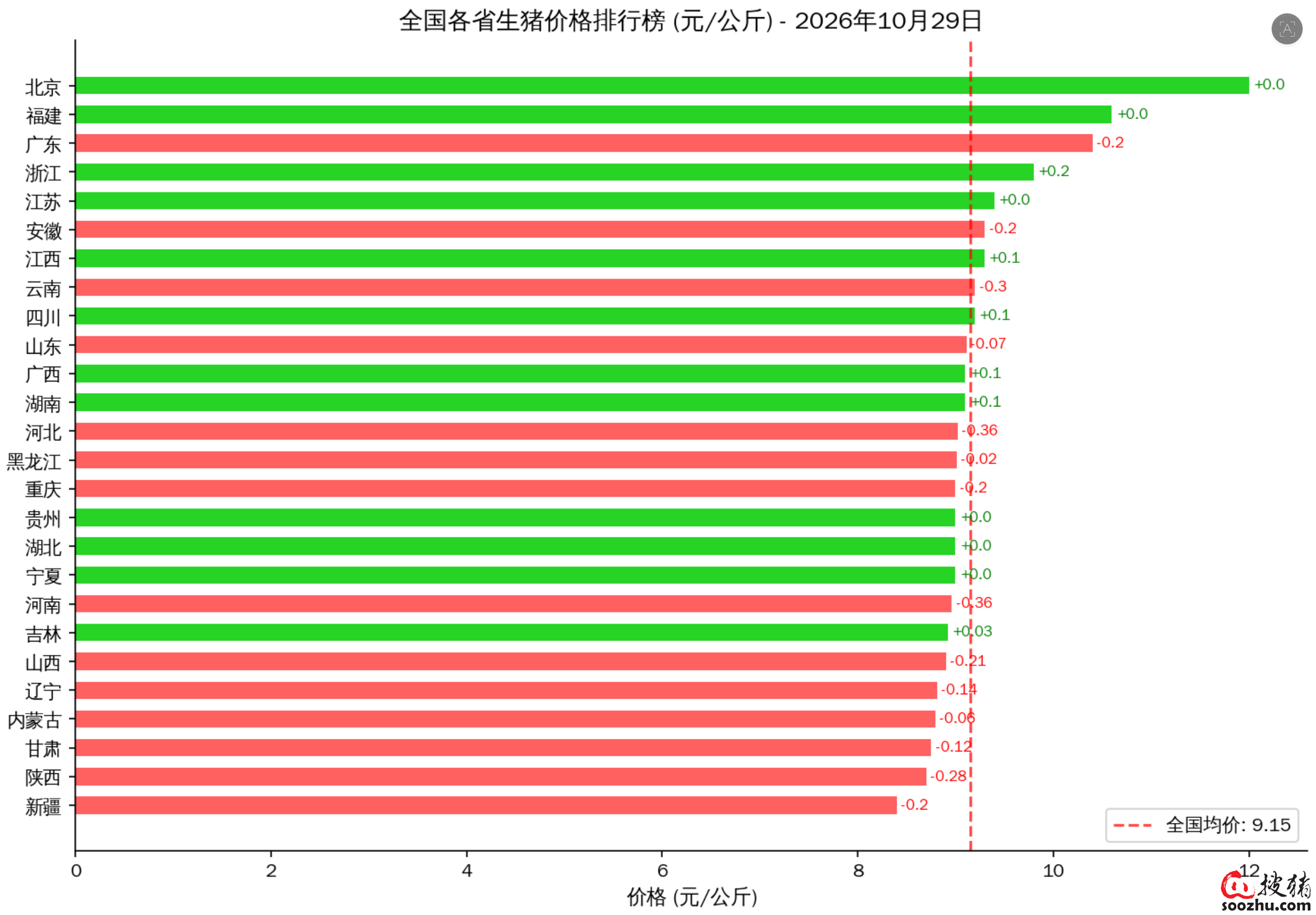
Today, the national hog price shows a"pattern of declines in the north, stability in the south, and widespread declines", the proportion of provinces that declined exceeded60%:
North China and Northwest China led the decline: Hebei-0.36yuan/kilogram, Henan-0.36yuan/kilogram, Shanxi-0.21yuan/kilogram, Shaanxi-0.28yuan/per kilogram, Yunnan-0.30yuan/per kilogram. Prices in provinces that rebounded yesterday fell across the board today, indicating weak bullish confidence. The rebound was merely a technical correction, not a trend reversal.
Divergence in southern sales regions: Guangdong-0.20yuan/per kilogram, Chongqing-0.20yuan/Kilos under downward pressure; Zhejiang+0.20yuan/Kilos rose against the trend; Anhui-0.20yuan/Kilograms declined, and the overall market in southern sales regions lacked clear direction.
Prices generally fell in the northeastern production regions: Liaoning-0.14yuan/per kilogram, Inner Mongolia-0.06yuan/kilogram, Gansu-0.12yuan/kilogram, Xinjiang-0.20yuan/Per kilogram, the northern region still has a low-price advantage, and pressure to sell hogs remains.
Provincial Hog Price Rankings
|
Province |
Average price (yuan/per kilogram) |
Change (yuan/kg) |
|
Beijing |
12.00 |
0.00 |
|
Fujian Province |
10.60 |
+0.00 |
|
Guangdong Province |
10.40 |
-0.20 |
|
Zhejiang Province |
9.80 |
+0.20 |
|
Jiangsu Province |
9.40 |
+0.00 |
|
Jiangxi Province |
9.30 |
+0.10 |
|
Anhui Province |
9.30 |
-0.20 |
|
Sichuan Province |
9.20 |
+0.10 |
|
Yunnan Province |
9.20 |
-0.30 |
|
Shandong Province |
9.11 |
-0.07 |
|
Hunan Province |
9.10 |
+0.10 |
|
Guangxi |
9.10 |
+0.10 |
|
Hebei Province |
9.02 |
-0.36 |
|
Heilongjiang Province |
9.01 |
-0.02 |
|
Ningxia |
9.00 |
+0.00 |
|
Hubei Province |
9.00 |
+0.00 |
|
Guizhou Province |
9.00 |
+0.00 |
|
Chongqing Municipality |
9.00 |
-0.20 |
|
Henan Province |
8.96 |
-0.36 |
|
Jilin Province |
8.92 |
+0.03 |
|
Shanxi Province |
8.90 |
-0.21 |
|
Liaoning Province |
8.81 |
-0.14 |
|
Inner Mongolia |
8.79 |
-0.06 |
|
Gansu Province |
8.75 |
-0.12 |
|
Shaanxi Province |
8.70 |
-0.28 |
|
Xinjiang |
8.40 |
-0.20 |
Summary of spot market trends
After briefly stabilizing the day before yesterday, spot prices weakened again today and hit a new low, indicating that a market bottom has yet to be confirmed. Although producers are strongly resisting lower prices, under the dual pressures of continued losses and high frozen-product inventories, their efforts to hold prices firm have not translated into actual price increases. Large-scale farms have somewhat slowed their shipment pace, but there has been no widespread holding back of market hogs, and market supply remains ample. In the short term, spot prices are expected to be within8.70-9.20yuan/The kilogram range continues to fluctuate at the bottom, awaiting substantive changes on the supply and demand sides.
II. Latest hog supply and demand monitoring by Souchow Network
(I) Supply side: Short-term pressure remains, while the long-term herd reduction logic is unchanged
Short-term pressure: The average weight of hogs currently marketed remains at125kgor above, with previously held-back heavy hogs and hogs from secondary fattening still in inventory, and a strong tendency to continue marketing. National Bureau of Statistics data show that pork production in the first three quarters was4508ten thousand metric tons, up year on year by3.2%,"Reduce the sow herd, not the meat"The characteristics are pronounced, and the short-term contraction in effective supply is limited. Today, the national average price fell below9.2yuan/kilograms, with the loss per head for self-breeding and self-raising operations widening further to350-400yuan/head, while small and medium-sized independent producers suffered greater losses.
Long-term herd reduction: at the end of the third quarter, the national breeding sow inventory fell to3602ten thousand head, a month-on-month decrease178ten thousand head, falling below for the first time3750ten thousand head, the normal inventory regulation threshold. However, there is a10-12-month transmission lag between sow herd reduction and contraction in market hog supply, corresponding to2027Market hog shipments will not decrease significantly until the second quarter of the year. Notably, the price of crossbred replacement gilts rose against the trend today.26.67yuan/per head to1300yuan/This may reflect that some large-scale farms have begun restocking quality breeding sows in anticipation of capacity reduction. This signal is worth watching but still needs to be verified.
(II) Demand: The seasonal low is nearing its end; expectations for preserved-meat demand remain to be verified
It is currently the seasonal consumption off-season, and the operating rate of slaughtering enterprises is maintained at only30%or so, while the fresh-sales rate is low. However, as temperatures fall,11month onward, seasonal demand for preserved meat, sausage stuffing, and similar products will gradually pick up, marking a peak demand window for the year. However, weighed down by three factors—the changing structure of household consumption, stronger substitution by beef and mutton, and high frozen-product inventories—the demand boost from this year's peak preserved-meat season is likely to fall short of previous years, leaving limited room for a spot-market rebound.
(III) Summary of supply-demand balance
The current hog market is in a"divergent situation: expectations for a favorable reduction in future production capacity contrast with unchanged short-term ample supply and demand"pattern: the stabilization of spot prices is more a result of sentiment recovering than a reversal in supply and demand. Only when the reduction in the breeding sow herd is consistently realized, frozen product inventories have declined significantly, and the supply of large hogs has been fully absorbed will there be a signal that a turning point in supply and demand has arrived.
III. Analysis of Hog Futures Market on the Dalian Commodity Exchange (Closing on 10 month 29
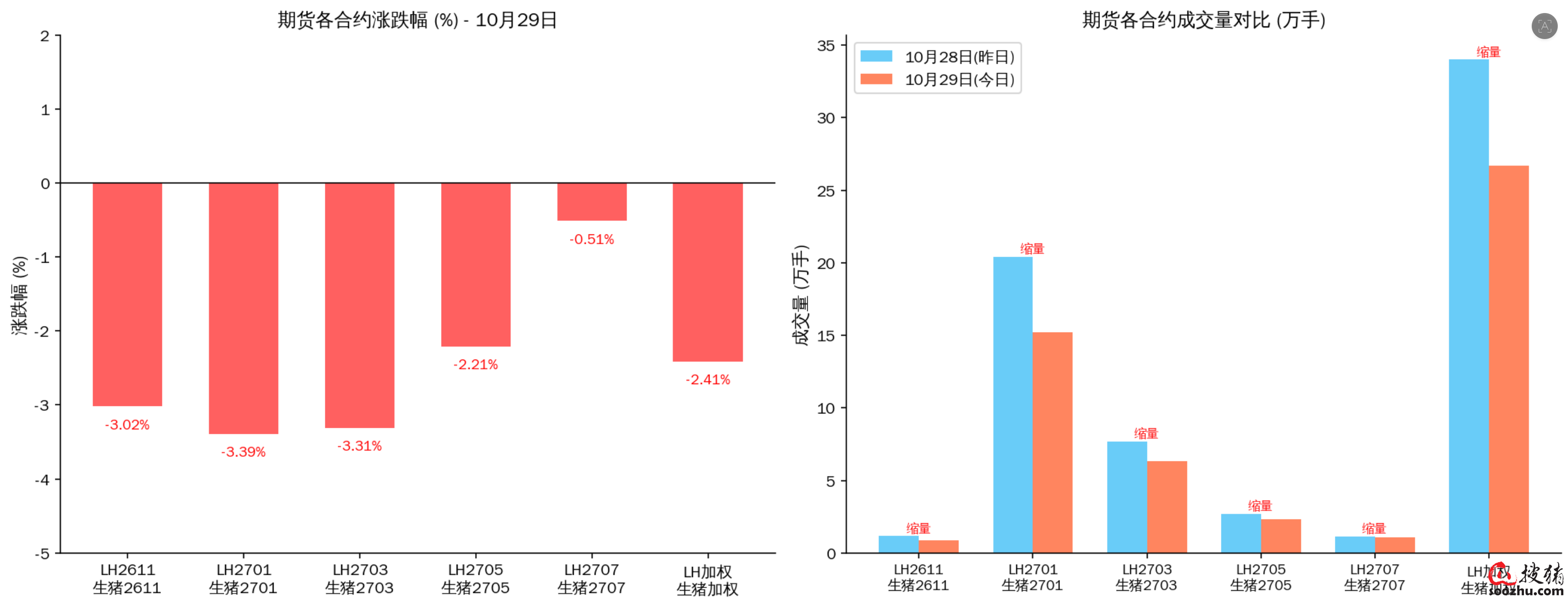
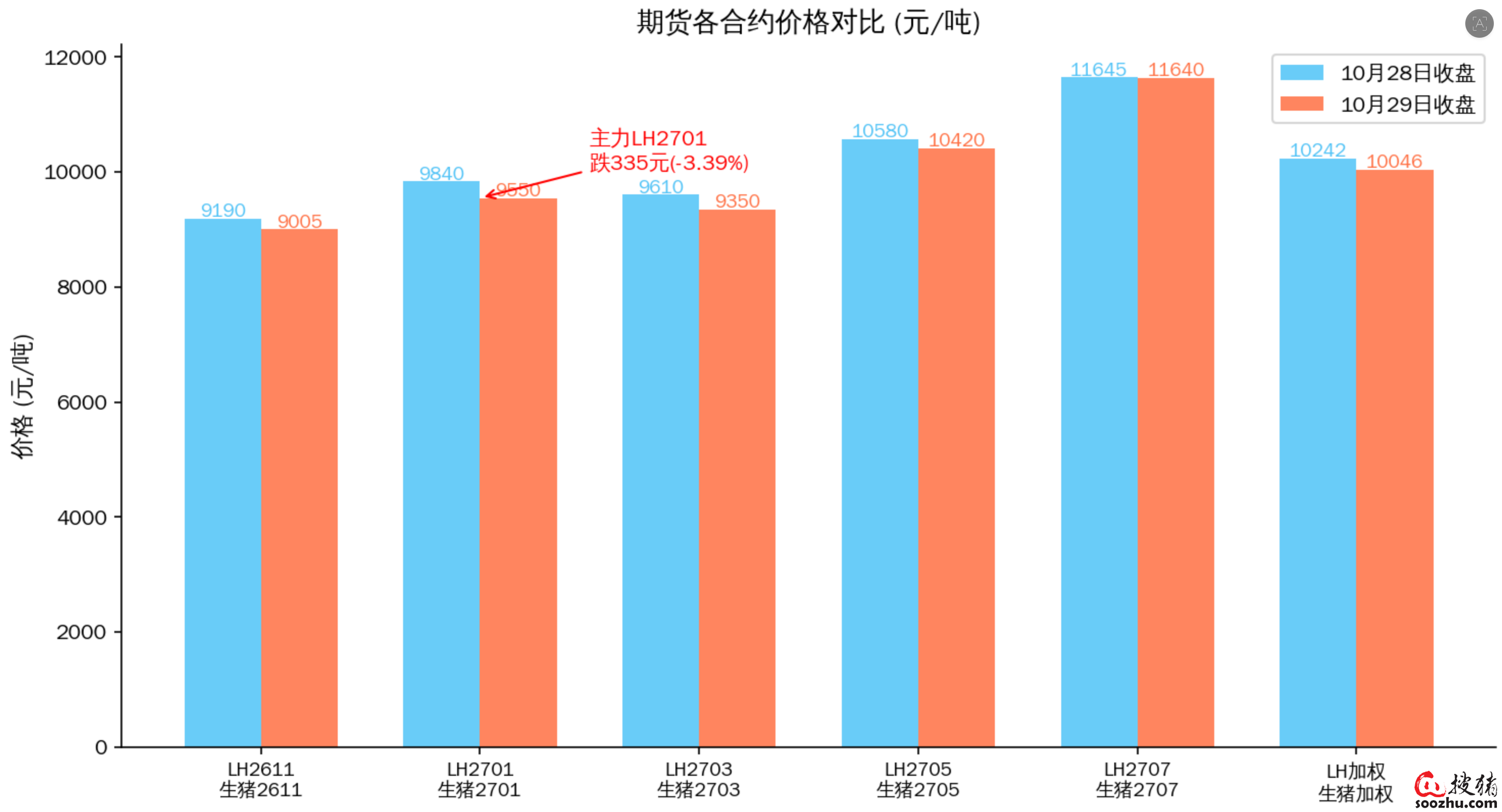
Today, the hog futures market showed"a sharp drop across the board, with declines on lower trading volume"trend. Weighed down by spot prices hitting new lows again, live hog futures fell sharply across all contracts, and the most actively traded contractLH2701fell3.39%at9550yuan/yuan per ton, approaching9500yuan, a round-number threshold. Notably, despite the sharp decline, trading volume in all contracts shrank significantly compared with yesterday, with the most-active contract falling from20.4ten thousand lots to15.2ten thousand lots, a decline of approximately25%, indicating insufficient willingness among bulls to buy the dip, while the momentum of bears chasing the decline is also waning, leaving the market in a"downward trend without volume support"weak, volatile pattern.
Futures Price Overview
|
Contract Code |
Name |
Latest Price(yuan/ton) |
rise/fall(yuan/ton) |
percentage change(%) |
Total volume(ten thousand lots) |
Amount(hundred million yuan) |
highest(yuan/ton) |
amplitude(%) |
|
LH2611 |
Live pigs2611 |
9005 |
-280 |
-3.02% |
0.88ten thousand |
12.81 |
9145 |
1.51% |
|
LH2701 |
live pigs2701 |
9550 |
-335 |
-3.39% |
15.2ten thousand |
234.75 |
9750 |
2.23% |
|
LH2703 |
live pigs2703 |
9350 |
-320 |
-3.31% |
6.33ten thousand |
95.26 |
9600 |
2.74% |
|
LH2705 |
Live pigs2705 |
10420 |
-235 |
-2.21% |
2.32ten thousand |
38.81 |
10570 |
1.97% |
|
LH2707 |
live pigs2707 |
11640 |
-60 |
-0.51% |
1.10ten thousand |
20.40 |
11670 |
0.98% |
|
LHweighted |
weighted live pigs |
10046 |
-248 |
-2.41% |
26.7ten thousand |
419.59 |
10198 |
1.74% |
Most-traded contractDetailed review of LH2701
Today's most-traded contractLH2701Closed at9550yuan/tons, a sharp drop335yuan/tons, a decline of3.39%, intraday high9750yuan/per ton, with the low not falling below9500threshold, trading volume15.2ten thousand lots, compared with yesterday20.4Ten thousand lots contracted by approximately25%, changes in open interest need to be further analyzed in conjunction with post-market data.
Market trend rationale: Yesterday, spot prices stopped falling and stabilized, which gave the market some confidence. Futures may have seen a tentative rebound in the morning session, but spot prices quickly fell again today, reaching a new low and directly undermining bullish confidence. Futures weakened along with spot prices, but the key signal was the significant contraction in trading volume——this indicates that there was no panic selling during the sharp decline. Bears were mainly reducing positions to take profits rather than entering the market in large numbers with new short positions, leaving some possibility of a subsequent rebound.
The deeper implications of a plunge on shrinking volume: The contraction in trading volume signals two things. First, bullish bargain-hunting funds are cautious and unwilling to enter with heavy positions before a bottom is confirmed, reflecting disagreement in the market over where the bottom lies. Second, although bears have the advantage and are driving prices down, they are not sufficiently determined to add to short positions; this may be because earlier short positions are being closed to take profits as prices fall. This"There is a downward trend, but no supporting volume."This pattern usually means the downtrend may be nearing its end, but confirmation of a bottom still requires a signal of increased volume and price stabilization.
Comments on Other Contracts
LH2611(nearby contract): decline of3.02%at9005yuan/tons, with a trading volume of only0.88ten thousand lots, indicating poor liquidity. The nearby-month contract is at a substantial discount to spot, leaving limited room for basis recovery.
LH2703 (the second-nearest active contract): decline3.31%Report9350yuan/tons, trading volume6.33ten thousand lots, with a decline close to that of the front-month contract, indicating that the deferred-month market is also under pressure.
LH2705/LH2707(Far-month contracts): The declines are relatively smaller (-2.21%, -0.51%), showing a contango structure with both near- and far-month contracts weak. However, the far-month decline is clearly smaller than the near-month decline, indicating that the market still has some expectations of improved supply and demand in the longer term.
IV. In-Depth Analysis of Market Sentiment and Bull-Bear Forces
(I) Market Sentiment
Farming segment: After a continuous week of declines, the proportion of farms operating at a loss has increased further. Although smaller farmers are strongly resisting lower prices, their confidence is clearly lacking. Signs of stabilization appeared only yesterday, but prices broke through those levels today, indicating that farmers lack confidence in the sustainability of price increases. Some may choose to sell their livestock as the market falls to reduce losses.
Industry segment: Slaughtering companies and traders are still primarily"producing according to sales"with little inclination to proactively raise purchase prices for hogs and doubts about the sustainability of price increases, leaving sentiment cautious. With frozen product storage capacity utilization high, slaughtering businesses are more inclined to buy at low prices to build inventory rather than raise prices to compete for hogs.
Speculative segment: There may have been tentative entry by bargain-hunting funds in the futures market during the morning session, but the rapid retreat in spot prices undermined bullish confidence. The key signal is that trading volume contracted sharply compared with yesterday, indicating that funds are unwilling to commit heavily to long positions before a bottom is confirmed. Overall sentiment is cautious to bearish.
(two) Bull-Bear Tug-of-War
|
Strength |
Core logic |
Current strength |
|
Bullish |
1.The breeding sow inventory has fallen below the target reserve level, confirming the capacity reduction logic |
Moderately weak, with a lack of sustained capital inflows |
|
Bears |
1.Large hogs are being held back for sale, and frozen-product inventories are high; short-term supply pressures have not eased |
Relatively strong, but momentum for chasing the short is fading due to lower volume |
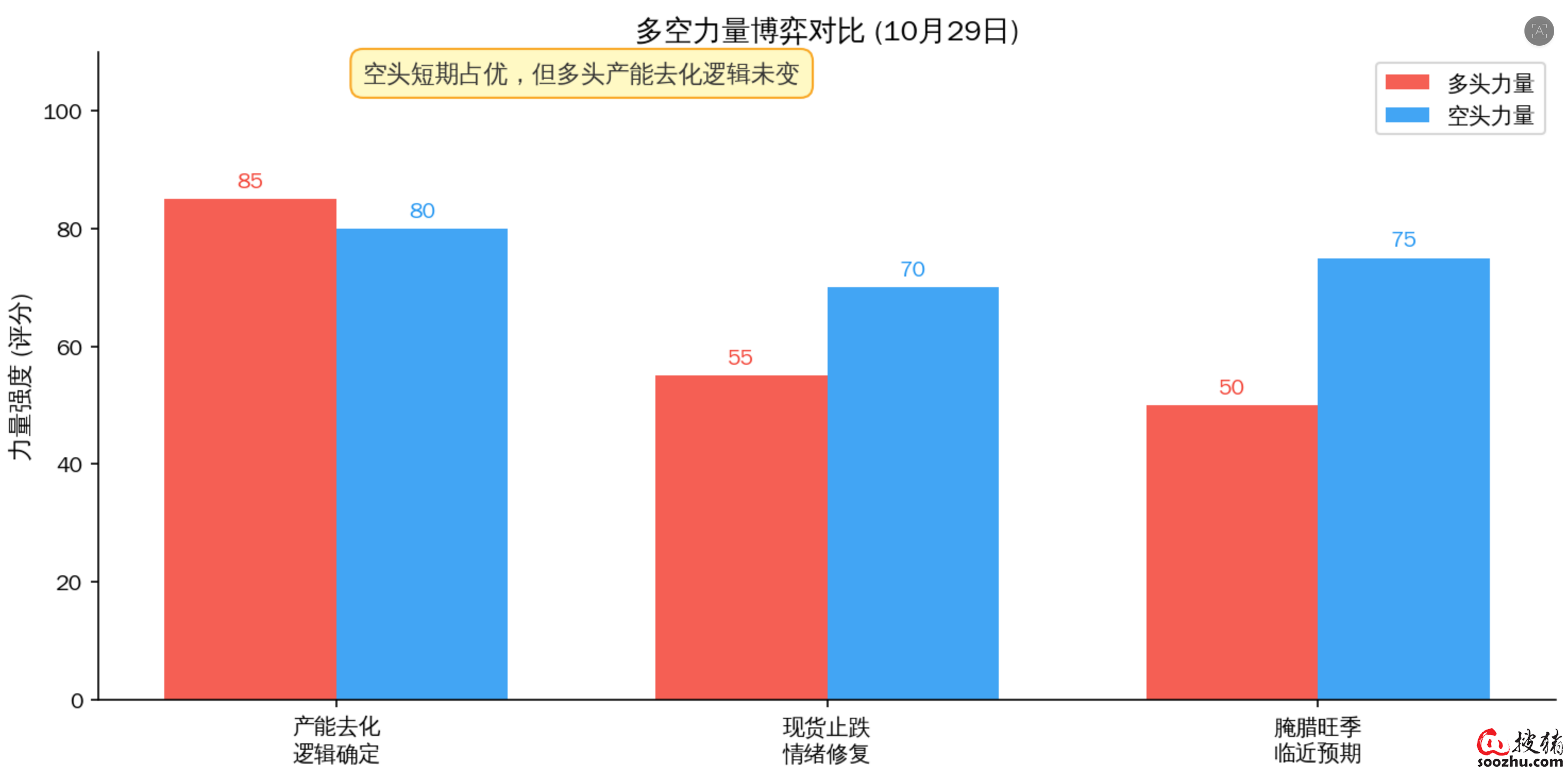
The current market is in a state of"bearish dominance but fading momentum"The bears have the near-term pressure of ample supply, driving prices steadily lower; the bulls have long-term support from capacity reduction, but lack investor recognition and short-term catalysts. The decline in the main contract on falling volume is a signal worth noting—Historically, similar"Volume contraction probing for a bottom"This pattern often appears near a cyclical bottom, but confirming a bottom requires seeing prices stabilize on increased volume or a positive catalyst.
V. Outlook and Trading Recommendations
Spot Market
In the short term, supported by firm pricing on the farming side and reduced sales from large-scale farms, spot prices will be at8.70-9.20yuan/The kilogram range fluctuates,11After the peak season for curing and preserving begins in the month, a temporary rebound is expected, but its potential is limited, with the peak expected at9.80-10.00yuan/About kilograms. If spot prices fall below8.70yuan/kilograms, which may trigger larger-scale capacity reductions and provide strong support for forward prices at that time.
Futures market
Main contractLH2701In the short term, it will be9300-9900yuan/The ton range fluctuates, with the upper side9750-10000yuan/The pressure in tons is relatively high; below9300-9500The yuan support is relatively strong. Far-month contracts will continue to price in expectations of capacity reduction, but volatility will intensify markedly. Key signals to watch: first, whether trading volume can expand again (whether on rising or falling prices, increased volume can confirm the direction); second, whether spot prices can stabilize at their current levels3More than one trading day.
Operating recommendations
Aquaculture companies: can be used when futures market prices rebound to9800-10000yuan/For the tonnage range, use moderate selling hedges to lock in sales prices for the first quarter of next year. We do not recommend panic selling at the current low; you can wait for the market during the peak curing season.
Speculators: The current market is range-bound with a bearish bias; it is advisable to wait and see. If trading volume picks up again and prices stabilize, consider cautiously testing a long position with a small amount, setting the stop-loss below the previous low. Strictly control position size; do not chase rallies or sell into declines.
Risk warning
1.Capacity reduction is below expectations: if the pace of reduction in the breeding sow population slows going forward, deferred-month contracts will face downward pressure.
2.Demand falls short of expectations: If consumption during the peak season for cured and preserved foods performs worse than in previous years, the scope for a spot market rebound will be further constrained.
3.Disease risk: Winter is a peak season for diseases such as African swine fever. If a regional outbreak occurs, it will affect short-term supply and market sentiment.
4.Operational risk: Futures markets are highly volatile, so invest with caution. The above analysis is for reference only and does not constitute investment advice.
Sozhu.com analyst Dashi Xiong
2026 year 10 month 29 day