Pig prices plunge, with the average approaching 4.5 yuan/jin. Could a turnaround be just around the corner?
As the end of 10 approaches, the domestic hog market is currently facing an imbalance between supply and demand that is difficult to reverse. Supply continues to weigh on the market, while demand provides little support, highlighting strong supply and weak demand. Domestic pig prices have “fallen relentlessly”! During the traditional seasonal peak in pork consumption, the “Golden September and Silver October” period, the hog market has seen a “precipitous” decline. It is reported that at the beginning of last month, domestic prices for standard hogs briefly rebounded to around 11.09 yuan/kg. However, the pre-holiday rise in pig prices “failed to materialize.” With the market experiencing a peak season that was not really a peak, prices gradually declined. At the end of 9, prices for standard hogs fell below 10 yuan/kg. In 10, although prices briefly rose to 10.25 yuan/kg at the start of the month, demand came under increasing pressure at the margin and supply pressure continued to be released, leaving the market listless and prices in a “precipitous decline”!
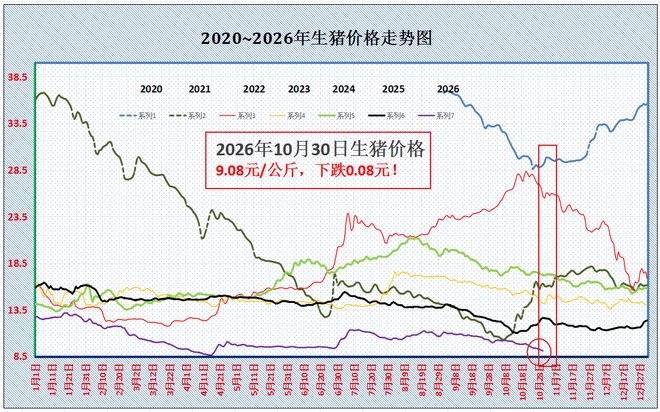
As of 10 30, institutional data showed that the national average slaughter price for standard lean-type pigs of the three-way crossbreeds was 9.08 yuan/kg, down another 0.08 yuan from the previous day. Pig prices remain weak near the bottom, with the average hog price approaching 4.5 yuan/jin. After falling into the “4-yuan era,” pig prices continued to decline. Compared with the beginning of last month, they have fallen by nearly 18% in total, with the price level dropping from 11 yuan to 9 yuan/kg. The market’s “precipitous” decline is becoming clear!
According to the latest information, the hog market is seeing a broad-based decline across the 28 northern and southern regions monitored nationwide. In the north, prices in the Northeast market—Heilongjiang, Jilin, and Liaoning—fell to 8.9-9.2 yuan/kg; in the North China market, prices in Shanxi and Hebei were 8.9-9.05 yuan/kg; and in the Northwest, prices in Shaanxi and Gansu fell to 8.8-9.2 yuan/kg. In the south, prices in Sichuan and Chongqing in the Southwest were 8.85-9 yuan/kg, and prices in Yunnan and Guizhou were 8.5-9.05 yuan. In East China, prices in Shandong and Anhui were 9.1-9.15 yuan, while prices in Jiangsu and Zhejiang were 9.15-9.45 yuan. In Central China, prices in Henan were 9.05 yuan, and prices in Hubei and Hunan were 8.85-9.15 yuan. In South China, prices across Guangdong and Guangxi were 9.05-10.55 yuan/kg!
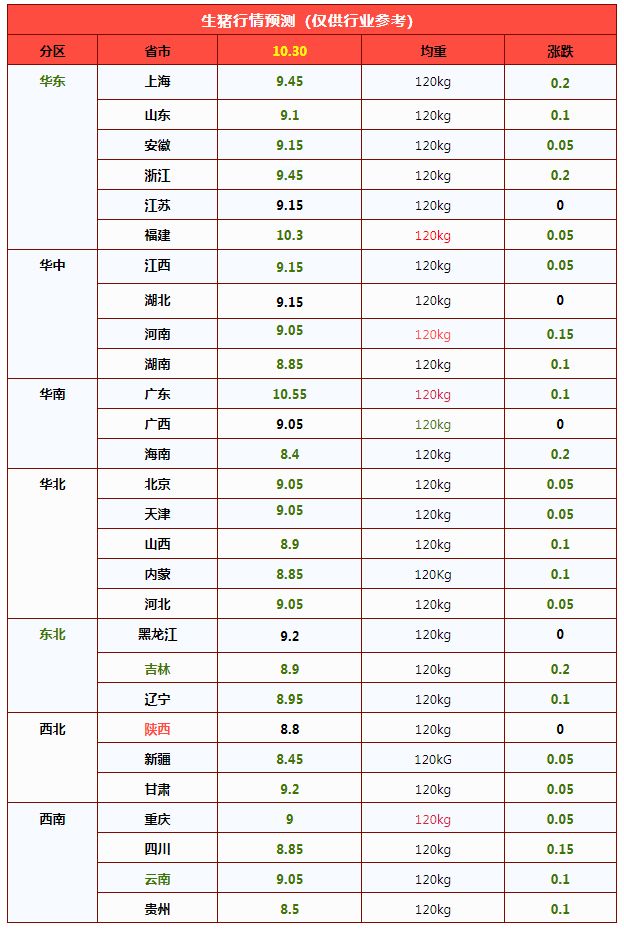
Thus, the hog market is continuing to decline across most of the 7 production regions in northern and southern China. The number of regions where the average hog price has fallen below 9 yuan/kg has risen substantially. In the high-priced East China market, prices have generally fallen to around 9.15 yuan/kg, and the market price level continues to move lower. The factors supporting the decline in pig prices are analyzed as follows:
On the demand side, an analysis of the consumer market shows that current white-strip pork prices in major domestic cities have fallen by 0.1 yuan in Beijing. Pork trading and procurement are average, and sales are not moving smoothly. In Shanghai, white-strip pork prices have stabilized at 12-12.2 yuan/kg. Wholesale market arrivals have decreased, and trading and procurement of white-strip pork are poor. Some markets still have a certain amount of unsold stock. At present, pork consumption is not sufficiently concentrated. Although the weather is turning cooler and temperatures are falling in the north, demand for pork trading and procurement at rural markets in the domestic market has improved. However, urban population mobility has declined and tourism consumption has cooled, with no clear increase in demand. Domestic slaughterhouses continue operating on an order-based basis, with the operating rate at sampled slaughterhouses at around 30.97%. Demand is providing no clear support.
On the supply side, regarding shipments from leading and larger pig producers, yesterday shipments from pig producers in the northeast increased, while shipments from large-scale producers in east, central, northwest, and southwest China fell slightly. However, as losses from pig fattening have deepened, the average loss per pig for farrow-to-finish operations exceeded 300 yuan this week. In addition, temperature fluctuations have intensified, increasing biosecurity risks at pig farms. With continued losses on the farming side, the need to recover funds has increased, and independent pig farms are actively willing to sell. As for hog deliveries to slaughterhouses, deliveries in the northeast were smooth yesterday, procurement was relatively easy, and market sentiment was bearish. In east and central China, sales progress among group pig producers was average, and slaughterhouse procurement was relatively smooth. In southern markets, some group pig producers made average progress toward completing their shipment plans. At present, market sentiment is mainly either bearish or stable, with little confidence in a price increase.
In particular, shipment plans among large-scale pig producers are high for 10; hidden supply capacity in pig farming is being released in a concentrated manner. In addition, farmers lack confidence in the market outlook, the weight of shipped pigs is rising, and the proportion of medium and large pigs in inventory is increasing. The price spread between standard and heavier hogs in China is narrowing, and concerns about an oversupply outlook for hogs and pork remain. This is driving increased shipments from various market participants.
Based on this analysis, demand is not strong enough to absorb supply, the seasonal recovery in demand is weak, and shipments from group pig producers are increasing during the month, while the pace of shipments has been slow. Market supply-side pressure is high. In the short term, hog prices may continue to fluctuate downward, and this decline is likely to push prices below 4.5 yuan/jin. As for forecasts of a hog price increase, the mainstream view is that after mid-to-late 11, as temperatures fall further and expectations for southern China’s preserved-meat season strengthen, the hog market may gradually improve. However, the scope for price increases will also be limited.
Prices plunge! Pig prices are falling “out of control”—can even the Second Brother Pig at 9 yuan per kilogram “stay steady”?
Time flies; less than 10 month remains. As month-end approaches, in China’s livestock and poultry farming sector, the live pig market continues its lackluster trend, with prices falling “out of control”! The traditional “Golden September and Silver October” has completely lost its luster, and pig prices are seeing a “peak season without a peak”! Earlier, at the start of Golden September, supported by the back-to-school season, pig prices briefly rebounded to 11.09 yuan per kilogram. Unfortunately, prices then began a “wave of declines.” Although the Mid-Autumn Festival and National Day holidays both came and went, the downward trend in pig prices proved difficult to halt. In particular, after National Day, prices followed a gradual downward trend, and producers entered a period of deep losses!
According to data monitoring and analysis, on 30 of 10, the national average ex-farm price for lean-type, three-way-cross live pigs was 9.08 yuan per kilogram, down 0.08 yuan from yesterday. Pig prices continued to retreat, with a cumulative decline of 18.12% compared with the beginning of last month! According to an industry survey, as of this week, the average loss per pig for China’s mainstream farrow-to-finish operations had increased to around 307 yuan, and producers had entered a “bottoming-out” phase. So how will pig prices develop next? Can even the Second Brother Pig at 9 yuan per kilogram stay steady? An analysis follows:
According to the data, pig prices are currently continuing to fall across the board in northern and southern China. In the 28 key provinces and cities monitored, mainstream live pig quotations fell by 0.05-0.2 yuan per kilogram. The average ex-farm price was close to the 9.1 yuan per kilogram recorded in Shandong. Live pig quotations in the north and south ranged from 8.45-10.55 yuan per kilogram, with Xinjiang the lowest and Guangdong the highest! In mainstream domestic markets, live pig quotations hovered around 8.8-9.45 yuan per kilogram. For a time, the live pig market saw prices fall across both the north and south!
As the saying goes, when things go against expectations, there is usually a reason. As pig prices fail to peak during the peak season, I believe the deeper explanation lies in the worsening imbalance between market supply and demand!
On the supply side, although the breeding sow inventory was gradually reduced last year, falling from 4074 ten thousand head to 3961 ten thousand head, the breeding sow inventory at the end of last year, at 3961 ten thousand head, was still far above the newly revised normal holding level of 3750 ten thousand head! Based on current inventory trends and the accelerated reduction in breeding sow numbers in the fourth quarter of last year, in theory, pressure on hog supply may ease during the “golden September and silver October” months this year! However, according to recent feedback, large corporate hog producers have increased month-on-month marketings over the past two months. In 10 month, planned marketings by large-scale hog producers increased by 1.91% month on month.
On the one hand, breeding sow numbers were reduced earlier, but the production base was high, and sow productivity improved significantly, so there is substantial pressure from latent production capacity in the market at this stage. On the other hand, with insufficient marginal support from demand, market expectations were uniformly bullish earlier, encouraging producers to hold back hogs for heavier weights and prompting rolling entry into secondary fattening. As the weather cools, hogs gain weight more quickly during fattening, while disease risks at hog farms increase. These factors further strengthen supply capacity and intensify the fundamentals of a high level of production capacity being released in phases!
On the demand side, peak-season pork consumption has been lackluster. Before Mid-Autumn Festival, demand was supported by the holiday, and slaughterhouse operating rates rebounded. However, the increase during the month was extremely limited, marginal demand from households was insufficient, and substitution consumption increased! Some hog producers faced constraints on completing their average monthly marketing plans. In 10 month, after National Day, consumption support weakened further, and slaughterhouse operating rates fell to around 30%. Although slaughterhouse order volumes increased slightly since the second half of 10 month, the increase was extremely limited! In addition, frozen pork has recently been shipped out in various regions, further limiting the recovery in slaughterhouse operating rates!
In summary, on both the supply and demand sides of the hog market, supply has increased in phases month on month, and a range of livestock producers have a strong need to convert inventory into cash, resulting in a greater willingness to market hogs. Meanwhile, demand has declined month on month, pork trading has been sluggish, and more frozen pork has been shipped out! With these opposing trends, the fundamentals of domestic hog prices are bearish, and the price center continues to fall!
As 10 draws to a close, pig prices have fallen to 9.08 yuan/kg. With market sentiment weak, prices remain under pressure to break lower. In this latest decline, pig prices are likely to fall below 9 yuan/kg. Going forward, attention will focus on changes in the pace of market hog sales by corporate pig producers.
Piglet prices fall to a recent-year low, with a slight rise possible at year-end
【Introduction】Piglet prices have continued to decline, reaching a recent-year low. Although low prices would normally encourage producers to replenish their stocks at lower levels, expectations for the market outlook remain weak and ongoing disruptions from pig diseases have kept producers' willingness to restock low, with demand for piglets remaining subdued. As time passes, producers' expectations for prices at their upcoming marketing points have shifted somewhat. Restocking enthusiasm may improve marginally at year-end, and piglet prices could see a slight recovery. However, factors such as production capacity and production efficiency are likely to limit the upside.
Piglet prices fall to a recent-year low
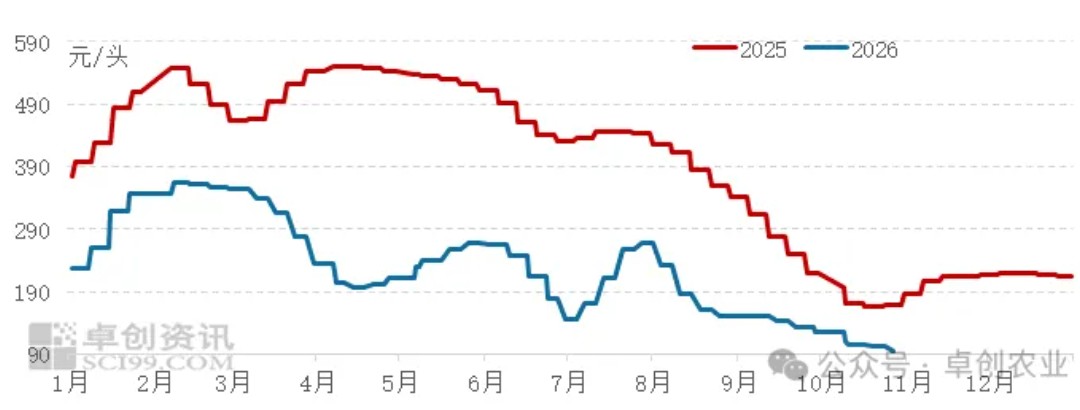
Data from Zhuochuang Information show that since month 8, the national market price of 7-kilogram piglets first fell rapidly and then declined slowly. As of 10 month 23, the market price of 7-kilogram piglets was 95 yuan per head, down 174 yuan per head from the price at the end of month 7. The data show that piglet prices have fallen below their recent-years low, and also, for the first time in recent years, dropped below 100 yuan per head. Generally speaking, when piglet prices fall to low levels, some producers are attracted to replenish their herds at lower prices. However, piglet prices have now remained at relatively low levels for several months, during which producers’ enthusiasm for replenishing their herds with piglets has been difficult to improve significantly. One reason is that producers are relatively pessimistic about the market outlook; another is that the normalization of pig diseases has made producers more cautious about replenishing their herds.
Figure 1: Zhuochuang Information’s monitored trend in the national price of 7-kilogram piglets
Hog prices hovering at the bottom have kept demand for piglets low
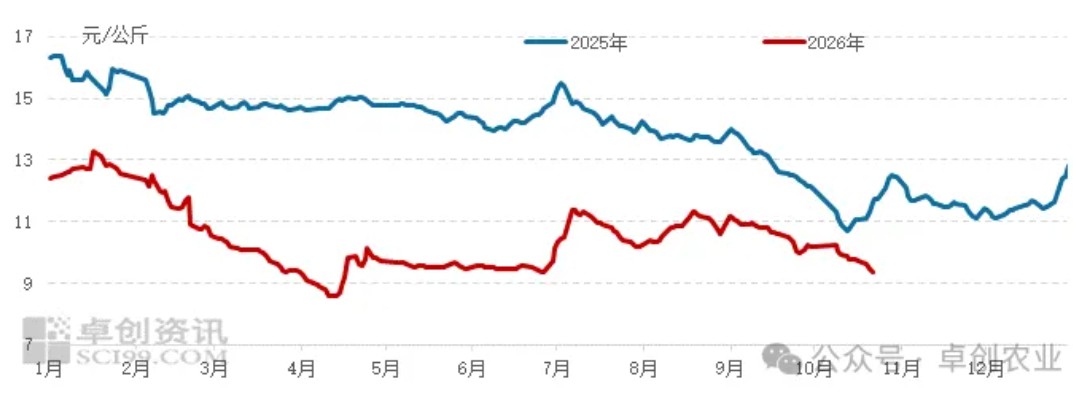
Zhuochuang Information’s hog research group previously studied the correlation between piglet prices and hog prices. The results showed that piglet prices are one of the indicators for gauging producers’ expectations for future hog prices. Piglet prices have fallen to a recent-years low but have still not stimulated producers’ enthusiasm for replenishing their herds, indicating that producers are pessimistic about future hog prices. Based on the growth cycle, the 7-kilogram piglets stocked in months 8-10 will be marketed in months 2-4 of year 2027, when demand will be at a post-Spring Festival low and hog prices may remain low, failing to provide producers with sufficient incentive to stock piglets. Meanwhile, hog prices have fluctuated downward in recent months, with no adequate upward momentum yet in evidence. Some producers are relatively pessimistic about the market outlook; combined with the continued presence of pig diseases since the second quarter, this has made producers relatively cautious about stocking piglets. Overall demand for piglets is low, and prices have hit a new low.
Figure 2: Zhuochuang Information’s monitored national average live pig price trend
Piglet prices may edge up at year-end
According to research, pig farms’ willingness to restock piglets increased slightly in the second half of 10 month. In 11 month, on the one hand, the cost of restocking piglets is low; on the other hand, piglets restocked in 11-12 will be marketed in 2027 5-6. By then, live pig prices may recover, and pig farms have some expectations of rising prices, which may support an increase in their willingness to restock piglets. However, capacity reduction remains limited and psy is rising. Some pig farms still have limited expectations of higher prices in the later market, so willingness to restock piglets in 11-12 may not increase significantly, and the rise in piglet prices may be limited.
Regional capacity divergence is reshaping live pig circulation patterns
[Introduction] In 2026, regional differences emerged in the pace of capacity reduction and recovery in China's domestic hog industry. Self-sufficiency rates varied across provinces, reshaping the pattern of interregional hog transportation. Traditional exporting provinces saw a contraction in outbound shipments, while reliance on external supplies declined in major consumption regions. Looking ahead to 2027, the radius of interprovincial live hog transportation may narrow further, the flexibility of outbound shipments to other regions may weaken, and the share of nearby allocation may increase, as the structure of interprovincial live hog flows continues to improve.
Changes in the proportions of regional inflows and outflows in 2026
In 2026, supply capacity changed across regions, and hog transportation patterns reflected a shift of hogs from south to north.
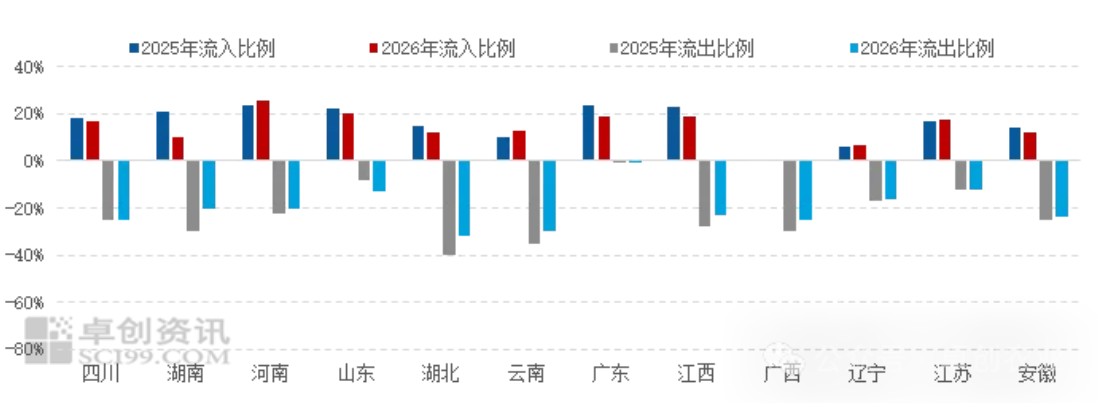
Comparison chart of the proportions of hog inflows and outflows in China's key provinces, 2025-2026
Comparing pig transportation patterns over the past two years, the inflow and outflow patterns have diverged significantly across provinces. On the inflow side, Henan’s inflow share rose from 23.50% to 25.50%, making it one of the few provinces where the inflow share continued to increase. The inflow shares of Hunan, Guangdong, Jiangxi, Shandong, Sichuan and other major pork-consuming or balanced production-and-consumption provinces declined, with the sharpest decrease in Hunan.
The outflow pattern has been restructured. The outflow shares of traditional exporting provinces, including Sichuan, Yunnan, Hubei, Hunan, Guangxi and Jiangxi, narrowed, and the volume of pigs transported out decreased. On the one hand, in 2026, there were no significant price differences between regions, making it difficult to support large-scale cross-regional transportation. On the other hand, controls on quarantine certificates also restricted interprovincial transportation. Guangdong’s outflow share remained unchanged over the two years, with production and consumption staying balanced. Overall, as regions differ in the pace of production capacity reduction and recovery, regional self-sufficiency rates are diverging, dependence on external supply in traditional major pork-consuming regions is weakening, and the structure of cross-regional pig flows continues to adjust.
Regional outflow shares may converge somewhat going forward
Soochow Information expects the radius of pig transportation to narrow in 2027, with the proportion of interregional flows potentially slowing. The South’s breeding advantages are still likely to persist, sustaining its central position in China’s pig supply pattern. However, during this production capacity reduction cycle, the flexibility of subsequent sales from producing regions is also narrowing. Traditional major exporting provinces such as Sichuan, Hunan, Jiangxi and Guangxi have also strengthened their capacity to absorb local supply, slowing the pace of external sales. Guangdong has a large consumer base and relatively constrained local breeding resources, so demand for inbound pigs is likely to persist over the long term. However, as supply from surrounding producing regions decreases and supporting capacity within the province steadily increases, its inflow share may fall further. Climate and supporting conditions in northern regions constrain sow breeding, and capacity recovery is relatively slow. Shandong’s balanced production-and-consumption profile continues to strengthen, with its inflow share continuing to decline. Henan leverages its transportation hub advantage, together with production-and-consumption links across Central China, to maintain a two-way flow pattern with Hubei and Hunan.
Overall, as zoned prevention and control and the policy direction of “transporting pork instead of live pigs” continue to be implemented, alongside steadily rising self-sufficiency rates across regions, interprovincial live pig transportation will generally decline, circulation distances will shorten, and the share of regional, nearby allocation will increase.