Vitamins are important not only for the health of laying hens but are also key factors determining egg quality (eggshell, egg white, and yolk). This article briefly describes the specific effects of various vitamins on the three main components of eggs.
Effects of Vitamins on Eggshell Quality
Eggshell quality directly affects breakage rates and economic benefits. Vitamins mainly act by regulating calcium and phosphorus metabolism and maintaining oviduct health:
·Vitamin D3 (especially 25-hydroxyvitamin D3): the “commander-in-chief” of eggshell calcium deposition. Vitamin D deficiency can lead to thin-shelled eggs, soft-shelled eggs, or even shell-less eggs. Increasing vitamin D3 levels in the later laying period improves calcium transfer in the uterus, significantly enhancing eggshell strength and thickness,.
·Vitamin C: a “protective shield” during periods of stress. Under high summer temperatures or immune stress, laying hens’ ability to synthesize vitamin C declines. Supplementing vitamin C (can significantly increase eggshell strength and thickness and reduce the rate of breakage caused by heat stress.
·Vitamin A: a “repairer” of the oviductal mucosa. Vitamin A deficiency can cause damage to and shedding of the oviductal mucosal epithelium; in severe cases, it can also affect the normal secretory function of the shell gland as a whole.
·Vitamin E: has anti-stress effects and can alleviate the adverse impact of heat stress on eggshell quality. However, excessively high doses of vitamin E may have a slight negative effect on eggshell thickness.
Effect of vitamins on egg white (albumen) quality
The thickness of egg white (Haugh units) is an important indicator of egg freshness and quality:
·Vitamin B2 (riboflavin): the “catalyst” for egg white protein synthesis. Adding an appropriate amount of riboflavin to the diet can significantly increase albumen height and Haugh units, making the egg white thicker.
·Vitamins C and E: Their synergistic action can increase egg white thickness. Vitamin E deficiency can cause the egg white to become thin (watery albumen).
·Vitamin A: A deficiency in vitamin A can damage the oviduct, causing blood spots or meat spots to appear in the egg white and seriously affecting appearance quality.
The Effects of Vitamins on Egg Yolk Quality
Egg yolk color, size, and nutrient deposition are closely related to vitamins:
·Vitamin E (tocopherol): the egg yolk’s “preservative” and “color-enhancing helper.”
Antioxidant preservation: Protects carotenoids in the yolk from oxidation, thereby deepening and stabilizing the yolk color.
Nutrient enrichment: Adding vitamin E to feed can significantly increase the vitamin E content of egg yolks, producing functional eggs high in vitamin E.
·Vitamin A: A “double-edged sword” for yolk color. Vitamin A and carotenoids have similar structures, and the two interact functionally. When vitamin A is insufficient, carotenoids are converted into vitamin A, causing the color to become lighter.
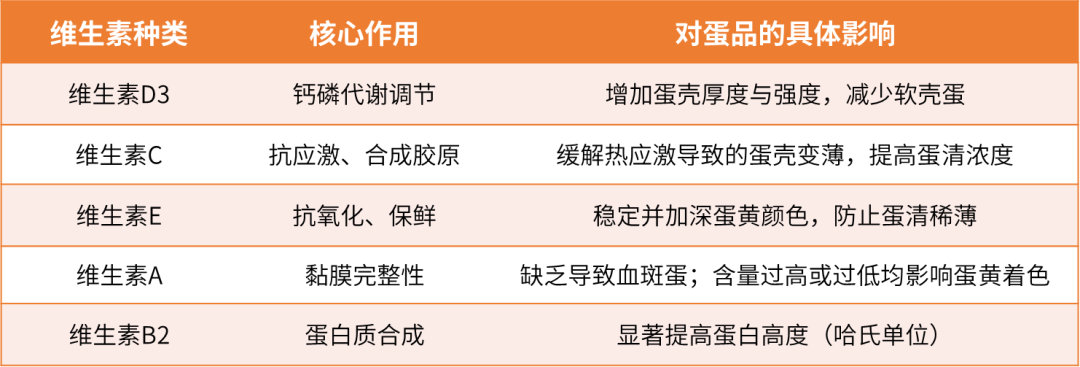
Summary table of the effects of vitamins on egg products