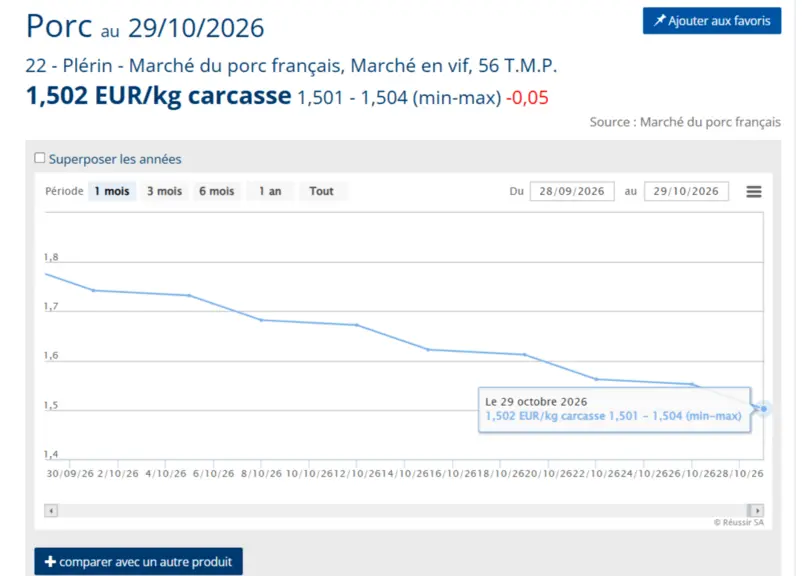
The French pig market has recorded a further drop in its quotation this week. With no prospects of improvement in the short term, producers are growing concerned as their margins continue to shrink in a context marked by limited outlets. Negotiations took place in a particularly tense atmosphere, as they have in recent weeks. Slaughterhouses are seeking to take advantage of abundant supply to keep their purchases at the lowest possible price, while farmers are trying to preserve profitability that has already been undermined by falling prices. In this difficult context for farmers, the sector is urging consumers to choose French pork in order to support producers and contribute to a better balance in the market.
Pig markets in northern Europe are lowering their quotations this week.
In Germany, the pig market has recorded a further drop of 8 cents this week. Despite an increase in slaughtering activity, major slaughterhouse groups are applying strong downward pressure on prices. Taking advantage of sufficient supply and a favorable balance of power, large buyers are seeking to obtain pigs at a lower cost, leading to a fall in the quotation. This continued pressure is weighing on producers, who face a market where outlets remain limited.
Read also: Pigs: the Philippines opens an investigation into imports, with the EU in its sights
The pig market in the Netherlands continues to decline, with the quotation falling by 5 cents. Available volumes are struggling to find buyers among slaughterhouses, which are facing limited outlets in the meat market. This situation is putting pressure on prices and contributing to the decline in quotations.
In Denmark, the pig market is also losing ground after a period of rising prices followed by stabilization over the past two weeks. Despite ample supplies on farms, pig volumes are not being marketed quickly enough. Against a backdrop of insufficient demand, the quotation is unable to rise.
Overall, the pig market in Europe is under strong downward pressure, with too many pigs available relative to sluggish demand, and no rebound is expected in the short term.