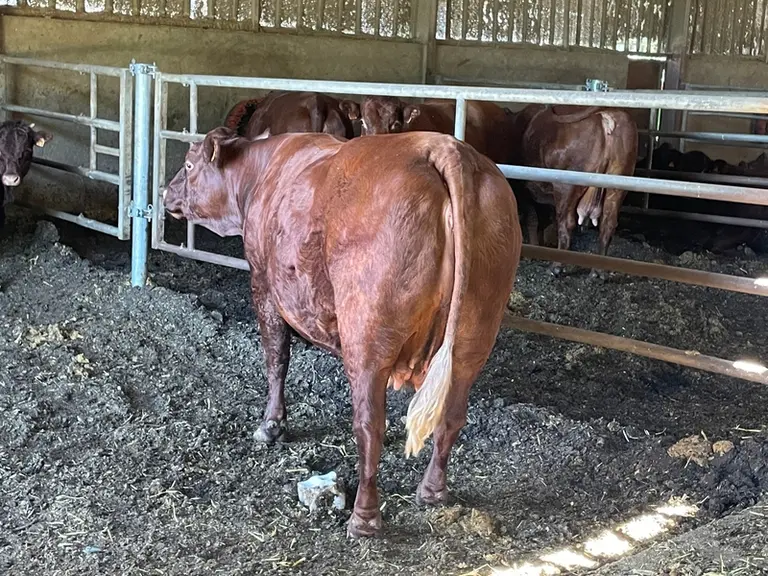
At EARL de Combelles, in Arpajon-sur-Cère in Cantal, Jean-François Bruel raises 100 Salers cows. To feed the herd, this long-standing member of the performance monitoring program relies each year on the forage balance, the analysis results for grass and maize silage, and the calculation of rations on the advice of François Martin, from the Cantal Chamber of Agriculture. The “very young cattle” (target 650 kgV at 15-17 months) are also weighed once a month, and the farmer quickly adjusts the ration if it needs to be fine-tuned.
Read also : Fattening store cattle: “I received support to develop my cow-calf system”
For these young males and for the fattening cows, he recently reviewed his practices to improve the feed value of their ration. It consists of maize silage and lucerne–cocksfoot hay, distributed with a straw chopper-distributor, along with cereals and a protein supplement spread over the top by bucket.
Yellow crusts around the eyes and raised hair behind the shoulder
“Last winter, Jean-François was going a little too fast when feeding the finishing groups. He has a lot of work to do with one labor unit per hundred calvings”, François Martin explains. “I observed that the cows were not ruminating very well.” A good proportion of them had yellow crusts at the corners of their eyes, a specific sign of excess soluble nitrogen, and their hair behind the shoulder was raised, a sign of licking after the meal because acidosis causes itching/pain. The advisor is trained in the Obsalim method and has incorporated into his advice his own way of observing cattle behavior. “This makes it possible to put into words the problems that can be explored in terms of ration efficiency.”
Read also: Beef cattle farming: “we build our margins for each herd category”
The ration was well designed; the only thing that needed changing was the ration distribution practices, so that the cows would eat more fiber before starting to eat the concentrate. “Now I organize things differently, explains Jean-François Bruel. I distribute the forage to the cows being fattened and then go to the other building to do something else. Half an hour later, I come back to distribute the grain and the supplement.”As early as two days later, the signs on the eyes and coat of the fattening cattle had disappeared. At the end of the fattening period,fattening: the cows remained in good condition and growth was in line with forecasts; the “very young cattle” reached their targets.
Farm profile
140 ha UAA: 3 ha of barley, 12 ha of wheat, 10 ha of silage maize, 10 ha of alfalfa and cocksfoot, 10 ha of multi-species pasture and 95 ha of permanent grassland
100 Salers cows with sales of young cattle (650 kg liveweight at 15-17 months) and breeding stock
1 UMO
Dietary adjustment through observation of signs
The Obsalim method consists of a systematic analysis based on observing cattle. It was developed by veterinarian Bruno Giboudeau starting in the early 90s. One hundred and forty-three symptoms are listed as specific identification keys relating to manure, the eye, nose, skin, hair, hoof, horns, milk and urine, as well as behavior, general condition, intake, reproduction, rumination and premises. The results indicate whether there is too much or too little fermentable energy and overall energy, fermentable nitrogen and total nitrogen, fine fiber and structural fiber, as well as the level of rumen stability.
Observations are made on a group of animals or the entire herd, by the farmer after training, an advisor or a veterinarian.
The method is detailed in the 4th edition of the book Cows Talk to Us About Feeding. It is also available as a set of around sixty cards with photos and software.