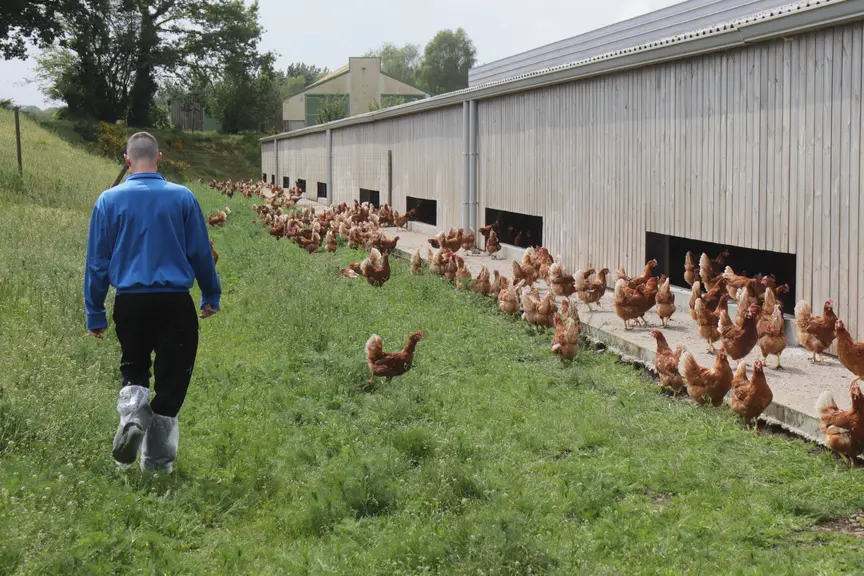
The decision to confine farmed poultry was made by the Minister of Agriculture, Fisheries, Food Security and Nature, Silvio Erkens, on Wednesday, 28 October. The measure came into effect after 3 consecutive reports of cases in the country: on 26 October in Lutjegast (Groningen), on 27 October in Middelie (North Holland), and on 28 October in Grootgast (Groningen). Taking into account the experience of previous years, with an increase in reports between October and November, the government wanted to take effective measures from the first cases to reduce contact between captive birds and wild birds. The bird confinement requirement applies to all farmed birds (with an exception for pheasants). The government also indicated that a mandatory vaccination plan was being considered for chickens playing hens in order to prevent avian influenza outbreaks and limit the recurring management of risk situations.
Culling of flocks of laying hens
Of the 3 outbreaks reported between 26 and 28 October, 45 000, 150 and 51 000 animals respectively had to be culled. The two outbreaks in the province of Groningen involved laying hens, while the outbreak in Middelie affected an educational farm. Restriction zones were established around the 3 outbreaks, each with a protection zone and a surveillance zone, with respective radii of 3 and 10 km. Before this measure, 8 cases of HPAI H5N1 had been recorded in wild fauna between 6 August and 14 October 2026 (ESA platform), marking the start of the epidemiological season 2026-2027. These cases involved Anatidae (ducks, swans and geese).