
I. Selecting chick weight
Egg weight multiplied by 70% is approximately equal to the weight of the hatched chick. As the age of the breeder flock increases, egg weight and chick weight increase. Chick weight can therefore be used to estimate the breeder flock’s age in weeks, and subsequent follow-up can help identify any problems that arise. The data in the table below show the relationship between egg weight and age in weeks for Ross 308 breeder chickens:
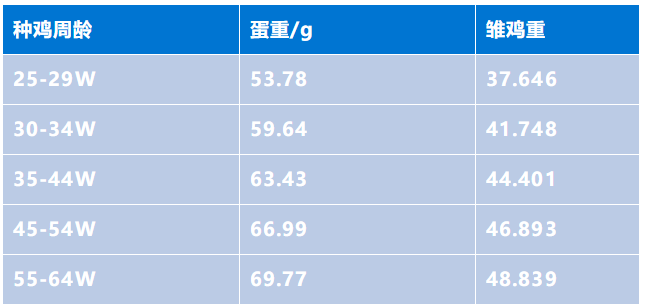
As can be seen from the table above:
When chicks weigh less than 38g, the breeder flock is in the early laying period. Chicks may start eating late, and the time to market may be delayed.
Some farmers have received chicks weighing 36g. The chicks ate relatively little during the first two days after arriving at the poultry house, then returned to normal from the third day. The farmers were concerned, but subsequent growth was normal; only the time to market was delayed by three days.
Chicks that weigh too little may have poor growth performance. Chicks that weigh too much are associated with the late laying period of the breeder flock. When antibiotics were used to treat bacterial infections, the treatment was less effective, suggesting that heavier chicks had stronger drug resistance. However, their growth performance was better than that of lighter chicks.
Farmers generally report that chicks weighing 39-45g are the easiest to raise.
Two. Maternal antibody levels
Laboratory monitoring data show that the average maternal antibody levels for NDV, H9, and H5 in most chicks are above 8.
Good maternal antibody levels are the foundation of a flock’s disease resistance in its early stages. Maternal antibody levels also provide a basis for determining the age for the flock’s first vaccination. Therefore, monitoring maternal antibody levels in chicks at 1 days of age is particularly important in clinical practice.
Three. Gizzard condition
Examinations of chick gizzards have found that the gizzard koilin layer in chicks at 1 days of age has relatively severe ulcers and cracks. Some experts point out that although a chick’s gizzard may be unhealthy, it will repair itself after feed is consumed, and this will not have a major impact on feed intake or health later on.
However, continued follow-up of flocks at later stages has found that flocks with severe gizzard damage in chicks later develop gizzard inflammation and proventriculitis, resulting in reduced flock production performance and lower production efficiency.
Four. Yolk proportion
The quality of chick rearing and management directly affects the chicks’ growth and development, production performance, survival rate, and other factors, and is closely related to farming profitability. Therefore, brooding is crucial. Successful brooding depends greatly on yolk absorption: the more uniform and complete the yolk absorption, the healthier the chicks.
After hatching, some yolk remains to provide part of the nutrients chicks need during their first 3 days of age and to supply maternal antibodies, thereby meeting their nutritional needs and helping them resist disease. However, problems that arise during brooding often lead to incomplete yolk absorption, affecting chick quality.
1、Unsuitable temperature
Sudden or uneven temperature changes affect yolk absorption in chicks.
Excessively high temperatures interfere with the dissipation of body heat and moisture in chicks, reduce their appetite, make them susceptible to respiratory diseases, slow their growth and development, and increase mortality.
At excessively low temperatures, chicks cannot maintain a stable body temperature and huddle together. This can cause breathing difficulties, halt yolk absorption, and even lead to chick deaths.
2、Unsuitable humidity
Because the temperature in the chick house is relatively high and there are few water sources inside, the environment can easily become dry, which affects yolk absorption in chicks.
3, insufficient water intake
Providing chicks with sufficient drinking water is a key measure for improving brooding survival rates and raising strong, healthy chicks.
First, after chicks hatch, the yolk in the yolk sac has not yet been fully absorbed. It takes 3-5 days for these nutrients to be almost completely absorbed. At the same time, substantial water is lost through respiration and defecation. Providing water properly can effectively promote the absorption and utilization of nutrients in the yolk sac, benefiting chick growth and development.
Second, chicks experience stress during long-distance transport and handling, resulting in water loss from their bodies.
Finally, after chicks are moved into the poultry house, excessively high or low indoor temperatures can make the environment dry, and chick excretion also causes water loss. If some chicks in the flock do not drink enough, yolk absorption may be affected, resulting in many weak chicks in the flock.
4, incorrect timing of first feeding
Starting chicks on feed at the right time is an important part of brooding. Timely feeding helps with yolk absorption and the expulsion of meconium, promoting chick growth and development.
Starting feed too early may damage chicks because their digestive organs are fragile, while starting too late depletes their energy and nutrients, hindering their development.
Chicks are generally given their first feed 12-24h after hatching. Mortality during this period is lowest when feeding begins. After the chicks have had access to water for 3h, 6-7 tenths of them can move around freely, and it is appropriate to begin feeding when half of the chicks show pecking behavior.
After conducting post-mortem examinations and weighing chicks from different batches and different suppliers, the author found that the yolk sac accounted for between 4% and 12% of body weight.
For chicks with a large difference in body weight and a relatively small yolk sac that accounts for a large proportion of their body weight, one would generally suspect whether the chicks are from the same batch and are 1 days old. This also places higher demands on subsequent feeding and management. For chicks with a relatively large yolk sac, its absorption should also be promoted by controlling temperature, humidity, and the time of first feeding.
V. Positive Rates for Escherichia coli, Salmonella, and Other Bacteria
Recent testing of Escherichia coli and Salmonella in chicks has shown a marked increase in detection rates. The Salmonella detection rate rose from less than 10% to 30%, with some samples reaching 62.5%. The Escherichia coli detection rate ranged from 30% to 80%.