
Genetic selection has long relied on criteria directly linked to performance. Today, animals must also be able to maintain their performance in varied environments and cope with changes in farming conditions.
Read also: “Our healthy pigs grow faster during the finishing phase”
The aim is to continue genetic progress in traits linked to profitability, while incorporating greater robustness, resilience and adaptability. For the breeder, this requires working on traits that are sometimes antagonistic. “The geneticist’s work is to improve several parameters without worsening the others. There is a trade-off to be found”, Loïc Flatrès-Grall, geneticist at Axiom, said at the company’s first international seminar, which brought together 250 participants from 29 countries to discuss robustness and the sustainability of the pig industry.
Tools for managing trade-offs
This search for trade-offs involves developing new selection tools. Axiom has notably been using Optimum Contribution Selection (OCS) since 2017. This mathematical method helps select the best candidates while preserving genetic variability and limiting the increase in inbreeding. “It is a decision-support tool that also makes it possible to take the performance of subsequent generations into account”, explains the geneticist.
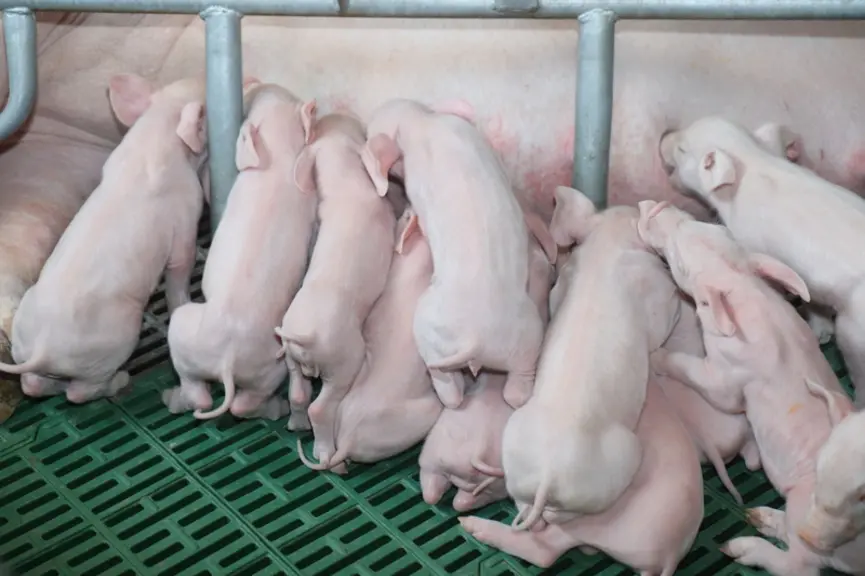
The challenge in the farrowing unit is to maintain performance in increasingly diverse environments and housing systems. The concept of robustness is therefore becoming all the more important. © A. Puybasset
Improving piglet survival
The farrowing unit clearly illustrates this search for balance. To increase sow prolificacy without compromising piglet quality, Axiom relies on the “GMQqmat” selection trait. Based on the difference in litter weight between 24 hours of life and 21 days, it measures the sow’s maternal ability to wean larger numbers of heavier piglets. “We want to increase litter size without compromising piglet weight. Over the past four years, we have gained around 0,5 live-born piglet per litter, while increasing individual birth weight by 40 grams”, explains Julien Selves, head of Axiom’s genetic creation division.
Selection therefore takes into account prolificacy, litter uniformity, the sow’s nursing capacity, and piglet survival at the same time. Birth weight is an important indicator of the rest of a piglet’s career. Heavier, more uniform piglets have a better chance of survival and growth. “Since 2021, Axiom has also selected for the proportion of piglets weighing less than 1 kg at birth. In two lines, this proportion fell from 24 to 14% in five years.
A growth robustness score
The search for robustness now extends to the growth phase. Axiom is developing a new indicator to characterize the ability of pigs in the fattening phase to maintain their performance under varying conditions. It combines several measurable factors, including weight, viability, and health status. “Although the heritability of robustness during the growth phase remains low, ranging from 0,04 to 0,13 depending on the lines, it is not zero: a response to selection is therefore possible”, notes Loïc Flatrès-Grall.
Axiom is therefore working on a new trait, named Alpha, related to feed efficiency and intended to estimate the animal’s sensitivity to its environment. It distinguishes animals that maintain their efficiency when rearing conditions vary. “With this new value, we will be able to measure more precisely the animal’s ability to respond to its environment, maintain the expected performance level and improve its resistance to stress situations—social, health-related and climatic,” concludes Albin Coz, Axiom’s Asia technical manager. This trait is calculated from data collected by the individual feeders installed at selection sites.
Measuring feed efficiency more effectively
The breeding company is also working on new indicators related to digestion and nutrient use, based on fecal analysis. The aim is to understand why some animals make more efficient use of their feed and, ultimately, to select pigs capable of producing more with fewer resources. By facilitating data collection, artificial intelligence should also improve the analysis of interactions between genetics, the environment and performance.
Glossary
Robustness :the animal’s ability to continue performing regardless of the environment.
Resilience :the animal’s ability to regain performance after stress