Although fertility monitoring in dairy herds has become widespread, it has proved difficult to implement in suckler farming. The reasons are multifactorial: animals grazing during the summer period, farmers being less sensitive to this issue…
Reproductive efficiency to measure on every farm
Three main criteria can be used to characterize reproductive efficiency in suckler herds:
- A high pregnancy rate
The pregnancy rate is the only way of expressing fertility. Calculated over a period of 12 months, which varies between herds depending on calving periods, it is equal to the proportion of pregnant females relative to the number of females bred. The generally accepted threshold is 92 % for Charolais and 95 % for Limousin.
- A calving interval of around 370 days
The average interval between calvingsSuccessive calvings are the most practical illustration of a cow’s fertility. The average calving interval reflects the herd’s fertility, with the aim of an average calving interval of around 370 days and a limited number of cows with an interval of more than 390 days. The indicators for our département are worrying, with an average calving interval of around 400 days for cows and 440 days for heifers.
- A calf mortality rate before 48 hours of less than 3%
The mortality rate of calves before 2 days is an indicator of a poor choice of bull, insufficient body condition in the mother, inadequate monitoring or a health problem. It is complemented by the mortality rate at weaning, ideally less than 5%. Unfortunately, the overall situation is deteriorating, with alarming national figures: 9,2% for Limousin, 9,7% for Charolais and 11,7% for Blonde d’Aquitaine. The causes are, of course, multifactorial (climate change, feed, health crises, genetics, increasing herd sizes, etc.), but the economic impact is considerable.
Assessing the herd and identifying potential areas for improvement
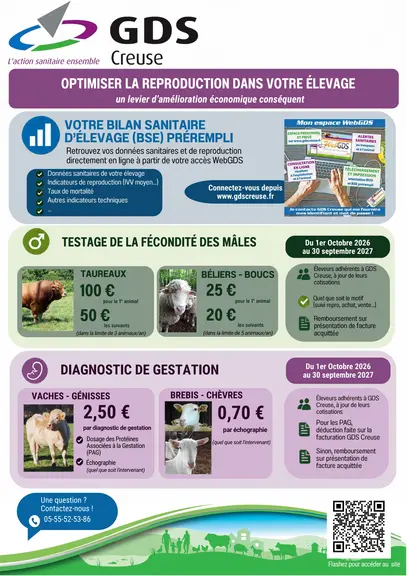
Analyzing a herd’s results using the above criteria makes it possible to quantify losses and the calculation of the number of calves weaned per cow put to breeding, or numerical productivity. This will involve identifying the farm-specific risk factors and implementing a prevention and control plan tailored to each farm according to its objectives. With the pre-filled farm health assessment provided by GDS Creuse (downloadable via WebGDS or available on request from GDS Creuse), for the desired campaign dates, everyone has their data and can assess their reproductive (and health) performance and initiate the corresponding analysis, particularly with their veterinarian.
A significant economic impact…
The first effect of good reproductive management is measured by the number of calves produced. Let us not forget the target: one calf weaned per cow per year. Simply going from an average calving interval (IVV) of 370 days to 380 days across 37 cows is equivalent to losing one calf, even if there is no carcass disposal form! Numerical productivity, which incorporates this average IVV together with pregnancy and mortality rates, is a key concept for every livestock farmer to know.
… increased in a year of drought
The year 2026 was marked by two major phenomena: a prolonged drought and repeated heat waves. Feeding an unproductive cow has a cost (2 € to 3 € per day, depending on the systems), which increased this year due to the very limited availability of feed resources. In addition, forage-based rations are unbalanced and deficient, particularly those based on straw. High temperatures have impaired the bulls’ libido and caused significant stress in cows, leading to reduced appetite and fertility, less pronounced signs of heat, and an increase in early abortions. More than ever, it is necessary to identify unproductive females as quickly as possible.
Managing reproduction requires daily vigilance…
For the farmer, this involves observing the animals daily to identify and record cows in heat, spot any abortions or returns to heat following pregnancy, and identify empty cows early so they can be culled. Ultrasound can also be used, or blood tests to measure Pregnancy-Associated Proteins (PAG). GDS Creuse offers to support you in this process (see box).
… and an annual assessment
The numerical productivity of suckler herds is a major factor in their economic success. If the indicators point to a problem, its cause must then be determined. For more information, you can consult GDS Creuse articles on “reproduction” or contact your veterinarian or GDS Creuse services.
Dr Boris Boubet
GDS Creuse – www.gdscreuse.fr