
In modern intensive farming systems, the impact of environmental factors on feather growth and health is becoming increasingly prominent. Among these factors, lighting is a core environmental parameter that can be precisely controlled, and its role is particularly important and complex. This article briefly describes how light affects poultry feather growth, health maintenance, and appearance quality. It also draws on key considerations from production practices to provide a theoretical basis and practical guidance for developing sound lighting management strategies and improving poultry feather quality and overall farming efficiency.
I. Physiological Mechanisms
Hormonal regulation: Light stimulates chickens’ retinas and affects the secretion of melatonin by the pineal gland, thereby regulating the levels of thyroid hormones (T3, T4), growth hormone (GH), and insulin-like growth factor (IGF-1). These hormones are directly involved in feather follicle development, cell division, and protein synthesis, promoting rapid feather growth.
Vitamin D metabolism: Ultraviolet light (UVB band, approximately 290-320nm) promotes the conversion of 7-dehydrocholesterol in the skin into vitamin D3, enhancing calcium and phosphorus metabolism. Adequate vitamin D helps keratin deposit in feathers, making their structure stronger and reducing the risk of breakage.
Blood circulation and metabolism: Moderate light stimulation can dilate blood vessels in the skin and increase blood supply to the feather follicle area, providing more oxygen and nutrients for feather growth. At the same time, light promotes overall metabolic activity and accelerates the feather renewal cycle.
II. Considerations
Light source selection: Natural light is best, but modern farms often use artificial light sources (such as LED and fluorescent lamps). Ensure that the light spectrum contains an appropriate amount of ultraviolet light (avoid excessive amounts that may cause skin damage) and visible light (especially the red and blue wavelengths, which are particularly important for hormone regulation).
Light intensity and duration:
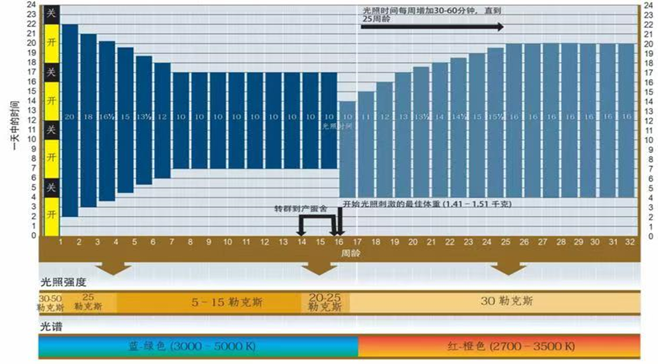
1, chick stage (0-4 weeks): Relatively strong lighting (20-40 lux) is needed to stimulate feeding and activity and promote rapid feather development, but excessively strong lighting should be avoided as it may cause feather pecking.
2, growing period (5-18 weeks): Gradually reduce the intensity to 5-10 lux to prevent premature sexual maturity while ensuring that feathers and bones grow in sync.
3, laying period: Maintain 10-15 lux, combined with 16-17 hours of long-day lighting to stimulate egg production, but prevent excessively long lighting periods from causing excessive feather wear.
Reducing feather-pecking behavior (protecting feather integrity):
1, optimizing light color: Red light (wavelength 600-700nm): Reduces the flock's visual sensitivity and reduces feather-pecking behavior (especially pecking at other birds). Studies show that the incidence of feather pecking under red light is 30-50% lower than under white light. Avoid blue light (460-490nm) and green light (500-570nm): These light colors may stimulate aggressive behavior in chickens and increase the risk of feather damage.
2, lighting uniformity: Ensure that lighting is distributed evenly throughout the chicken coop, avoiding dark areas that may cause the flock to gather and peck at feathers.
3, in combination with environmental management: Measures such as lowering stocking density and providing grit (to promote digestion and reduce boredom-related feather pecking) can help reduce feather damage.
Three, regulating feather color and quality
Pigment synthesis and deposition: Melanin: Light regulates melanin synthesis by affecting tyrosinase activity. For example, prolonged intense light may inhibit melanin deposition, making dark feathers lighter in color (for example, black-feathered chickens may develop a grayish tinge under sustained intense light). Carotenoids: In some chicken breeds (such as yellow-feathered broilers), the yellow pigment in the feathers comes from carotenoids in the feed. Moderate lighting (such as yellow or orange light) may promote carotenoid metabolism and enhance yellow coloration, but the effect is strongly influenced by genetic factors. Structural color: The iridescence or metallic sheen of some feathers is determined by their microscopic structure. Light may affect the arrangement of the feather's keratin layer, indirectly affecting its luster.
Commercial application cases:
1, ornamental chicken breeding: By controlling photoperiod and light color, varieties with specific feather colors can be selectively bred (for example, extending blue-light exposure to enhance blue tones).
2, broiler market grading: Some markets prefer broilers with a deeper yellow feather color. Increasing yellow-light exposure during the later stages of rearing may improve feather scores, but growth rate and color requirements need to be balanced.
Interactions with environmental factors:
1, humidity and lighting: High-humidity environments (>70%) combined with dim light can easily lead to feather mold and fading. Intense light (especially natural light), together with ventilation, can inhibit mold growth and keep feathers clean.
2, nutrition and lighting work together: when certain nutrients (such as sulfur-containing amino acids and B vitamins) are lacking, feathers may still appear dull and break easily even with sufficient light. Ensure that feed formulations and lighting management are optimized in coordination.