
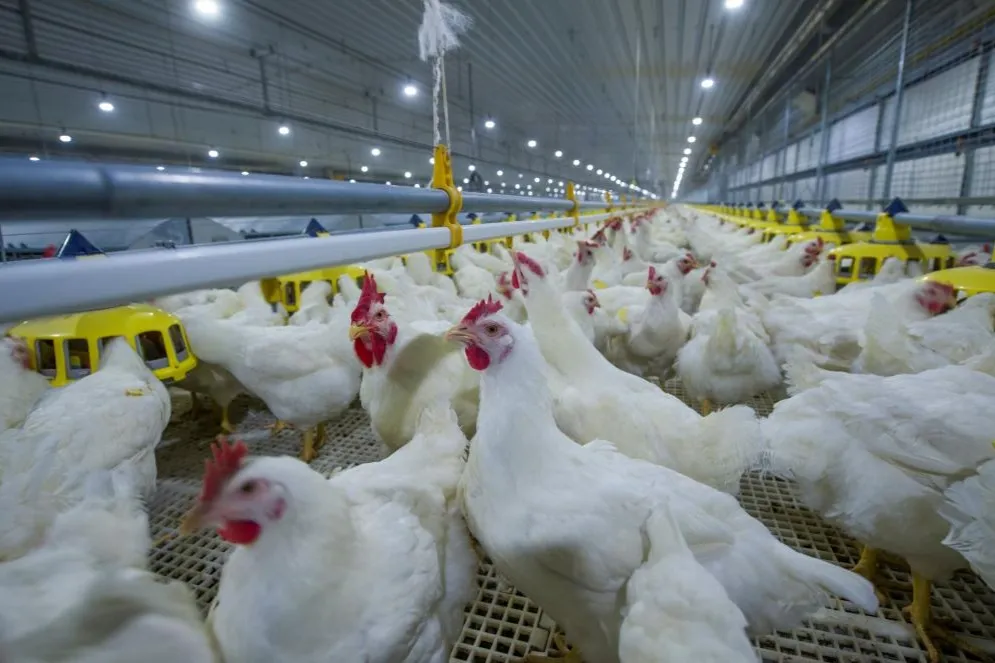
During the middle and later stages of broiler rearing, feed intake may fail to keep pace with the birds’ age. If feed intake does not keep pace with age or body weight falls short of the target, this means growth is slow. If the birds have not consumed as much feed, their weight gain will certainly be very slow too. So, what causes feed intake to stall during the middle and later stages of broiler rearing?
I. Viral diseases occurring in the later stage
Due to various issues, including management, the flock develops a viral disease. For as little as one week, or as long as ten days, the chickens show feed wastage and no increase in feed intake. As the chickens grow larger, what appears to be no increase in feed intake is actually feed wastage.
Viral diseases are generally accompanied by a high fever. After the viral disease has passed, more than 85% of the chickens may develop secondary mixed infections, including airsacculitis and pericarditis, hepatitis, and peritonitis, causing feed intake to remain sluggish. Other viral diseases, such as atypical Newcastle disease (never underestimate the damage atypical Newcastle disease can cause to the digestive tract!), may cause severe diarrhea and green droppings while the chickens have a fever, affecting their feed intake.
II. No feed restriction in the middle phase
With the development of caged broiler farming, many farm owners have given up feed restriction because it is inconvenient to control feed intake in cage-rearing systems. Flocks that consume feed too rapidly during the middle phase (consume more than two days’ worth of feed in 25-35 days) must have their feed restricted, especially during seasons when outside temperatures are low and chickens eat the most.
Three. Poor water-line flow
As the flock gets older, the chickens become increasingly lethargic and may not even want to get up to drink. If the water line’s output is less than 45ml per minute, feed intake will be affected. After taking a couple of sips without drinking enough, the chickens get tired, lie down, and stop drinking. In other words, the water line does not have to be completely blocked to make the chickens less willing to eat feed.
Four. In the later stage, the temperature is too high, ventilation is insufficient, and the oxygen level is too low.
One thing must be made clear: during cold seasons, if the temperature in the chicken house is not lowered according to the standard temperature, excessive heat retention will cause ventilation problems in the later stage, and our fuel costs will increase significantly.
Excessively high temperature in the chicken house can affect broilers’ feed intake. At a normal temperature, chickens eat normally; a moderately lower temperature can stimulate feed intake. If our chickens’ droppings, respiratory tract, and general condition are normal, and none of the causes mentioned above apply, but they still are not eating enough feed, we should consider whether the temperature is too high and the ventilation rate too low, resulting in insufficient oxygen. Recommended response: Adjust the temperature according to the normal temperature curve, lowering it where needed. Increasing ventilation later will then follow naturally.
Recently, the editor has encountered several cases of flocks failing to increase their feed intake because the target temperature was too high and the ventilation rate too low. After ventilation was adjusted, feed intake began to increase that same day. Friends who tend to ventilate conservatively, especially with 817 meat-type crossbred chickens, should pay extra attention.
Five. Causes of chicken diseases
If chickens develop proventriculitis and gizzard inflammation, there is little need to elaborate on the issue. In severe cases, flocks with proventriculitis may be unable to eat enough feed throughout the entire cycle. Later on, the spleen and stomach have a reduced ability to process and transport nutrients, and intestinal absorption is even poorer, so feed intake does not increase. Feed is present in the droppings, which are loose.
Response: Prevent glandular gastritis during the first 15 days of age. When the stomach and intestines are healthy, it is hard for chickens not to grow quickly.