
Compared with open poultry houses, closed poultry houses offer advantages such as more efficient land use, reduced labor requirements, a larger flock size per house, and easier standardized management. They are increasingly popular among poultry farmers and are also a development trend for China's poultry industry. Ventilation is extremely important in managing closed poultry houses. Whether a closed poultry house can be ventilated scientifically tests each poultry farmer's husbandry knowledge and skill. When used well, it can achieve twice the result with half the effort. However, improper use can also easily lead to problems.
During on-site diagnosis of diseases at some poultry farms, the author found that the causes of many diseases (rhinitis, avian influenza H9, infectious bronchitis, etc.) are closely related to improper ventilation. To help everyone ventilate more appropriately, the basic points of ventilation are introduced below:
I. Three objectives for controlling the ventilation environment in poultry houses
Whether a poultry house is open or closed, its fundamental purpose is to control and improve the house environment. Environmental control in poultry houses is the sole criterion for evaluating whether a ventilation method is good. Three indicators are most important: temperature, air quality, and relative humidity.
Target temperature:
20-24°C (after 30 days of age)
Good air quality:
Oxygen content ≥19.6%;
Ammonia concentration <15 ppm;
CO2 concentration below 3000 ppm;
CO concentration below 10 ppm;
Relative humidity:
50-70%
(The recommended range for chicks and broilers is 55-65%)
For air quality assessment, large-scale commercial poultry farms can use professional testing equipment to perform quantitative measurements, while some small- and medium-scale poultry farms can have someone go into the poultry house to get a “real feel” for conditions.
Everyone can understand the indicators above, but they also have an order of priority. For example, the ventilation objectives for adult chickens in winter follow this logic: air quality > relative humidity > target temperature. In other words, ensure air exchange while retaining as much heat as possible.
II. Four Key Points of Ventilation and Air Exchange
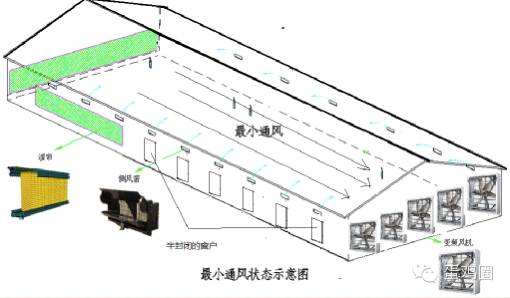
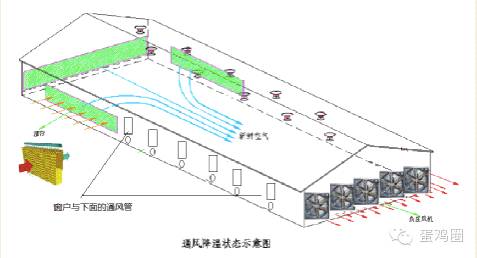
Based on the basic principles of ventilation, ventilation modes can be divided into minimum ventilation (timed exhaust to provide fresh air) and temperature-controlled ventilation (temperature control, primarily for cooling). Each mode serves its own purpose. In winter, minimum ventilation is used primarily. In summer, temperature-controlled ventilation is used primarily.
(I) Target (Set) Temperature:
For flocks from 30 days of age onward, the set range must be 20-24℃. It must not be too high or too low, and should not be changed arbitrarily; it should remain relatively stable. Perceived temperature should be taken into account.
(II) Timed Fans:
These correspond to minimum ventilation; the optimal timed cycle is 5-8 minutes. It should not be too long.
(Three) Temperature-controlled fans:
Corresponding to temperature-controlled ventilation; when the actual temperature inside the chicken house exceeds 23℃, gradually increase the number of fans to provide temperature-controlled ventilation. When it exceeds 28℃, start the cooling pads to provide cooling ventilation.
(Four) Air inlet velocity:
The air intake volume must match the exhaust volume. Air inlet velocity is related to factors such as negative pressure, small windows, and the cross-sectional area of the chicken house. It determines where air enters the chicken house; the direction and speed of airflow are important.
Three. Key points and common misconceptions about winter ventilation
Broilers:
Among all breeds, white-feather broilers are the most difficult to ventilate. On the one hand, their body weight increases rapidly every day, and the corresponding minimum total ventilation volume also increases. On the other hand, broilers have weaker resistance, and even a slight mistake in ventilation can easily lead to major risks such as chilling or heat stress. Among the different broiler-rearing systems, floor-litter rearing is the most difficult, followed by raised-floor and cage rearing. Therefore, broiler rearing, especially floor-litter rearing, has the highest requirements and is also the most difficult. Of the four seasons in 1, the most difficult periods are the transitions between winter and spring and between autumn and winter.
1, Several parameters relating to minimum winter ventilation:
There are currently two reference parameters used domestically: 0.6CFM (0.0168m³/kg body weight·minute) and a value based on the constant 0.0155m³/kg body weight·minute. Here, the pollution conditions in China’s farming environments need to be taken into account; the gap compared with other countries remains relatively large. Therefore, this should be considered when applying ventilation parameters on site. Because viral contamination in other countries is relatively light, they generally recommend a high-ventilation mode. One purpose is air exchange; more importantly, it provides chickens with sufficient oxygen to improve production performance. The situation in China is quite different: adopting a high-ventilation mode can easily pose a risk of chilling. If one must choose the lesser of the risks between disease and improving production performance, priority should still be given to reducing infectious diseases such as influenza and infectious bronchitis.
Some domestic companies currently apply a 50%-70% discount to the recommended parameters when setting minimum ventilation.
2, ventilation management objectives for the winter-spring and autumn-winter seasons: first consider oxygen demand, then relative humidity, and finally temperature.
(1) Oxygen demand is generally very easy to meet. Some scholars have estimated that, according to the minimum ventilation parameters recommended overseas, if the sole purpose is to provide oxygen, 1/5 of the ventilation volume is sufficient. In fact, the main purpose of minimum ventilation is to remove moisture from the poultry house; in practice, the relative humidity indicator is more important.
(2) Relative humidity is an extremely important indicator in broiler management and the most important indicator for assessing whether minimum ventilation is appropriate, especially in floor-raised broiler systems. Why is relative humidity so important? Mainly because it determines litter quality and affects the amount of ammonia. Relative humidity that is too low can cause excessive dust, while excessively high relative humidity, combined with elevated temperatures, can easily cause heat stress. Therefore, relative humidity is extremely important during the winter-spring and autumn-winter seasons. It is generally reasonable to keep it between 50-70%.
For the practice of artificially adding humidity at some farming companies, we generally do not recommend it. Artificial humidification can mask the true condition of the litter and also make ventilation indicators ineffective. Some companies use high ventilation, which dries the litter and air and increases dust. They then resort to artificial humidification by spraying. On the surface, the relative humidity meets the target, but this actually masks many underlying problems.
When relative humidity in the poultry house is found to be low during the winter-spring or autumn-winter seasons, the correct approach is to reduce minimum ventilation appropriately to raise relative humidity. This can save energy. More importantly, it reduces the risk of chilling. The biggest problem during the winter-spring and autumn-winter seasons is that outdoor temperatures change quickly and by a wide margin. If a high-ventilation mode is used at such times, the flock can easily become chilled when outdoor temperatures drop rapidly.
(3) Temperature target management can be addressed last. Before 30 days of age, the actual temperature in the flock may be allowed to exceed the target temperature (for example, during some periods around noon, the actual temperature may exceed the target temperature by 5℃), but it must not fall below the target temperature. Use heaters appropriately to raise the temperature. When the actual temperature in the poultry house exceeds the target temperature, this is generally caused by relatively high outdoor temperatures. At such times, the operating time of the ventilation fans can be increased appropriately and the ventilation level raised, but the fans must not run continuously. For example, over one time cycle, the fans can run for a maximum of 70% and remain off for 30%. The maximum number of fans running at once should also be limited to prevent multiple fans from cooling the house aggressively.
When the temperature exceeds the target, if relative humidity was controlled reasonably beforehand, there generally will not be a major problem. Problems at the farm often arise when, after high temperatures, ventilation is sharply increased for a short time to cool the house; this can instead easily lead to chilling and cold-like symptoms.
3. Basic approach to ventilation control and the prevention and control of “bronchial obstruction” in broilers:
Because stocking densities in China are high and biosecurity at poultry farms is often inadequate, viral infectious diseases cause serious illness. Diseases such as avian influenza H9 and infectious bronchitis make cold stress, such as “chilling,” a very important trigger for illness. Therefore, avoiding this during ventilation is a very important management objective in broiler farming.
In spring and autumn, the poultry house environment is the most difficult to control. At noon, it may be in temperature-controlled ventilation mode, while at night it switches to minimum ventilation mode. This is where the challenges of broiler ventilation lie, especially during 3-5 months. As the chickens get older, their temperature requirements decrease. However, the outdoor temperature keeps rising, making the ventilation balance point hardest to manage. If ventilation is too low, the flock may experience heat stress, with high ammonia levels and humidity. But if ventilation is too high, the flock may suffer cold stress and chilling, which becomes more dangerous when compounded by viral infection. Many problems at broiler farms also tend to occur most often during this season.
Based on our observations and experience over the years, before 28 days of age during this season, temperature-controlled ventilation (when the actual poultry house temperature exceeds the target temperature) should be used conservatively. If the relative humidity inside the poultry house is found to be too low (for example, below 40%), consider slowing the increase in ventilation level or even lowering it appropriately.
A certain range of temperature fluctuation inside the house can be allowed. During this season, outdoor temperatures drop quickly, and the harm caused by short-term heat stress is much less than in summer. In addition, aggressively increasing ventilation for cooling over a short period can easily lower the temperature and humidity in the poultry house, causing the flock's perceived temperature to drop sharply in a short time. At the same time, a large volume of cold air entering the poultry house over a short period can make it difficult to mix the cold and warm air evenly, increasing the risk of the flock becoming chilled.
In short, during this season, ventilation should still maintain minimum ventilation, focusing on air exchange, with temperature-controlled ventilation used as appropriate to supplement it.
4, several common ventilation mistakes in broiler production:
① Avoid the basic mistake of “heating while running high ventilation.” This wastes fuel and can also chill the flock.
Regarding conservative ventilation practices in spring and autumn: note that this refers to being conservative with temperature-controlled ventilation. Minimum ventilation settings can be adjusted flexibly according to the flock’s condition.
② Common practices for conservative ventilation: Some poultry farm managers like to indirectly reduce ventilation by raising the target temperature (1-2℃) in the ventilation control system (such as AC2000). This approach is suitable only for fine-tuning and temporary emergencies, and should not be used long term. The target temperature should be kept as stable as possible. When the ventilation rate is too high, adjust the fan settings rather than the target temperature.
③After 10 days of age, it is generally best not to rely on artificial misting for humidification. On the one hand, this can easily cause relative humidity reference indicators to become unreliable; on the other hand, improper misting can also pose a risk of cold stress.
④Broiler ventilation does need to be standardized, but more importantly, ventilation parameters should be adjusted flexibly based on factors such as the flock’s actual condition and outdoor temperature and humidity. This is where the role of on-site production management staff comes into play: they must neither apply rules mechanically nor fail to make timely, anticipatory fine-tuning and pre-adjustments based on the flock’s condition.