
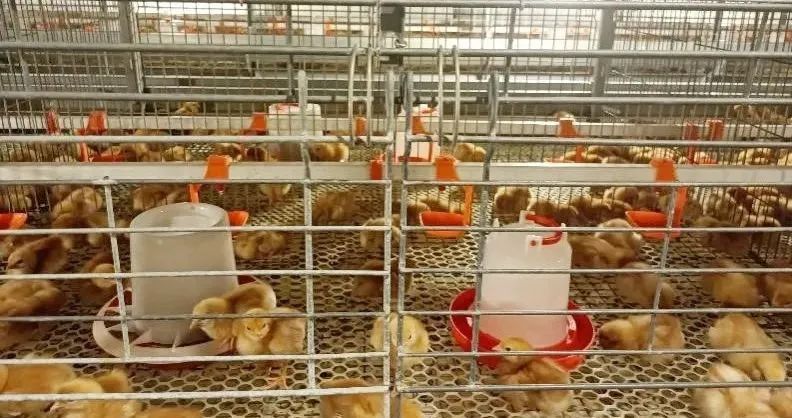
The first time chicks drink water is called “first drinking,” and the first time they eat feed is called “first feeding.” Properly managing first drinking and first feeding can quickly stimulate the chicks to drink and eat, promote the development of their immune and digestive systems, improve body weight uniformity, and reduce mortality and culling. The key points for chicks’ first drinking and first feeding are introduced below:
I. First drinking
1, purpose of the first drink
Prevents dehydration in chicks and helps maintain metabolic balance and nutrient absorption; helps with the excretion of meconium and absorption of the yolk sac by chicks; adding water-soluble multivitamins can reduce transportation and environmental stress.
2, first-drinking equipment
Vacuum drinker: for example, a base diameter of 17 cm, a water container diameter of 12.5 cm, and a height of 17.5 cm. Provide one drinker for every 24-28 chickens.
Water storage bucket: A capacity of 50L can be selected for mixing water-soluble multivitamin solution.
Plastic measuring cup: A capacity of 500ml can be selected for adding the mixed multivitamin solution from the water bucket to the vacuum drinking tank.
3, initial drinking method and timing
Water temperature and quality control: It is best to use cooled boiled water or high-quality deep well water, with the water temperature maintained at around 25℃ to prevent cold stress in the flock caused by water that is too cold.
Water-soluble multivitamin preparation ratio: Prepare the water-soluble multivitamin at a ratio of five ten-thousandths, that is, add 25 ml of water-soluble multivitamin to a bucket containing 50 kilograms of clean water at around 25°C and stir evenly.
Initial drinking time: After the chicks have settled in the cages, provide water before feed to speed up rehydration and prevent dehydration in high temperatures. Generally, 2 hours before the chicks arrive, place one vacuum drinker in each chick cage. Use a measuring cup to pour the prepared hydrolyzed multivitamin solution into the drinker. The water depth should be at least 2 cm to reduce drinking discomfort in debeaked chicks.
Two. Feeding
1, Purpose of feeding
Stimulate chicks to eat more, promote the development of the digestive system, transition the way nutrients are consumed, and meet the body's nutritional needs.
2, feeding equipment
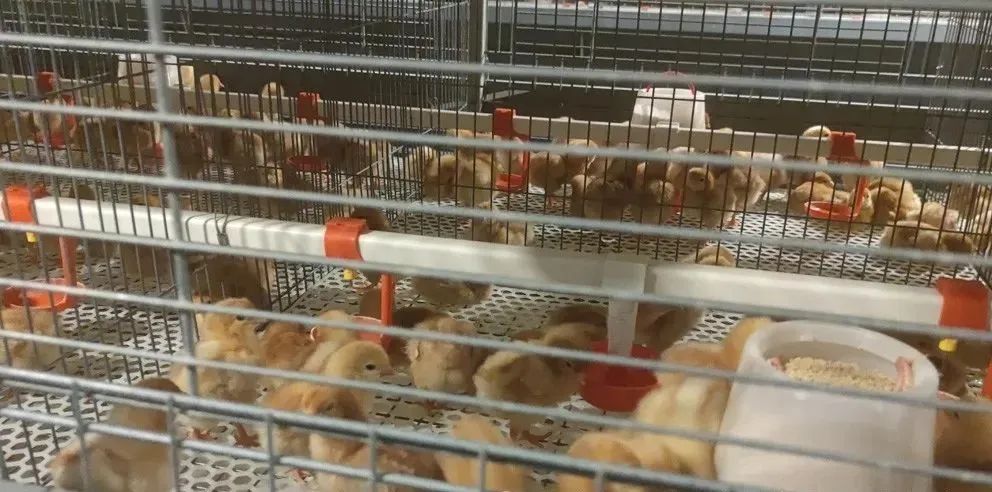
Feed tray: For example, if the feed tray has a diameter of 35 cm, provide one feed tray for every 24-28 chickens.
Feed scoop: A feed scoop with a capacity of 25 g can be selected for adding moistened feed to the feed tray.
3, feeding method and timing
Feed selection: It is recommended to use “Enhanced Type I Pelleted Feed” and moisten it before feeding. Its advantages are that it is easy to absorb, nutritionally complete, and the pellets can increase feed intake in chicks.
Preparation of moistened feed: To prepare it, add 7.5 kilograms of water to every 50 kilograms of pellets and mix thoroughly. The pellets are at the proper moisture level when they can be squeezed into a clump by hand and then naturally crumble apart when released.
Feeding start time and amount: Starting to feed too early is detrimental to the chicks’ digestive organs, while starting too late will affect their growth and development. Place the feed tray in the cage 2 hours before the chicks arrive. 2 hours after the chicks’ first drink, add the moistened “Enhanced Type I Pelleted Feed” at a rate of 0.5 g per chick to prevent dehydration and promote yolk absorption. Thereafter, feed once every 2 hours.
4, assessment of chick feeding results
Based on a proportion of 2% of the total flock's chicks, a combination of “fixed-point sampling” and “random sampling” is used to assess feeding results at 6 hours, 12 hours, and 24 hours after the chicks begin feeding.
For sampling, sampling cages are selected at the front, middle, and rear of each side of the poultry house. All chicks in the sampling cages are assessed, and some chicks in other cages are randomly sampled for assessment.
To assess the results, staff feel the chicks' crops. If crop fullness reaches 70% at 6 hours after feeding begins, 85% at 12 hours, and 100% at 24 hours, this indicates good feeding results.
For chicks that start eating later, provide manual feeding training. You can attract the chicks to eat by tapping the feed tray with your fingers, or assist them with feeding manually. This helps the chicks develop good feeding habits and a regular feeding pattern.