France
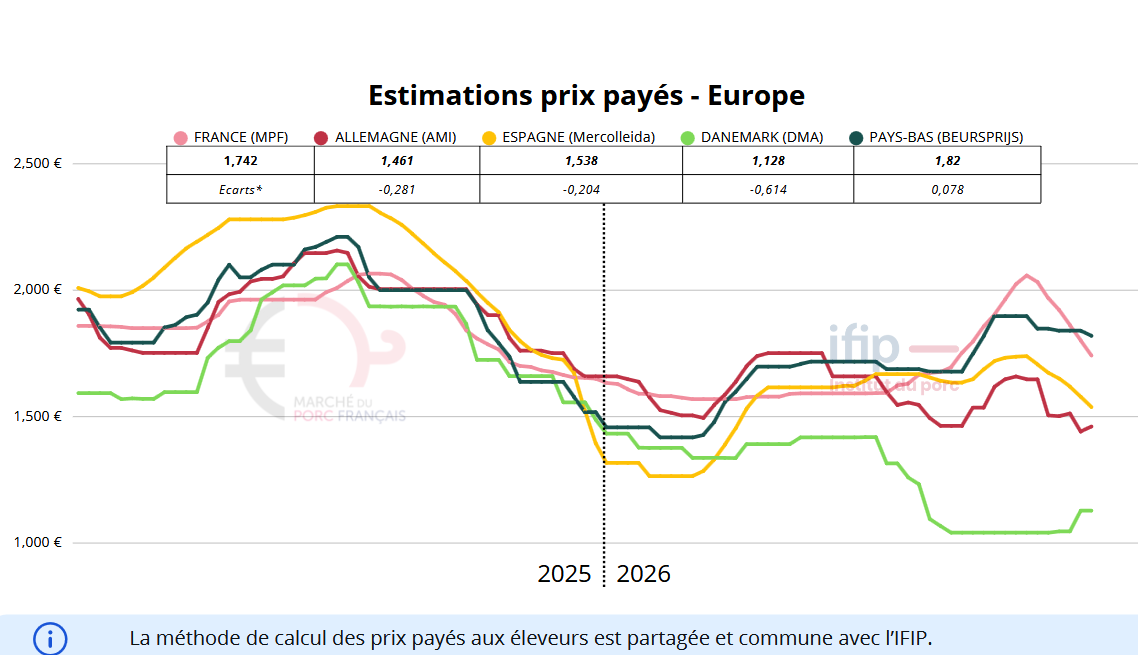
French pork market: The price has now been falling for six weeks at the French Pork Market, including five consecutive weeks marked by the maximum permitted decrease of 6 cents. This movement is reinforced by strong convergence among buyers’ positions, observed during auctions. Faced with this firmness, sellers have little choice but to accept the offers made, in a context of very limited demand.
Uniporc: Slaughter numbers rose very slightly last week, but remain 10 000 pigs below the level of 2025, reflecting continued weak demand from slaughterhouses. Weights continue to increase, but at a slower pace than in previous weeks. Although they are now higher than those of 2025, the difference remains limited to 310 grams. Last week therefore saw a less pronounced gap between the supply of and demand for pigs, although the market has not yet returned to equilibrium.
European Union
The German price indicator stabilizes at 1,40 €/kg after last week's drop of 5 cents. Slaughter numbers are down slightly to 737 786 pigs, while weights remain high at 98,6 kg. Supply remains substantial, particularly in the north and west, while slaughterhouse demand remains limited. The meat trade lacks momentum, and promotional activity is limited. Despite the stable quotation, pressure on the market persists.
In Spain, the level of price decline recorded remains the same as the previous week. The supply of pigs is gradually increasing, but slaughterhouses continue to take the available animals. Weights continue their seasonal rise, while remaining around 3 kg below those of 2025. The main imbalance remains in the meat market, where prices are weighing on slaughterhouse margins.
In Belgium, pig availability remains limited and competition among slaughterhouses to secure their supplies remains intense. Not all slaughterhouses therefore followed the German decrease eight days earlier. Weights even fell by 160 g. However, the meat market is deteriorating, with decreases of 10 to 12 cents on certain cuts.
In Italy,The downward trend continues. The supply of pigs has increased and now meets slaughterhouse requirements. As in France, the price gap with the rest of Europe is intensifying pressure on the domestic market, particularly with the arrival of imported meat at more competitive prices.
United States and China
The deterioration of the U.S. market continues, with a decline of 4,3 % in the value of cuts, leading to a 3,8 % drop in pig prices. Slaughter numbers remain close to 2025, at 2,55 million head, but demand is struggling to support prices. This situation directly affects farm profitability, with the average profit falling to 1,71 $ per pig in September, compared with nearly 50 $ a year earlier.
The Chinese market continues to decline, with live pig prices falling. Pig production increased by 3,2 % in the first nine months, despite a 2,6 % decline in the herd at the end of September. Supplies therefore remain abundant and weigh on prices. The contraction in the herd could nevertheless herald a gradual reduction in supply in 2027, although the prospect of this scenario, announced many months ago, has had limited effects so far.