
In late month 10, the national average hog price fell below 10 yuan/kg,hog futuresthe most actively traded contract 2701 also fell below the ten-thousand-yuan mark. Even the traditional peak consumption season of “Golden September and Silver October” failed to support hog prices. Why has the peak-season price-rise logic failed?
According to past cyclical patterns, falling hog prices force supply to contract, creating the prospect of prices stabilizing and rebounding. This time, the market has had to wait longer. This round of the “hog cycle” has continued to “bottom out,” with the prolonged downtrend lasting more than 40 months.
Additionally, the current breeding sow inventory has fallen below the normal holding level. Why has the benefit of capacity reduction not yet become apparent in hog prices? And how long will this prolonged “bottoming-out” phase last?
Hog prices falling below the “10 yuan range” has breached the industry’s full cost line
For the hog farming industry, this year’s “golden September and silver October” did not meet widespread expectations.
Data show that since 9 month, 生Pig pricesPrices fluctuated downward throughout, and the Mid-Autumn Festival and National Day holidays failed to provide a significant boost. After 10 month 14, the national average live pig price remained below 10 yuan/kg.
“Livepig pricesAfter falling below 10 yuan, prices kept sliding. “This year’s market has been beyond what most industry participants expected at the start of the year,” an observer of the hog farming industry told reporters. “In previous years, prices were usually higher in 9 and 10, especially in 9, but this year has been very disappointing.”
The spot market was sluggish, and the futures market was also under pressure. In late 10,hog futuresthe most active 2701 contract fell below the ten-thousand-yuan mark, closing at 9860 yuan/ton on 10 22, a new low since the contract was listed. The continued weakness in futures prices signaled cautious market expectations for the short term.
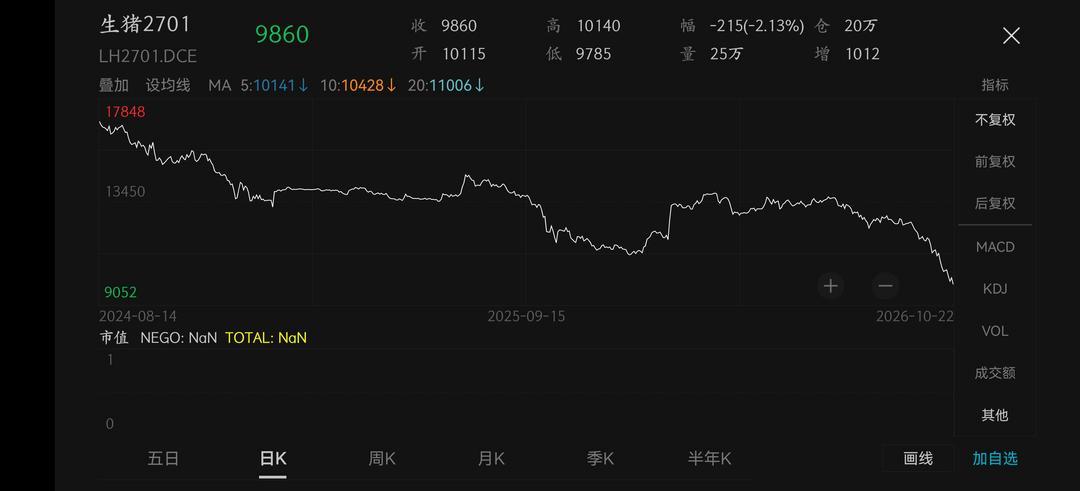
The live hog main contract 2701 hit a record low. Source: Wind
More difficult still, spot prices for live hogs have fallen below the full-cost line. Take Muyuan Foods as an example: in 9, the full cost of raising live hogs was slightly below 11.5 yuan/kg.
Operating pressure has begun to emerge. Wens Foodstuff Group's third-quarter report showed that revenue for the first three quarters reached 721.97 billion yuan, down 4.74% year on year; net profit attributable to shareholders of the parent company was a loss of 49.61 billion yuan, turning from profit to loss. The company attributed this to meatPig pricesfell sharply, and the pig farming business incurred substantial losses.
Behind the data lies a typical industry predicament: higher volumes and lower prices, with revenue increasing but profits not. Wens Foodstuff Group’s live pig sales rose from 274.21 ten thousand head in 7 month to 298.83 ten thousand head in 9 month, and sales revenue increased from 36.62 hundred million yuan to 40.56 hundred million yuan. However, the average selling price of live pigs hovered around 10.8 yuan/kg, down 18.44% year on year in 9 month.
Other leading companies faced the same situation. Muyuan Foods sold 642.3 ten thousand commercial pigs in 9 month, up 15.24% year on year, but the average selling price was only 10.36 yuan/kg, down 19.57% year on year. At self-breeding farms monitored by Yongyi Consulting with 5000–10000 sows, the loss per head last week had reached 259.97 yuan, with the entire industry under pressure.
Another impact of persistently low prices is that the industry is undergoing accelerated consolidation. With prices remaining depressed, small and medium-sized independent farmers are exiting more quickly. Leading companies have proactively reduced capacity but continue to maintain large slaughter volumes, further accentuating the industry’s Matthew effect.
In fact, hog prices have not remained weak throughout; they have undergone two rounds of modest increases since the beginning of the year. Data from China Pig Farming Network show that at the beginning of the year, livehog priceswere still in the range of 11—12 yuan/kg; after falling to the year’s low of 8.81 yuan/kg on 4 month 13, they rebounded slightly, reaching a temporary high of 11.3 yuan/kg in 7; after 9, they began a “second bottoming-out,” falling back into the range below 10 yuan in the second half of 10.
“Whenever prices fluctuate slightly, they soon fall back, making it difficult to sustain an upward trend.” Many people in the livestock farming industry share this feeling. The summer holidays, Mid-Autumn Festival, and National Day—consumption periods that had originally raised high hopes—were all unable to support a decent, sustained rebound.
The counterintuitive “bottoming-out grind”: efficiency gains “eat up” the benefits of capacity reduction
Why can’t even small price increases hold? The answer still lies on the supply side.
At the end of the third quarter, the national inventory of live pigs stood at 42533 ten thousand head, down 2.6% year on year; the inventory of breeding sows stood at 3602 ten thousand head, a decrease of 433 ten thousand head, down 10.7%, reaching 3750 ten thousand head, or 96% of the normal inventory level.
But during the same period, nationwide hog slaughter reached 53739 ten thousand head, up 1.4% year on year; pork production reached 4508 ten thousand metric tons, up 3.2% year on year. The number of sows in stock fell, but pork production increased instead, showing a clear industry trend of “fewer sows, no decline in pork production.”
This round ofthe hog cycleis the most counterintuitive part: the number of breeding sows in stock fell 10.7% year on year, yet hog prices are still hovering at the bottom. Policy support is intensifying, and herd reduction is accelerating. WhyThe hog cycleIs it still “bottoming out”?
The root of the change is a systematic improvement in breeding efficiency. Simply put, although there are fewer sows, they are more productive, and each pig provides more meat.
PSY, or the number of weaned piglets produced per sow per year, is a key indicator of sow reproductive efficiency. The observer cited earlier said, “Over the past few years, as breeding, feeding and management, and disease prevention and control have improved, the industry’s PSY has risen from 18–20 head to around 25 head, with some highly efficient farms even reaching 28–30 head.” Founder Futures estimates that the industry’s PSY has risen from 19.5 head to 24.3 head, an increase of 24.6%, enough to more than offset the decline in the number of breeding sows.”
Market hog weights are also rising. “Before African swine fever, the average weight of hogs sent to slaughter was around 100 kilograms; last year it had already risen to 126 kilograms,” the aforementioned observer said. “An extra 20 kilograms per pig is an increase of 20%.”
The latest data continue to set records. Statistics from Shenyin Wanguo Securities show that the average weight of hogs sent to slaughter across the industry reached 129.34 kilograms last week, the highest level for the same period in nearly five years. Against the backdrop of an accelerating fall in hog prices, this means that some hogs are being held back from slaughter involuntarily, and the resulting supply pressure still needs to be released.
Beyond efficiency, there is also an unavoidable time lag in adjusting production capacity.
“Pig farming is the production of living organisms; you cannot stop production at the push of a button as you can with industrial goods,” the aforementioned observer explained. A sow’s gestation period is about 4 months, and fattening piglets takes about 6 months. From reducing the sow herd to sending market hogs to slaughter usually takes around 10 months.
This means the pigs currently on the market still reflect sow capacity from the end of 2025 to the beginning of 2026. Not until after the second quarter of this year did the culling of breeding sows accelerate significantly, and the corresponding effects will not begin to gradually pass through to the number of pigs marketed until the second quarter of 2027 at the earliest.
Changes in the industry structure are also lengthening the bottoming-out cycle. In the past, when small-scale farmers accounted for a relatively large share, pig prices falling below the cost line would trigger a rapid exit, followed by a contraction in supply. Today, leading companies have stronger financial resources and cost-control capabilities. Even when facing temporary losses, they can maintain operations through financing, cost reductions, and refined management. Fitch Ratings has also noted that livestock companies are better able to withstand losses financially, which may instead delay the clearing of excess capacity and lengthen the downturn.
In addition, demand has not provided sufficient support either. “Consumption patterns have basically not changed. The domestic pig industry still mainly sells whole carcasses and fresh meat, with insufficient development of deep processing and niche products. It has yet to generate enough incremental consumer demand to absorb the additional supply.” In the view of the aforementioned pig-farming industry observer, with supply and demand out of balance, prices naturally lack the momentum for a sustained rise.
How long will the “bottoming out” last? The turning point may come in 2027.
How long will the “bottoming out” process last? This is a question the entire industry is asking.
“From a short-term perspective, a period of interim recovery may occur before the end of the year as the market builds up stocks for the Spring Festival.” The aforementioned observer of the hog farming industry said, but the scale and duration of this recovery should not be overestimated. On the one hand, overall hog inventories remain relatively high, and the large, heavy pigs that were held back earlier are still being shipped to market in batches; on the other hand, frozen pork stocks will also be released in concentrated volumes during the peak consumption season, adding to market supply.
Zhuochuang Information expects both supply and demand in the pork market to increase in the fourth quarter, with supply growing more. In particular, supported by demand, there may be a low-level rebound in 11月, with the monthly average price rising by approximately 5%—8%, although the peak is unlikely to exceed 15 yuan/kg. In 12月, as the improvement in demand weakens and hog supplies are released in a concentrated manner, prices may edge down again. Guojin Securities also stated that seasonal supply may decline somewhat, but the total volume will remain relatively large, and short-term pressure from hog supply will persist. Combined with the seasonal off-season, hogpricesThere is still room for a decline after the rebound.
A true trend reversal may not occur until the first half of 2027.
“Low prices may persist for some time, and conditions may improve by next year,” said an observer of the hog farming industry mentioned above, who holds a similar view. “The effects of capacity reduction may not become apparent until March or April next year, or even June or July.”
Shenyin & Wanguo Securities, meanwhile, believes that after nearly 3 and a half months, the hogPig pricesFalling below the 10 yuan threshold once again, a “second bottoming out” has begun, and capacity reduction is expected to accelerate again. To date, the entire hog farming industry has been operating at a loss for four quarters, with losses at farms and among farmers continuing to accumulate, while capacity reduction among breeding sows remains ongoing. The outlook for the year 2027 remains positive.Pig cycleThe persistence of the uptrend and the elasticity of hog prices. A cyclical turning point is drawing closer.
However, even if the next upward cycle arrives, it may not replicate the sharp price surges of the past.
“On the one hand, as aquaculture efficiency has improved, the industry’s balanced capacity level has shifted upward, and supply elasticity has increased substantially; on the other hand, with the share of large-scale enterprises rising, fluctuations in industry capacity will become more moderate,Pig cycleThe characteristics of sharp ups and downs will gradually weaken,” said the aforementioned observer of the hog farming industry.
For livestock farming businesses, simply waiting for prices to rebound is clearly not the best option.
“The key is to improve efficiency through management; we can’t rely solely on prices to make money,” said the aforementioned observer of the pig farming industry, identifying the core direction of the industry’s transformation. “The pig industry’s supply chain is long, and some pig farming companies have also achieved good results through refined management and supply chain expansion.”
An industry-wide earnings baseline still exists, but more profits will flow to companies with lower costs and more efficient management. “During the rapid expansion after African swine fever, some companies still expanded at low quality, and cost differences across the industry remain pronounced.” Guojin Securities believes that “as inefficient capacity gradually exits, leading companies still have considerable room to release excess profits.”
Pig cycleAt the bottom of the cycle, the industry is going through the pain of a shakeout, and businesses have a window of opportunity to strengthen their fundamentals. A turning point in prices will eventually come, but before it truly arrives, strengthening their fundamentals is what gives a hog farming company the real confidence to weather the cycle.