
Glucose is the lowest-cost and most reliable health-support ingredient for pig farms.
But 90% of farmers use it carelessly, add it indiscriminately, or ignore contraindications: either it has no effect, or problems increase the more it is used.
Today, we’ve put together a no-nonsense, practical glucose-use plan for pig farming that you can follow directly. It corrects all the misconceptions and provides precise amounts throughout. We recommend saving it!
The first rule of pig farming
Feed only feed-grade or food-grade glucose. Industrial glucose must never be fed to pigs; excessive heavy metals can damage the liver and kidneys!
I. Liver protection and detoxification: addressing tear stains, dead skin, and suboptimal health in sows
Glucose does not directly detoxify, but it can quickly replenish liver glycogen, protect the liver, and reduce the metabolic burden of toxins. Suitable for pig herds with long-term medication use, high levels of mold in feed, severe tear staining, or dull skin with excessive dead skin.
Targeted plan
Add glucose at 20kg per ton of feed (3%–5%) + Fuzheng Jiedu Powder mixed into the feed
Use continuously for 7–10 days, then stop
Important: This cannot replace a mycotoxin binder! Glucose is only for liver and kidney repair and conditioning in the later stage; mold control still relies on a mycotoxin binder and raw material management.
Two. Stimulating appetite and feed intake: for loss of appetite, low body temperature, and postpartum anorexia
Pigs may eat less or stop eating when they have a low body temperature, are ill, are physically weak after giving birth, or when the feed has a strong bitter taste from medication. Glucose quickly raises blood sugar and stimulates appetite.
Targeted plan
Feed mixing: Short-term feed mixing at 2%–5%; stop as soon as feed intake recovers
Drinking water: concentration not exceeding 5% (a high concentration can cause osmotic diarrhea)
III. Increasing sow productivity: briefly provide preferential feeding to thin sows to promote more ovulations and more piglets
Suitable only for: sows that have lost condition after weaning, and replacement gilts
Not suitable for: obese sows (the more they are fed, the less likely they are to come into estrus, and the risk of difficult farrowing increases)
Optimal window (key focus)
From weaning to breeding: 3–7 days
Per sow per day: 100–200g of glucose, fed in two portions
Effect: better follicle development, more ovulation, and a higher breeding rate
Correcting the biggest misconception online
No need to deliberately restrict sugar after breeding!
The online claim that “feeding sugar after breeding prevents implantation” is a rumor.
The actual principle: During the implantation period, control the overall feed amount and avoid suddenly feeding high-energy feed.
After breeding, if the animal has a low temperature and is not eating, a small amount of sugar water can be given as emergency support; there is no need to panic.
Four. Farrowing-room emergency care: saving weak piglets and treating diarrhea and dehydration in piglets
1, emergency care for weak piglets with hypoglycemia
Newborn piglets are pale, undersized, weak, and unable to suckle
Standard procedure: Administer 5% glucose, 10–20ml orally in small, frequent doses
(For extremely weak piglets, 10% may be used temporarily. Never administer a large dose all at once, as this can easily cause diarrhea.)
2, universal rehydration salts for piglets
1000ml clean water + glucose 20g + salt 3.5g + baking soda 2.5g + potassium chloride 1.5g
Use only for diarrhea with dehydration; stop as soon as the condition improves. Do not use long-term as drinking water for routine health maintenance.
3, health care during lactation
Provide drinking water with a small amount of sugar to promote the growth of beneficial intestinal bacteria and reduce indigestion and diarrhea.
Five. Anti-stress: stabilize the herd during relocation, cooling, and seasonal changes
Large temperature fluctuations, relocation, transportation, and seasonal changes can lead to reduced feed intake, fever, and stress-related illness.
Simple health care
Add 0.5%–1% glucose to the drinking water and use for 2–3 days
Stabilizes the herd at low cost and reduces sporadic illness.
Six. Reconditioning weak, stunted pigs (do not use growth promoters for fattening pigs)
For weak pigs that are thin, recovering from illness, or growing poorly, use thin feed plus a small amount of glucose.
Quickly improves palatability, restores feed intake, and helps pigs regain condition.
Important contraindications
Do not use sugar long-term to fatten finishing pigs!
It will only increase backfat, reduce the lean meat percentage, and raise the feed-to-meat ratio—a poor trade-off.
Seven. Enhance medication efficacy by mixing it into feed: mask the taste so pigs will take their medicine
Tilmicosin and enrofloxacin are extremely bitter; pigs may refuse feed mixed with them, rendering the medication ineffective.
Method: Mix glucose into the feed at the same time as the powdered medication to mask the taste completely.
Key incompatibilities
Amoxicillin, penicillin
Do not soak in sugar water for a long time! Prepare fresh and use immediately. It becomes ineffective if left for a long time in an acidic environment; mixing the dry powder into feed has no effect.
Eight. Support recovery from foot-and-mouth disease and reduce runts
Sick pigs cannot stand up, cannot eat, and are physically depleted.
Plan: glucose in drinking water + amoxicillin
Note: Amoxicillin only prevents secondary infections; it does not treat viruses. Glucose replenishes energy, promotes wound healing, shortens the course of illness, and reduces the number of pigs left stunted.
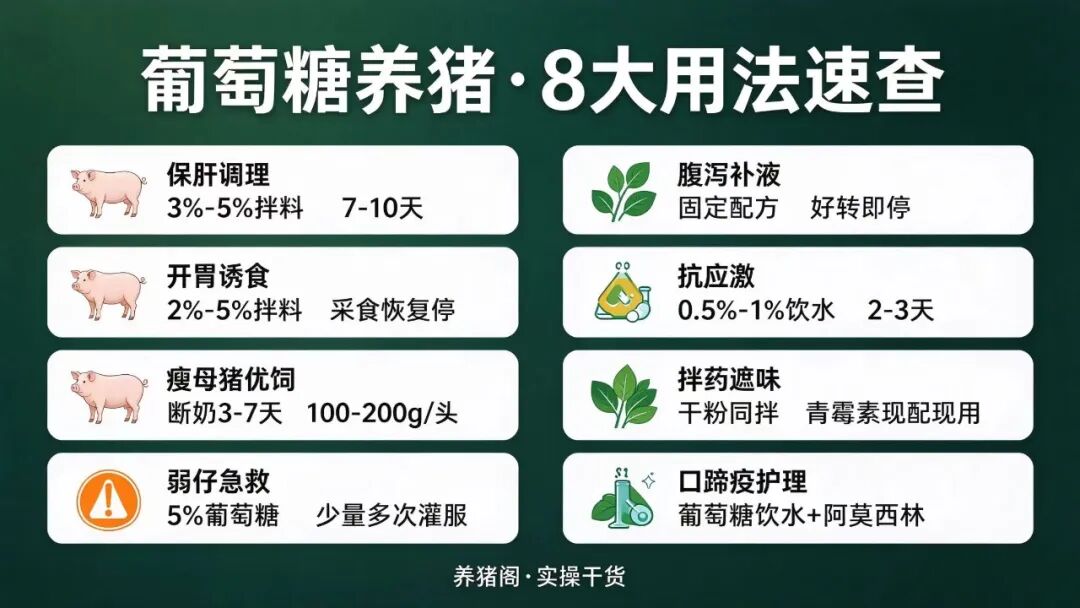
Glucose for Pig Farming · Ultimate Quick-Reference Checklist (Save This)
Liver support and conditioning: 3%–5% mixed into feed, for 7–10 days
Stimulating appetite in pigs with anorexia: 2%–5% mixed into feed / 5% in drinking water
Increase sow productivity: 3–7 days after weaning, 100–200g/head
Emergency care for weak piglets: administer small amounts of 5% glucose orally, frequently
Diarrhea and dehydration: standard oral rehydration salts; stop as soon as the condition improves
Anti-stress: 0.5%–1% in drinking water, for 2–3 days
Masking the taste of medication: mix in dry powder; prepare penicillin in drinking water immediately before use
Pig farmersMust-remember 4 major taboos
1, do not buy industrial glucose
2, do not add it long-term at high doses
3, do not use sugar to fatten finishing pigs or to stimulate estrus in overweight sows
4, sugar water spoils easily in summer; change the water frequently
Making money from pig farming relies on these low-cost tips!
Use glucose correctly to reduce illness and medication use and make more money.
But 90% of farmers use it carelessly, add it indiscriminately, or ignore contraindications: either it has no effect, or problems increase the more it is used.
Today, we’ve put together a no-nonsense, practical glucose-use plan for pig farming that you can follow directly. It corrects all the misconceptions and provides precise amounts throughout. We recommend saving it!
The first rule of pig farming
Feed only feed-grade or food-grade glucose. Industrial glucose must never be fed to pigs; excessive heavy metals can damage the liver and kidneys!
I. Liver protection and detoxification: addressing tear stains, dead skin, and suboptimal health in sows
Glucose does not directly detoxify, but it can quickly replenish liver glycogen, protect the liver, and reduce the metabolic burden of toxins. Suitable for pig herds with long-term medication use, high levels of mold in feed, severe tear staining, or dull skin with excessive dead skin.
Targeted plan
Add glucose at 20kg per ton of feed (3%–5%) + Fuzheng Jiedu Powder mixed into the feed
Use continuously for 7–10 days, then stop
Important: This cannot replace a mycotoxin binder! Glucose is only for liver and kidney repair and conditioning in the later stage; mold control still relies on a mycotoxin binder and raw material management.
Two. Stimulating appetite and feed intake: for loss of appetite, low body temperature, and postpartum anorexia
Pigs may eat less or stop eating when they have a low body temperature, are ill, are physically weak after giving birth, or when the feed has a strong bitter taste from medication. Glucose quickly raises blood sugar and stimulates appetite.
Targeted plan
Feed mixing: Short-term feed mixing at 2%–5%; stop as soon as feed intake recovers
Drinking water: concentration not exceeding 5% (a high concentration can cause osmotic diarrhea)
III. Increasing sow productivity: briefly provide preferential feeding to thin sows to promote more ovulations and more piglets
Suitable only for: sows that have lost condition after weaning, and replacement gilts
Not suitable for: obese sows (the more they are fed, the less likely they are to come into estrus, and the risk of difficult farrowing increases)
Optimal window (key focus)
From weaning to breeding: 3–7 days
Per sow per day: 100–200g of glucose, fed in two portions
Effect: better follicle development, more ovulation, and a higher breeding rate
Correcting the biggest misconception online
No need to deliberately restrict sugar after breeding!
The online claim that “feeding sugar after breeding prevents implantation” is a rumor.
The actual principle: During the implantation period, control the overall feed amount and avoid suddenly feeding high-energy feed.
After breeding, if the animal has a low temperature and is not eating, a small amount of sugar water can be given as emergency support; there is no need to panic.
Four. Farrowing-room emergency care: saving weak piglets and treating diarrhea and dehydration in piglets
1, emergency care for weak piglets with hypoglycemia
Newborn piglets are pale, undersized, weak, and unable to suckle
Standard procedure: Administer 5% glucose, 10–20ml orally in small, frequent doses
(For extremely weak piglets, 10% may be used temporarily. Never administer a large dose all at once, as this can easily cause diarrhea.)
2, universal rehydration salts for piglets
1000ml clean water + glucose 20g + salt 3.5g + baking soda 2.5g + potassium chloride 1.5g
Use only for diarrhea with dehydration; stop as soon as the condition improves. Do not use long-term as drinking water for routine health maintenance.
3, health care during lactation
Provide drinking water with a small amount of sugar to promote the growth of beneficial intestinal bacteria and reduce indigestion and diarrhea.
Five. Anti-stress: stabilize the herd during relocation, cooling, and seasonal changes
Large temperature fluctuations, relocation, transportation, and seasonal changes can lead to reduced feed intake, fever, and stress-related illness.
Simple health care
Add 0.5%–1% glucose to the drinking water and use for 2–3 days
Stabilizes the herd at low cost and reduces sporadic illness.
Six. Reconditioning weak, stunted pigs (do not use growth promoters for fattening pigs)
For weak pigs that are thin, recovering from illness, or growing poorly, use thin feed plus a small amount of glucose.
Quickly improves palatability, restores feed intake, and helps pigs regain condition.
Important contraindications
Do not use sugar long-term to fatten finishing pigs!
It will only increase backfat, reduce the lean meat percentage, and raise the feed-to-meat ratio—a poor trade-off.
Seven. Enhance medication efficacy by mixing it into feed: mask the taste so pigs will take their medicine
Tilmicosin and enrofloxacin are extremely bitter; pigs may refuse feed mixed with them, rendering the medication ineffective.
Method: Mix glucose into the feed at the same time as the powdered medication to mask the taste completely.
Key incompatibilities
Amoxicillin, penicillin
Do not soak in sugar water for a long time! Prepare fresh and use immediately. It becomes ineffective if left for a long time in an acidic environment; mixing the dry powder into feed has no effect.
Eight. Support recovery from foot-and-mouth disease and reduce runts
Sick pigs cannot stand up, cannot eat, and are physically depleted.
Plan: glucose in drinking water + amoxicillin
Note: Amoxicillin only prevents secondary infections; it does not treat viruses. Glucose replenishes energy, promotes wound healing, shortens the course of illness, and reduces the number of pigs left stunted.
Glucose for Pig Farming · Ultimate Quick-Reference Checklist (Save This)
Liver support and conditioning: 3%–5% mixed into feed, for 7–10 days
Stimulating appetite in pigs with anorexia: 2%–5% mixed into feed / 5% in drinking water
Increase sow productivity: 3–7 days after weaning, 100–200g/head
Emergency care for weak piglets: administer small amounts of 5% glucose orally, frequently
Diarrhea and dehydration: standard oral rehydration salts; stop as soon as the condition improves
Anti-stress: 0.5%–1% in drinking water, for 2–3 days
Masking the taste of medication: mix in dry powder; prepare penicillin in drinking water immediately before use
Pig farmersMust-remember 4 major taboos
1, do not buy industrial glucose
2, do not add it long-term at high doses
3, do not use sugar to fatten finishing pigs or to stimulate estrus in overweight sows
4, sugar water spoils easily in summer; change the water frequently
Making money from pig farming relies on these low-cost tips!
Use glucose correctly to reduce illness and medication use and make more money.