
Lembang (TROBOSLIVESTOCK.COM). To support the recovery of livestock farming after disasters in Aceh, North Sumatra, and West Sumatra, the Ministry of Agriculture (Kementan) distributed 1.000 doses of Gama cattle frozen semen. Kementan is also preparing follow-up measures to ensure that this artificial insemination (IB) technology is used appropriately, in a measured manner, and in accordance with livestock farming conditions in each region.
Director of Livestock Breeding and Production Hary Suhada said that the development of Gama cattle needs to be accompanied by directed planning and support so that the use of frozen semen produces results that can be evaluated. “We want to ensure that innovations in breeding can be applied appropriately in the field, thereby contributing to increased livestock productivity, strengthening the beef cattle population, and the recovery of livestock businesses in disaster-affected areas,” Hary explained in Focus Group Discussion (FGD) on the Use of Gama Cattle Frozen Semen, organized by Kementan in Lembang, West Java, on Friday (23/10).
Gama cattle have been established as a new beef cattle breed through Minister of Agriculture Decree Number 840 of 2025 concerning the Release of the Gama Cattle Breed. These cattle are the result of a collaboration between the Faculty of Animal Science, Universitas Gadjah Mada (Fapet UGM), and PT Widodo Makmur Perkasa (WMP).
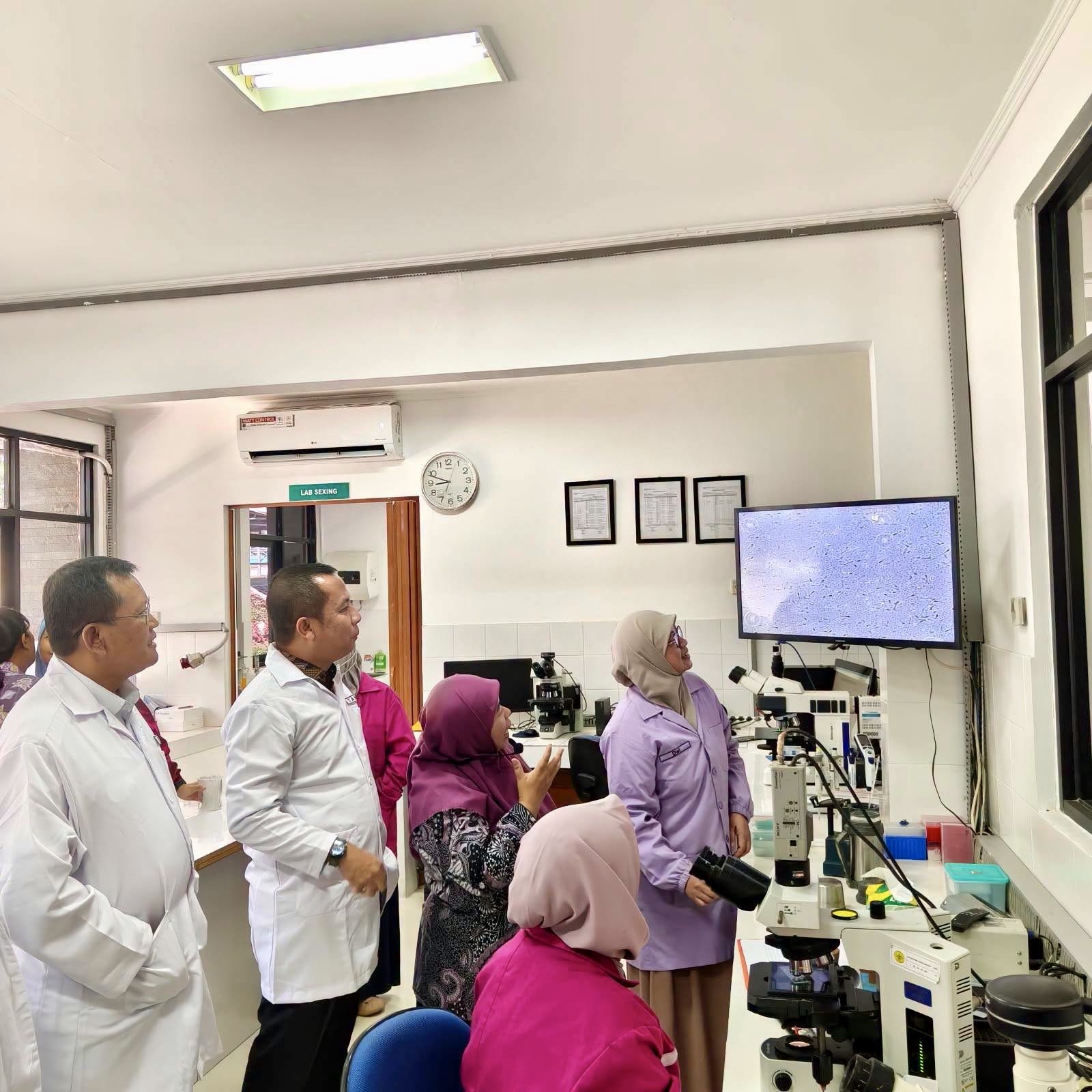 Photo by the Ministry of Agriculture
To support its development, selected Gama bulls have been placed at the Lembang Artificial Insemination Center (BIB Lembang) as part of efforts to prepare for the production and distribution of frozen semen. On 2026, 1.000 doses of Gama frozen semen were distributed through a grant mechanism to support post-disaster recovery. 200 doses were allocated to Aceh, 300 doses to North Sumatra, and 500 doses to West Sumatra.
The Minister of Agriculture’s Expert Staff for Livestock Downstreaming, Prof. Ali Agus, emphasized the importance of evidence-based development with clear targets and success indicators. According to him, the use of reproductive technology needs to be accompanied by recipient selection, orderly record-keeping, and ongoing evaluation.
“The development of Gama cattle must be carried out with careful planning and based on scientific evidence. We need to ensure that the use of frozen semen is supported by appropriate recipient selection, orderly record-keeping, and ongoing evaluation. In this way, the program will not stop at the distribution of frozen semen, but will become part of efforts to build a more productive and competitive national cattle breeding system,” he explained.
Technical discussions at the FGD covered the production and evaluation of frozen semen by BIB Lembang, breeding and bull preparation by PT WMP, and the roadmap for Gama cattle development presented by the UGM research team, including Prof. Ali Agus.
One of the meeting’s recommendations was to direct the use of frozen semen to areas with potential recipient cattle, with the aim of developing Gama cattle as a composite breedor composite breeds. Implementation should take into account the characteristics of the livestock and local farming conditions.
To this end, BIB Lembang and PT Pasir Tengah will develop guidelines or standard operating procedures (SOPs) for selecting locations and recipient cows. Selection will consider the technical requirements for using frozen semen, including restrictions on its use in local cattle and in breeding-source areas, prioritizing female cattle that have calved, and the availability and quality of feed.
Development will also be accompanied by testing the myostatin gene in selected bulls by BIB Lembang, PT Pasir Tengah, and the gama cattle research team. The three parties will also develop aherd book to support the recording, monitoring, and evaluation of population development.
In terms of standardization, PT Pasir Tengah and the research team will prepare a proposal to submit a Draft Indonesian National Standard (RSNI) for gama cattle breeding stock to BRMP. This step is expected to form part of efforts to establish breeding-stock quality standards that support the sustainable development of gama cattle.
As a follow-up, the Ministry of Agriculture, the relevant agencies, and BIB Lembang will prepare to launch an artificial insemination program using frozen semen from gama cattle in Aceh, North Sumatra, and West Sumatra. The launch is planned for late October or early November 2026, with implementation adjusted to the technical readiness and livestock-farming conditions in each province.
Through this initiative, the Ministry of Agriculture, together with local governments, research institutions, academics, and business operators, is preparing to develop gama cattle, focusing not only on the distribution of frozen semen but also on the quality of implementation and its results.
The program’s success will need to be assessed based on insemination results, offspring development, breeding stock quality, and the benefits farmers experience. With measurable monitoring and evaluation, the development of gama cattle is expected to contribute to increased beef cattle productivity and the recovery of livestock farming in disaster-affected areas.bella