
In its “Livestock and Poultry: World Markets and Trade” report, published on 9 October, the USDA projects that global pork production will fall by 0.7 % in 2027, due to declines in China and the European Union, while African swine fever in Spain and weak Chinese demand would reshape international trade.
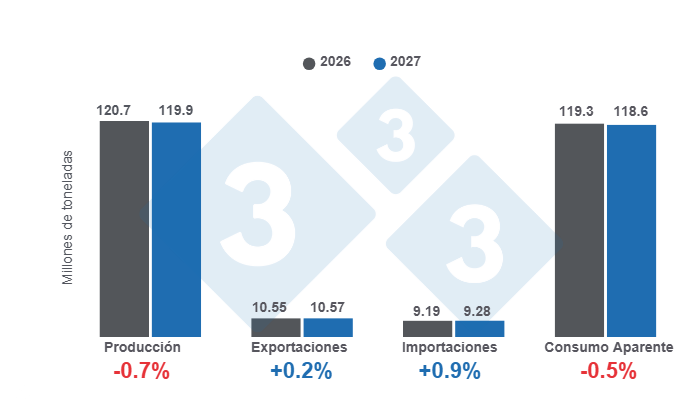 Chart 1: Projected supply–demand balance for global pig farming in 2027, year-on-year changes. Prepared by the Department of Economics and Sustainability of 333 Latin America with data from FAS - USDA
General context
- Global pork production would decline slightly in 2027, as decreases in China and the European Union would outweigh gains in Brazil, Vietnam, and the U.S. In China, the reduction in the herd driven by the government and the sector’s low profitability would have an impact, while in the EU the high domestic supply of 2026 and pressure from environmental regulations would weigh on production.
- Global exports would remain virtually unchanged after the increase of 2026, as higher shipments from Brazil, China, the U.S., and Mexico would offset the decline in the European Union. During 2026, greater exportable supply weakened international prices: through July, the export unit value fell by about 9 % in the EU, 2 % in Brazil, and marginally in the U.S. Major importers took advantage of that supply, and through June, purchases by Japan grew 5 %, those by South Korea 18 %, and those by the Philippines 1 %, the latter following a record in 2025 and with its domestic production recovering. However, pork inventories in these countries continued to increase through July, so the pace of imports stalled in South Korea and the Philippines and would moderate in Japan in the second half of the year, intensifying competition among exporters.
- The disruptive factor during the period was the discovery of African swine fever (ASF) in wildlife in Spain in November 2025, the first since 1994. Japan, the second-largest non-EU market for Spanish pork, along with Malaysia and Taiwan, maintains restrictions. In contrast, China and South Korea quickly applied regionalization, and the Philippines, the fifth-largest non-EU destination, recognized it in May 2026. Despite the outbreak, Spanish production increased through June by redirecting product to other Member States and expanding shipments to South Korea, Vietnam, and the U.S., while Denmark and France partially filled its place in restricted markets. This reallocation may have increased available supply in the EU and put downward pressure on prices.
Global Indicators
- Global production would stand at 119.9 million tonnes (Mt) in 2027, representing a decline of 0.7 % compared with 2026 (120.7 Mt).
- Global exports would reach 10.57 Mt, representing a slight increase of 0.2 % compared with the previous year.
- Meanwhile, imports would total 9.28 Mt, up 0.9 % compared with 2026.
- Apparent consumption would reach 118.6 Mt, 0.5% below the volume estimated for the previous year.
Key indicators by country
- China would produce 58.4 Mt in 2027, which represents a decline of 2.2 % compared with 2026. Imports of 820 000 tonnes (t) are also forecast, a figure that would represent a drop of 2.4 %, while its exports would grow by 21.2 % to 200 000 t, the highest volume since 2018.
- The European Union would reach production of 22.0 Mt, 0.5 % lower than the previous year. Along the same lines, its exports would fall 3.3 % to 2.95 Mt, amid lower available supply and greater competition in its main markets.
- The U.S. is projected to record 12.6 Mt, an increase of 0.7 % driven by more piglets per litter, despite a smaller breeding herd. Meanwhile, exports are projected to reach 3.22 Mt, representing growth of 0.6 %, supported by robust demand from Mexico and Canada.
- Brazil would reach 5.14 Mt, a figure 2.8 % higher than that of 2026, thanks to improvements in production efficiency and higher carcass weights. Likewise, its exports would increase 2.5 % to 1.85 Mt, a more moderate pace than in recent years
- Vietnam would increase its production by 3.5 %, reaching 4.20 Mt, driven by strong domestic demand and favorable pork prices. Its imports would total 155 000 t, 3.3 % more than the previous year.
- Japan would maintain production close to 1.28 Mt, with a slight decrease of 0.4%. In contrast to the trend in 2026, its imports would fall 2.0% to 1.48 Mt, given high domestic inventories.
- Mexico would produce 1.49 Mt, representing growth of 3.1 %. Imports of 1.76 Mt are expected, 3.5 % above 2026, while exports would increase by 9.1 % to 240 000 t, given the recovery in production after animal diseases and stronger-than-expected demand from the U.S. and Japan.
- Canada would consolidate 2.24 Mt, reporting growth of 2.3 %. Its exports would remain unchanged at 1.30 Mt, while imports would decline by 8.9 % to 205 000 t.
- Colombia would reach 735 000 t, a figure that would represent an increase of 4.3 % compared with 2026. In contrast, its imports would fall by 2.7 %, reaching 180 000 t.
13 October 2026 | Written by the Department of Economy and Sustainability of 333 Latin America based on USDA data.