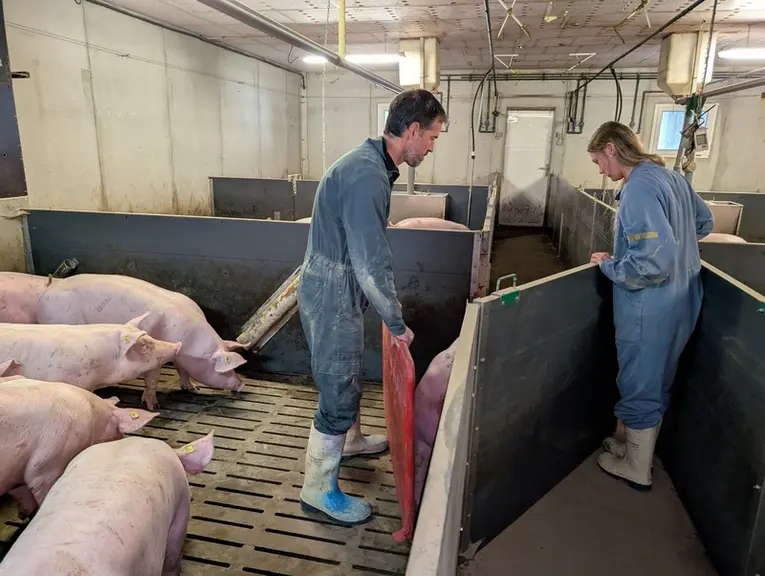
Despite highly structured management on farrow-to-finish pig farms, different work organization strategies are implemented on these farms.
Read also: Pig farming: “We rationalize the work to improve efficiency,” explain the employees of SCEA Kerhervé in Finistère
An analysis conducted by the Chambre d’agriculture de Bretagne and Ifip on working time and tasks performed on 67 conventional farms in Brittany highlights several organizational strategies. These depend in particular on how specialized farmers and their employees’ work is, as well as on how their profiles and skills complement one another within the team. This division of roles directly affects the farmer-animal relationship. Which of these five types of organization do you identify with?
-
1 Teams fully specialized in farrowing and finishing
In these teams of two to nine farmers and employees, everyone has their own area: farrowing or post-weaning to finishing (PSE), with no multi-skilled workers apart from a few part-time employees. From three people onward, a diverse range of profiles is preferred (maternity, boar and gestation unit (VG), and PSE) rather than having duplicate roles. The largest farms sometimes have a full-time employee specializing in maintenance and repairs. A ten-batch system is more common there than a five- or seven-batch system, in line with farm size. Employees specializing in PSE spend more time with the animals. Workers specializing in farrowing interact directly with them more often.
-
2 Specialists supplemented by polyvalent workers
On these farms with two to six breeders and employees, full-time and part-time polyvalent workers supplement specialized roles (farrowing, PSE, or both). The larger the team, the more specialized the tasks. Small farms (two to three people) have only one specialized person, while larger farms (four to six people) have only one full-time polyvalent worker. The time spent with the animals remains fairly consistent among the farm’s pig workers, reflecting the versatility of small and medium-sized teams.
-
3 Breeders and employees specialized exclusively in farrowing, with part-time workers covering PSE
On these farms with two to four people, part-time workers cover PSE in addition to the workers specialized in farrowing. These farms remain small; beyond this size, they move into category 1 or 2 with new roles. In farrowing, specialization is always focused first on VG, then on the maternity unit. All breeders are in contact with the animals, but the balance between direct interaction with them and simply being present varies from person to person, regardless of their specialization.
-
4 Entirely polyvalent teams
These small teams (one to two full-time polyvalent workers, often supplemented by part-time workers) operate without specialization. Everyone does everything, resulting in a balanced distribution of tasks and time spent with the animals.
-
5 The owner-operator alone
There is no team here: the owner-operator is maximally polyvalent and alone handles animal care, technical farm operations, and farm management.
Behind these five organizational models, one constant remains: almost all livestock workers are in daily contact with the animals. Thus, whatever the division of tasks, pig welfare is the responsibility of the entire work team.
Florentin Boucher, [email protected]
Key points
The way farmers’ roles are organized on a farm varies from one livestock operation to another. It may depend on choices about work organization, constraints related to farm size, labor availability, etc. There is no right or wrong way to structure work organization within the team, as long as it suits the workers and meets the livestock operation’s objectives.