How AI could change the way pig farms measure success
New times mean new opportunities. Different key performance indicators have become possible through new management strategies. Artificial intelligence (AI) and data gathering allow real-time analysis, decisions and predictions based on objective information. Goals: producing smarter, reducing costs and improving both animal health and sustainability.
The number of weaned piglets per sow per year is still a key performance indicator that resonates with sow farmers. It is an indication of whether a farm belongs in the top 25%. That is going to change, if Twan Claessens has his way.
With his innovative technology company, Arca Intelligence, the former pig producer has been paving the way to help the pig farming industry. He has developed technology to better monitor individual animals, treat them more specifically, and base business decisions on reliable data. Pivotal in the development are the key words automation, sensor technology, RFID, artificial intelligence (AI) and data analysis.
Other key performance indicators
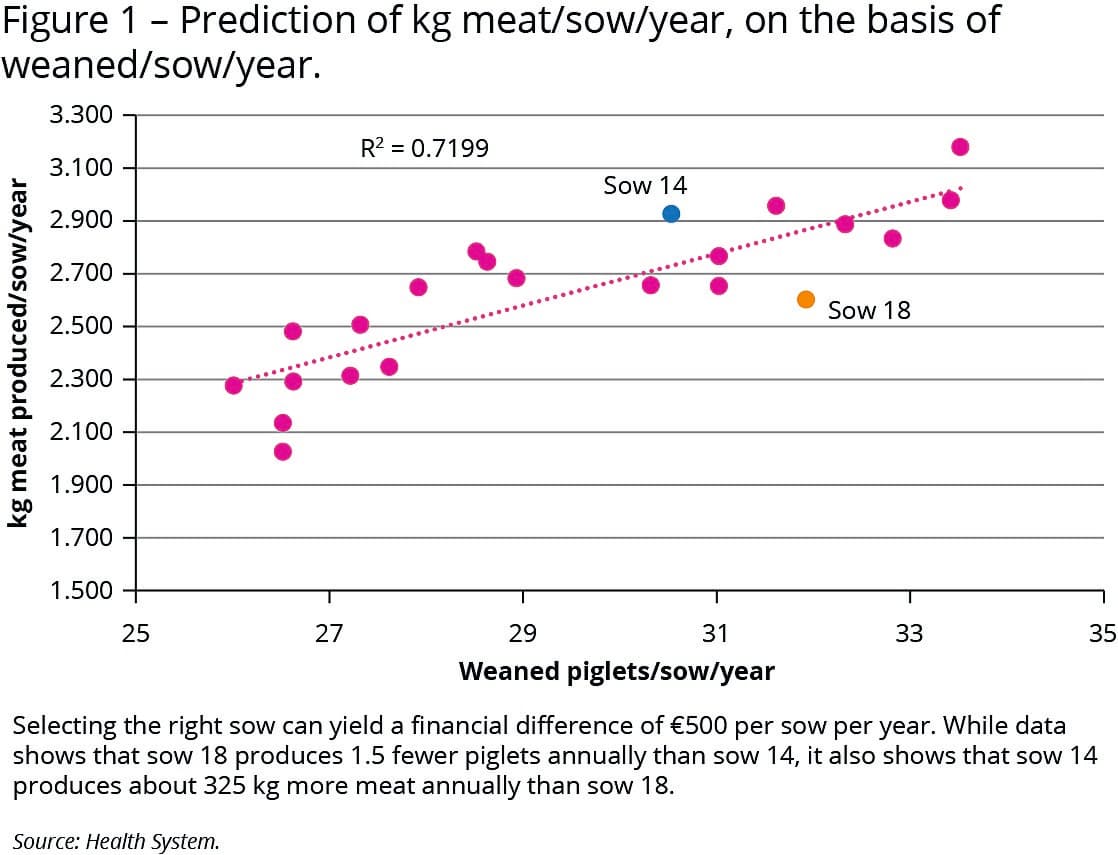
Claessens says, “Instead of the traditional key performance indicator (KPI), number of weaned piglets per sow per year, other indicators will become important on the sow farm. Ultimately, the KPI of kg of meat produced/sow/year will gain more value than the number of weaned piglets per sow per year.” However, it still takes time to give this new indicator a sense of purpose. Aiming for, around 35 or more weaned piglets per sow per year makes sense to sow farmers, as well as advisors and financiers, as for them, this translates into 3,500 kg of meat produced per sow per year.
Bert de Jong shares his opinion. He recently joined Arca Intelligence after 10 years of experience as a pig producer and 20 years as a pig farming specialist and nutritionist. He says, “Especially for closed farms and integrations, the focus will shift more towards the end product and revenues. We need more cooperation between sow farmers and finishing pig producers, so that the KPI of kg of meat/sow/year will represent added value for sow farmers, as well.”
He continues to say, “The value of the sow replacement KPI, which currently averages around 35% to 40%, will change if you focus more on quality rather than quantity. Instead of selection being based on the number of piglets per sow per year, KPIs such as litter growth and the predicted number of kg of meat/sow/year will become important new indicators. Which sow is better: a sow that weans 15 piglets with a litter weight of 130 kg, or a sow with 18 piglets with a litter weight of 130 kg? Analysis of available data on birth weights, weaning weights and weights moving a batch to finishing, using AI models and algorithms, can support pig producers in deciding when to cull a sow or keep another litter.”
Another way of recording data
The litter growth indicator in the farrowing pen is decisive for efficient growth in the finishing pig barn. That is the conclusion reached by Danish research centre SEGES. However, working with those and other new KPIs and analysing real-time data also requires a different method of recording the data. The starting point is the individual registration of the animals, along with their corresponding weights and treatments. One of the possibilities is the use of RFID ear tags in combination with the system of Arca Intelligence.
A survey among pig farmers, however, revealed a problem. Claessens says, “Half of the treatments available to sow farms are not performed or are performed incorrectly. Farms with a large staff often know that treatments are not being performed or are not being performed correctly, but they cannot or only partly get a grip on the situation. On family farms, people think things are going well, but they have no insight into whether all treatments have actually been performed correctly.”
Incorrect treatment
In order to build sufficient immunity, vaccinations only work with the right product, at the right time, and at the right interval. Quite often, however, treatments are administered incorrectly or in too low doses, says Claessens. He adds, “In addition, German pig farmers indicated in an MSD survey that they are convinced that the vaccination of Dutch piglets is not being carried out properly. Why would that be any different if the piglets remain in the Netherlands.”
An example of what can go wrong when treating piglets is the use of the wrong vaccination agent. For example, vaccinating against parvovirus instead of Mycoplasma hyopneumoniae. The consequences are certainly visible in the finishing pig barn. The use of an incorrect amount of antibiotics also occurs regularly because the age or weight of an animal is not estimated or calculated correctly.
In addition, entries into the management system are forgotten or performed incorrectly, resulting in incorrect inventory management or an incorrect withdrawal period for delivering the animal. Things also regularly go wrong when vaccinating sows. By ordering or using the wrong vaccine or because vaccination has been postponed. Being too busy or hot weather conditions may be legitimate reasons, but this carries the risk of vaccinations being forgotten altogether.
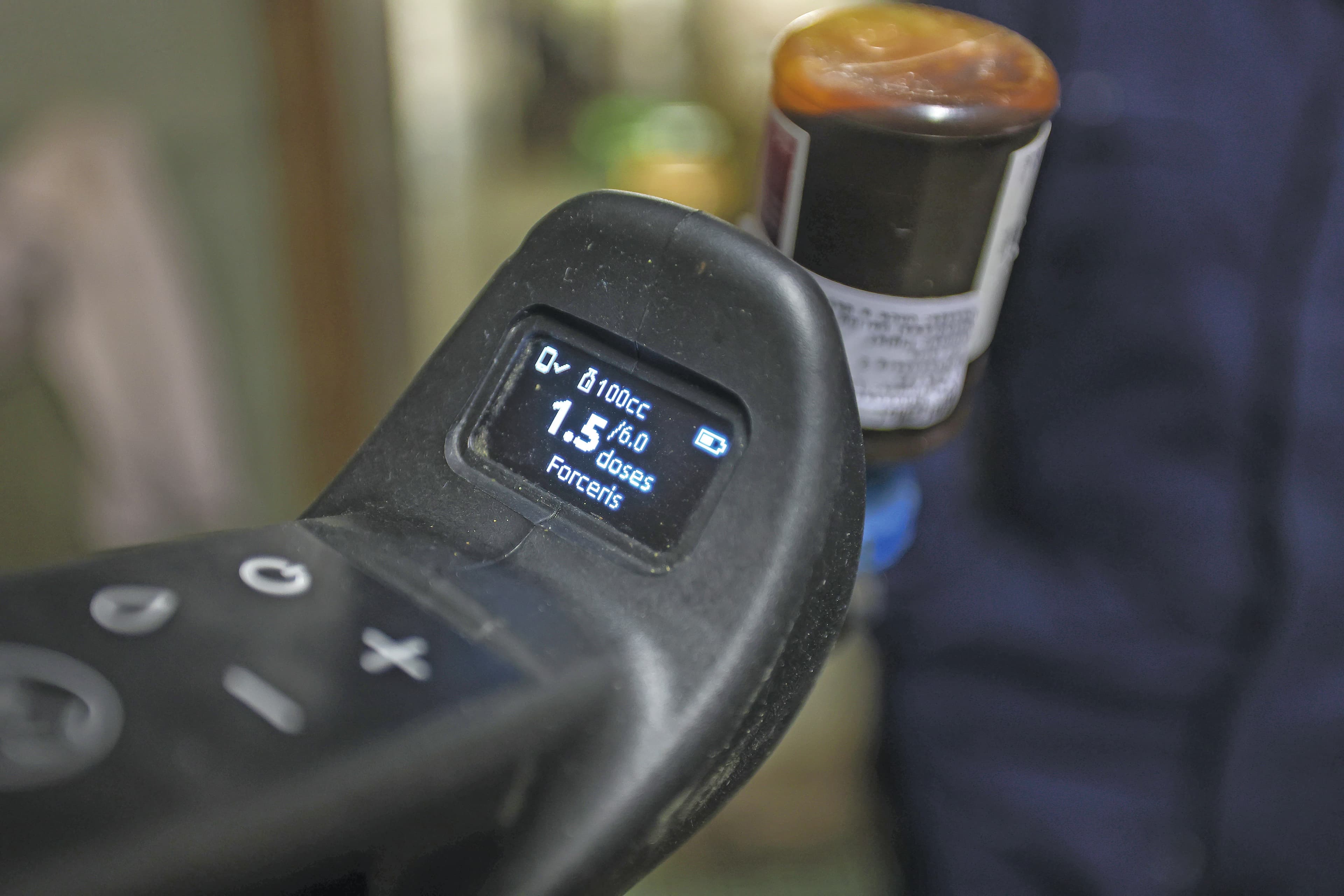
Development towards a data platform
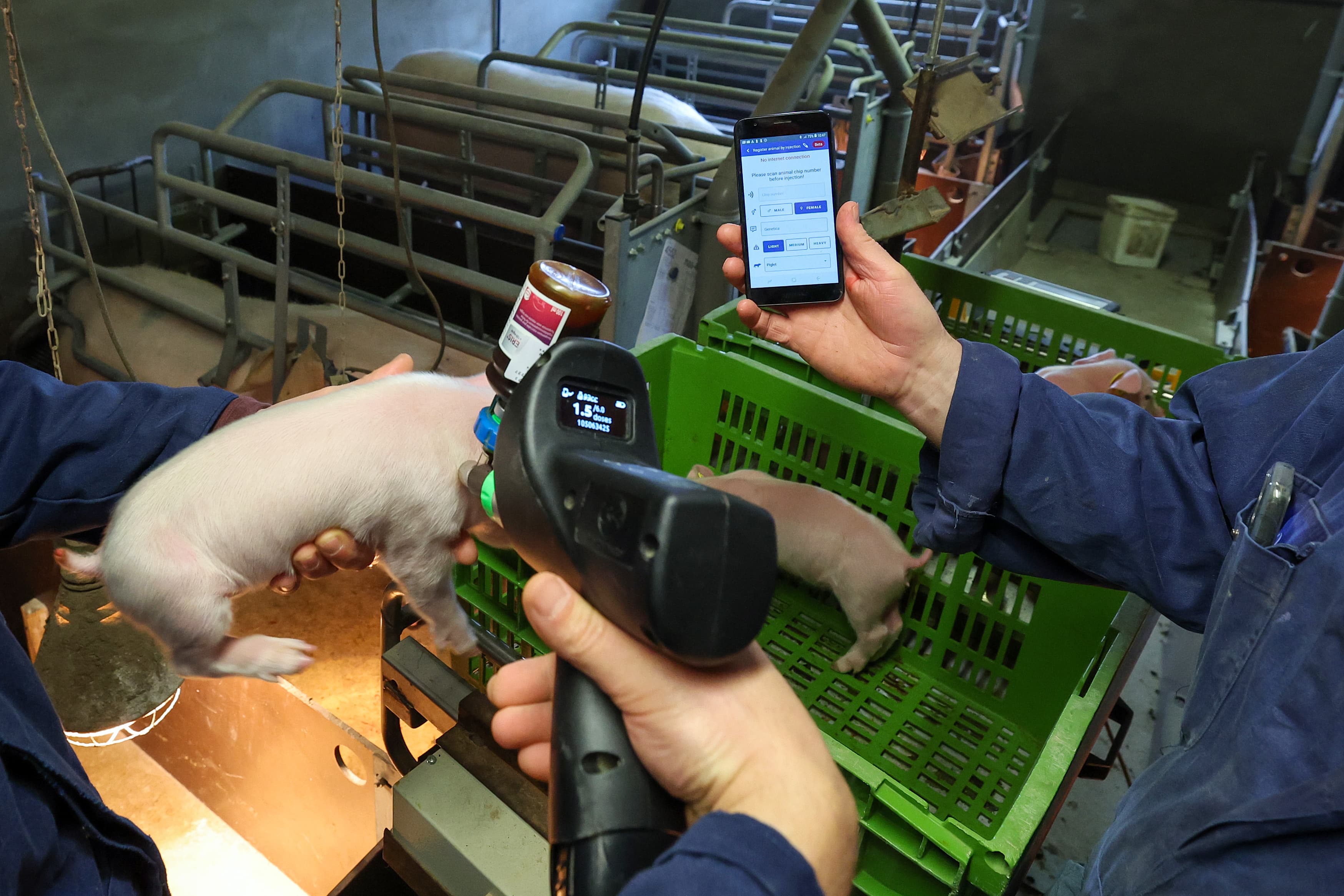
Through practical experience gained on his own sow farm, Claessens laid the foundation for individual recording of treatments. He developed the Health Injector to record piglet treatments individually. For this, he won a public innovation award in the Netherlands in 2022. Since then, the company’s product line has further evolved into a data platform for the pig farming industry. The platform supports entrepreneurs in data-driven management of animal health and sustainability and has grown into more than merely recording piglet treatments, as the current name of the platform suggests.
At the time of administering the iron injection, producers determine and record the individual starting weight. At the slaughter line, the electronic ear tags are read again, allowing individual slaughter data to be linked to them. It is also possible to measure uniform groups upon placement in the piglet or finishing barn. Claessens says, “Algorithms convert this into individual weights, and it is already possible to use these data to predict performance in the finishing barn.”
New developments with digital twin
Technology is constantly evolving. Claessens has developed a “digital twin” for piglets and finishing pigs. A digital twin is a digital copy of an animal that allows various scenarios to be simulated and predicted, based on both real-time and historical data. The digital twin contains data such as birth weight, weaning weight, antibiotic use, feed composition, and climate settings.
Claessens comments, “The major advantage of a digital twin’s calculations is its predictive capability. For example, you can predict what the growth rate will be and how many finishing pigs can be delivered in the long term. This is a major advantage for the planning of pig farmers, slaughterhouses, and transporters.”
He adds, “The goal of this technology is to achieve lower costs and optimal growth through better feed choices, better performance and welfare through smarter climate settings, healthier animals through greater insight into antibiotic use, and greater efficiency and return on the farm through these predictions.”
An example of a new insight gained through the use of technology is the ideal temperature at the end of the finishing cycle. Claessens says, “This is around 20 °C but is often set too high. The right climate setting means extra growth, and that can immediately be translated into income.”