
35 broiler trials link gut health to better feed efficiency and returns
In poultry production, few feed additive concepts remain relevant for more than 15 years. While markets change, genetics evolve, feed costs fluctuate, and production systems demand more resilience, some solutions keep performing because they are built on solid biological principles.
This is the case with AviPlusP, the poultry-specific solution in the Vetagro product line for performance enhancement, which combines selected botanicals (thymol and vanillin) and organic acids (citric and sorbic acids) through microencapsulation technology. Since its launch, EFSA validation and European Commission authorisation as a zootechnical feed additive (4d3) have supported the product.
At the time, we believed broiler performance was not determined only by controlling intestinal microflora. It also depends on intestinal barrier integrity, immune regulation, and efficient nutrient digestion and absorption. These functions interact continuously within the intestinal environment, shaping how feed is converted into growth. This integrated view anticipated many principles that now represent the foundations of modern poultry nutrition.
A multifactorial mode of action
This approach lies not only in the biological activity of its components, but also in how they are delivered. Microencapsulation technology protects botanicals and organic acids within a lipid matrix, helping preserve active compounds during storage, feed processing and gastric digestion. Once in the intestine, lipases progressively degrade the matrix, allowing a slow release of bioactives throughout the intestine, exactly where they are needed.
Moreover, because all compounds are present within the same microcapsules, botanicals and organic acids are released in close association. This allows their complementary effects to achieve synergy. At the microbial level, these ingredients work synergistically: botanicals interact with bacterial membranes to create pores, while organic acids limit the growth of potentially harmful bacteria by disrupting their internal pH. Together, they help control unwanted microflora while preserving beneficial microbial species.
However, the concept goes beyond microflora regulation (Figure 1). Scientific validation has also shown effects on intestinal integrity, immune balance and nutrient utilisation. Both intestinal epithelial models exposed to inflammatory challenge and broilers in experimental conditions have demonstrated that botanicals and organic acids support intestinal barrier function, tight junction-related markers and inflammatory balance.
Figure 1 - From a gut-focused approach to broiler performance.
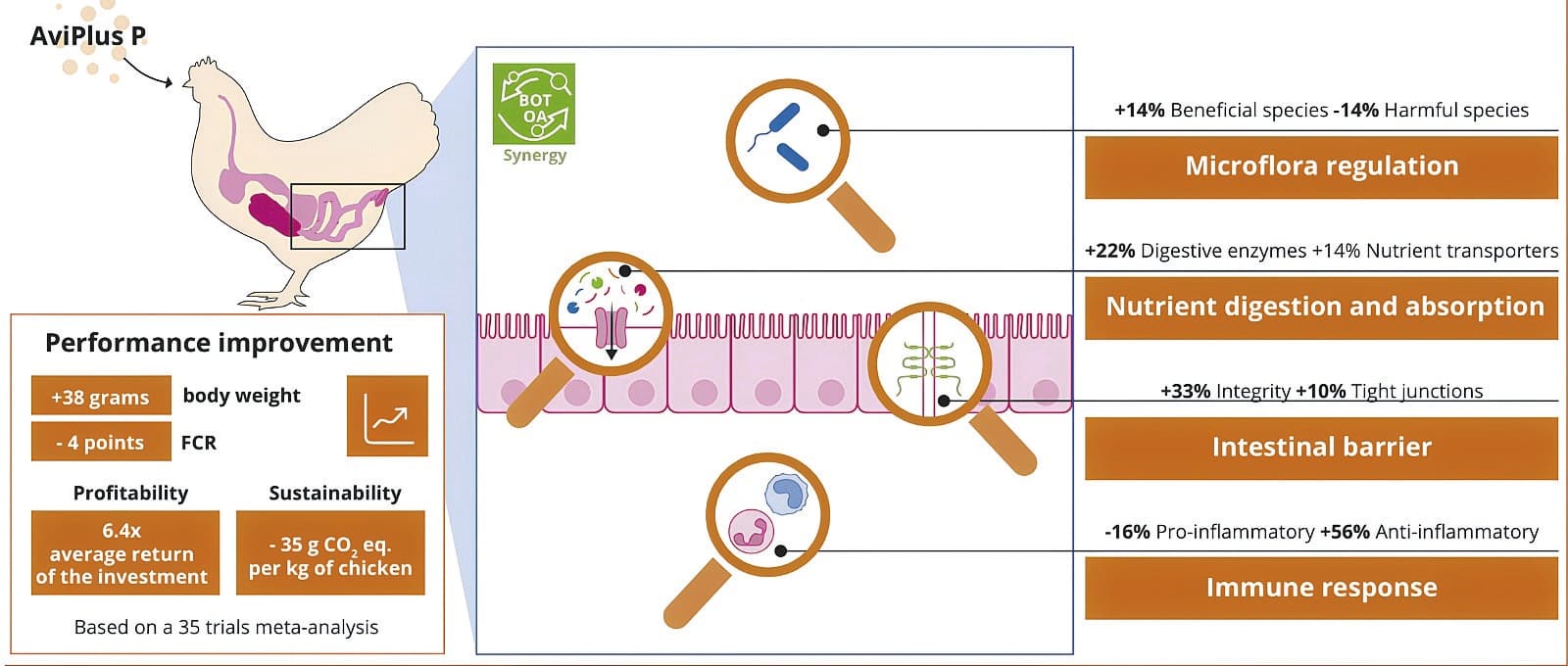
Published studies in broilers have also shown increased digestive enzyme activity and higher expression of nutrient transporters involved in sugars and amino acid uptake. In practical terms, this means the product helps protect the intestine and better equips it to digest and absorb nutrients.
35 trials
Scientific mechanisms are important, but poultry producers ultimately need tangible results under real production conditions. Therefore, we consolidated and assessed the full body of performance data generated over the years in a meta-analysis. The database included 35 experimental and field broiler trials conducted from 2009 to 2022 across Europe, the Americas and Asia. They covered Ross 308, Ross 708, Cobb 500 and Hubbard genetics, with heterogeneous diet formulations. The additive inclusion levels ranged from 200 to 500 g/MT.
Across this broad dataset, AviPlusP significantly improved final body weight by an average of 38 g and significantly reduced standardised FCR by 4 points. In numerical terms, final body weight increased from 2,466 g in controls to 2,504 g in the supplemented group, while average FCR decreased from 1.74 to 1.70, meaning that producers needed approximately 40 g less feed to produce each kg of live weight.
From performance to profitability
The meta-analysis results were converted into an economic evaluation. Using European market assumptions for broiler value and feed cost, the average return on investment for Avi PlusP was calculated at 6.4:1. This means every unit invested in the additive generated, on average, 6.4 units of return, with a consistent economic response. In this light, a better FCR means that birds require less feed to reach the same target weight. By supporting intestinal functionality, the additive helps birds extract more nutrients from the diet. For producers, this converts intestinal benefits into economic benefits: less feed needed per kg of live weight, lower feeding cost and improved profitability.
Nutrient efficiency and sustainability
Efficiency is also becoming a sustainability driver in poultry. If birds reach the same target weight on less feed, they need fewer resources. In this sense, better nutrient utilisation links gut functionality, profitability and environmental impact in the same direction. This was also reflected in a life cycle assessment: global warming potential, including land use change, decreased from 2.053 to 2.018 kg CO₂ equivalent per kg of live weight, corresponding to a reduction of 35 g CO₂ equivalent for every kg of chicken produced.
At farm scale, a house producing 30,000 broilers at around 3 kg live weight would save approximately 3 tonnes of CO₂ equivalent per cycle. Scaled to 1 million broilers, this would represent around 105 tonnes of CO₂ equivalent saved annually, equal to the carbon captured by around 4773 trees in one year, assuming each tree absorbs around 22 kg CO2 per year.
Supporting the intestine
Over the years, poultry production has become more complex. Producers must maintain performance, improve feed efficiency, reduce losses, meet sustainability expectations and protect profitability in markets under constant turmoil. In this scenario, supporting the intestine as the biological centre where microbial balance, barrier function, immune regulation and nutrient absorption come together to support productive efficiency remains highly relevant.
This is why the story of AviPlusP shows how a concept developed ahead of its time continues to generate value under modern production conditions. The scientific validation explains the mechanism, the 35-trial meta-analysis confirms performance, the ROI evaluation shows profitability, and the LCA demonstrates lower environmental impact. In a poultry industry focused on doing more with fewer resources, only science-based innovations can keep delivering.