
The latest statistics from the General Administration of Customs show that China’s chicken imports reached a new high for the year in 9, with increased supplies from the United States and Thailand serving as the main drivers of the month’s rise in import volume. Brazil, China’s largest source of chicken imports, was affected by a Newcastle disease outbreak. On 10 20, the General Administration of Customs updated its list of meat companies approved to export to China and suspended the acceptance of import declarations for products shipped from 14 Brazilian poultry companies on or after that date. With the ban now in effect, can it reverse the current surge in imports, and how will it affect domestic frozen-product prices? This article examines the issue in light of trade structure, arrival schedules, and market sentiment.
White-feather broiler product imports rose by around 3% month on month in 9, with frozen chicken feet posting the largest increase
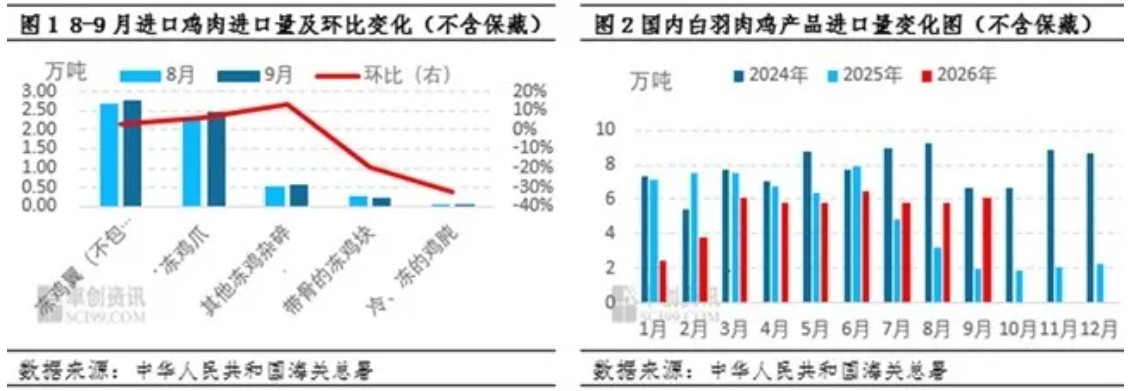
According to the latest statistics from the General Administration of Customs, domestic chicken product imports in 9 totaled 6.06 ten thousand tonnes (excluding preserved products), up 3.87% month on month and a sharp 200.83% year on year, marking the highest monthly import volume in the first three quarters of the year. Unlike 8, when typhoons disrupted shipping and delayed vessel schedules, arrival schedules returned to normal in 9, further increasing import volume.
In terms of product mix, chicken by-products remained the absolute mainstay of imports. In 9, imports of frozen chicken wings (excluding wing tips) and frozen chicken feet reached 2.77 ten thousand tonnes and 2.47 ten thousand tonnes, respectively, together accounting for 86.38% of total imports for the month. By product category, imports of frozen chicken wings (excluding wing tips), frozen chicken feet, and other frozen chicken offal all increased month on month, by 0.07 ten thousand tonnes, 0.15 ten thousand tonnes, and 0.07 ten thousand tonnes, respectively. Frozen chicken feet saw the most notable increase and were the main driver of the rise in total imports this month. In contrast, imports of bone-in frozen chicken cuts and chicken gizzards declined month on month by 19.28% and 32.56%, respectively. However, the import base for these products was relatively low, so despite the marked declines, they were not enough to change the overall pattern of import growth this month.
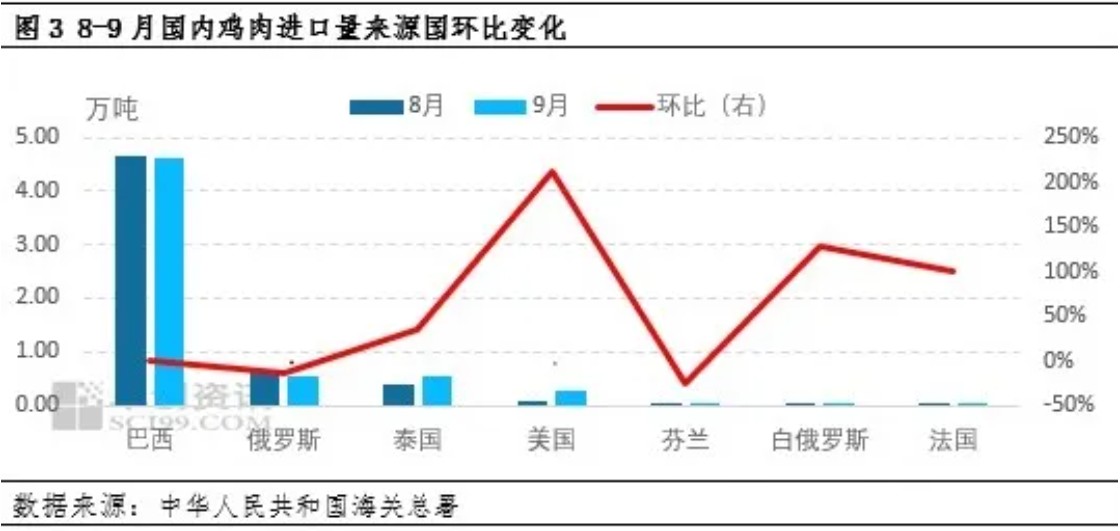
In 9, chicken imports from the U.S. and Thailand rose sharply month on month, while imports from Brazil and Russia contracted
By country, Brazil remained the leading source of chicken imports in 9, with imports of 4.61 ten thousand tonnes for the month, down 0.55% month on month. Chicken imports from Russia totaled 0.56 ten thousand tonnes, down 12.84% month on month, the largest decrease among source countries this month. The main reason was the tightening of domestic quarantine and market access requirements for Russian poultry meat. Qualifications of some exporters to China were restricted, while testing standards at port laboratories were also raised. This increased the risk of cargo inspection delays and port congestion, prompting importers to reduce purchases and suppressing the volume of Russian chicken arriving at ports.
In terms of month-on-month increases, imports of frozen chicken from Thailand and the U.S. were 0.55 ten thousand tonnes and 0.26 ten thousand tonnes, respectively, up 0.14 ten thousand tonnes and 0.18 ten thousand tonnes from the previous month, representing increases of 35.55% and 210.93%. The increase in imports from the U.S. was particularly pronounced, driven mainly by raw chicken feet: in 9, raw chicken feet imports from the U.S. reached 0.22 ten thousand tonnes, up 0.16 ten thousand tonnes month on month, an increase of 257.34%. The sharp rise in this individual product category drove up overall U.S. chicken imports.
The short-term impact of Brazilian poultry plants suspending exports to China is limited; imports may continue to increase in 10 month
The further increase in imports of chicken by-products in 9 has led to a domestic chicken market characterized by rising volume and falling prices. Against this backdrop, on 10 20, Customs suspended the acceptance of import declarations for products shipped from that day onward by some Brazilian poultry companies, quickly making this the main focus of the poultry import market. As the world’s largest chicken exporter, Brazil counts China as an important export market. Following implementation of the policy, declarations for new orders from the companies concerned to China were suspended, while the customs clearance progress of cargo already in transit also attracted considerable attention. However, in terms of shipping schedules, the policy’s actual impact in reducing supply will be significantly delayed: due to the ocean shipping cycle, it will take at least one and a half months for the contraction in supply to be reflected in domestic arrivals. With U.S. chicken supplies continuing to increase, chicken arrivals in 10 may therefore continue to rise. Turning to the domestic chicken by-product market, although expectations point to a contraction in future import supply, domestic stocks of chicken wings and other chicken by-products are currently high, and the consumer market is in its traditional off-season. The news-driven stimulus lacks support from market fundamentals and is unlikely to reverse the trend. Companies may accelerate stock sales to some extent, but chicken by-product prices are likely to remain weak, with limited room for an increase. (Note: The import volume figures above exclude other prepared or preserved chicken. For processed products, U.S. cooked chicken feet imports in 9 were 0.97 ten thousand tonnes, up 0.22 ten thousand tonnes month on month, an increase of 30.05%; imports of raw chicken feet were 0.22 ten thousand tonnes, up 0.16 ten thousand tonnes, an increase of 257.34%.)